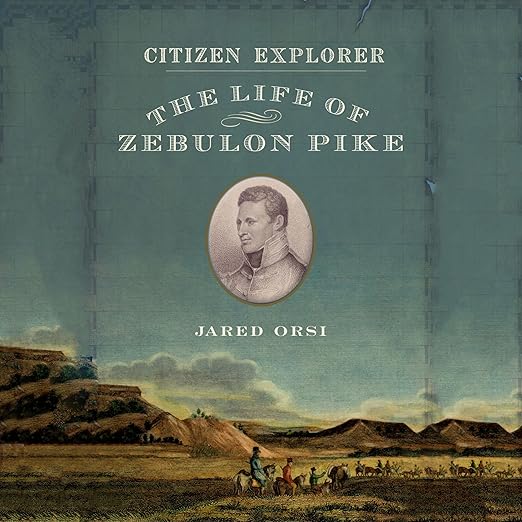
- Voice: Stephen McLaughlin carries thirteen and a half hours of expedition detail, frontier politics and Spanish place names.
- Big ideas: Westward expansion, an explorer overshadowed by Lewis and Clark, nationalism thinning at the frontier.
- Atmosphere: Scholarly, patient, deliberately cool.
- Worth it?: The serious modern account of Pike, built for listeners who came for history rather than adventure.
November 1806 opens this audiobook with a starving column in waist-deep snow and a commander not yet thirty who refuses to stop climbing. Zebulon Pike did turn back in the end, without reaching the summit that would carry his name regardless. Jared Orsi uses that failure as the doorway into the first modern biography of a soldier who ran expeditions across the young republic while more famous contemporaries collected the credit, and thirteen hours and thirty-four minutes later the doorway turns out to have been the whole point.
Pike as the Instrument for Testing an Argument
Expectation is the first hurdle, and a three-star on this record names it exactly. That response arrived having just finished a popular history by Tony Horwitz, observes that both books compete for the same reader, an American history fan looking for a good story, and concludes that the story and the meticulous research are both present while the reader has to work to reach them. That neatly marks the gap between a trade narrative and a scholarly biography, and this is firmly the second kind.
Orsi's argument is why the book exists, and it is more interesting than the expeditions themselves. The claim is that American nationalism thinned as it stretched west: what stood as Jeffersonian idealism on the Atlantic coast had become something practical and materialist by the time it reached the frontier. Pike serves as the instrument for testing that, because his assignment was to survey, measure and lay the American map grid across territory the republic barely controlled and did not understand.
The irony underneath gives the biography its shape. Pike spent a career trying to fold distant country into the nation, and survived the attempt only by depending on people with no attachment to that nation whatsoever: traders, guides, rival empires, communities with their own reasons for helping or refusing. He died in the same service during the War of 1812, in a battle his side won. A conventional adventure narrative would use that death as a heroic curtain. Here it arrives as evidence.
A Landscape Already Full of People
Specialists rate it highest, and the most detailed response on the page comes with a disclosure attached. A May 2014 five-star states plainly that the author supplied a complimentary copy and drew on that reader's own research into the Pike family, then adds that nobody asked for a review, that the book was good enough to buy again in a second format and a third time as a gift, and that out of a personal collection of books about Zebulon Montgomery Pike this is the one that excites the most. Weigh the disclosure however you like; the underlying claim, that this is the best available treatment of a heavily written subject, means something coming from a collector.
Supporting characters are the other pleasure. Pike's path crosses Aaron Burr and General James Wilkinson, each carrying his own conspiracies; Auguste and Pierre Couteau, patriarchs of the most powerful fur-trading family in St. Louis, angling to make themselves indispensable to Jefferson's administration; British traders, officers of the Spanish empire, and Native nations with every reason to resist an expanding United States. Orsi keeps all of them in frame rather than treating them as scenery, which is what the environmental perspective advertised in the description amounts to in practice: a landscape already full of people.
McLaughlin Alone Against a Text Thick With Names
Stephen McLaughlin reads the whole of this archival history for Audible Studios, and no response on this page says a single word about the reading, which leaves the sample carrying the entire burden of the decision. That matters more than usual here, because the text is thick with Spanish proper nouns, river systems, dates and place names, and the difference between a reader who keeps all that legible and one who does not is the difference between finishing and quitting somewhere around hour four.
The title is short by half. Written responses call the book Citizen Explorer: The Life of Zebulon Pike, while the title field on this record stops after two words. Anyone searching the full name may never arrive here, and anyone browsing sees a phrase that could belong to a hundred different books. The descriptive half of a title is what tells a buyer the subject, and it has gone missing from the one place where the buying happens.
Pacing earns one specific warning. A September 2016 five-star reports the book starting slowly until the shape of the argument came into view, then closes on a conditional recommendation: well written if you stick with it to the end and take the point. On the page you can skim a slow opening. In audio you cannot skim anything, which makes the first hour the genuine test of whether this is your kind of history.
Ordered for a History Class, Enjoyed Anyway
Students are an obvious constituency, and one of them is on the record. A December 2019 five-star ordered the book for a history class expecting a chore, and came away having enjoyed it and learned a great deal, which is roughly the best outcome an assigned reading ever produces. Anyone taking a course on westward expansion, the early republic or environmental history will find this usable, and the description's claim to be a state-of-the-art biography is at least defensible given that no modern one preceded it.
Adventure listeners should recalibrate before starting. The record files this under biographies and memoirs alongside sports and outdoors, with a tag for adventurers, explorers and survival, and that combination promises a very different book: privation, summits, narrow escapes. All three are present and none of them is the subject. The shortest entry on the page is a four-star consisting, in full, of the words good book, which is about all a browsing listener can extract from the column. Come for the argument about how a nation behaves at its own edges and Pike's expeditions will carry you the whole way. Come for the mountain and thirteen hours is a long walk for the view.
Frequently Asked Questions
Is this audiobook a narrative adventure or an academic biography?
An academic biography, written from what the description calls an environmental perspective and rich in cultural and political context. The expeditions supply the structure, but the analysis of how the young republic behaved at its own edges is what the book is for.
How does Pike relate to Lewis and Clark?
The description positions him as their rival and contemporary, running his own expeditions during the same era with far less lasting fame. Reading this alongside any Lewis and Clark account gives you the same westward decade from a second, less celebrated direction.
Does the audiobook cover Pike's death?
Yes, and it does not treat that ending as an epilogue. Pike was killed on active service in 1812, at a moment of victory rather than defeat, and Orsi runs the biography all the way through instead of closing the book when the expeditions finish.
Which expeditions does it follow?
The search for the headwaters of the Mississippi, then the later attempt on the sources of the Arkansas and Red Rivers, which brought him to the peak that carries his name and then into captivity under Spanish forces. Frontier service in the Ohio River valley comes first.