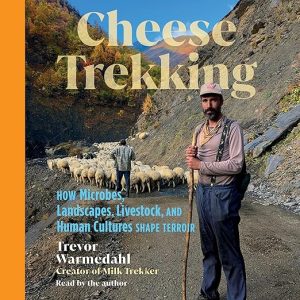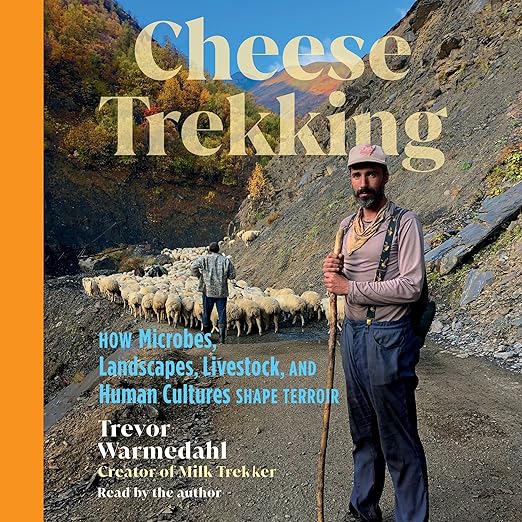
Terroir is a wine word, and this audiobook spends nine hours arguing that it belongs to milk. Trevor Warmedahl's premise is that the plants and ecology of a landscape get concentrated by a ruminant's digestion, carried out through the barn and the milk shed, then steered by human hands into food, which makes a cheese a readable record of one specific hillside. Cheese Trekking follows that idea across pastoral communities in various countries, watching the same problem get solved differently in each of them. It works as a travel book and a dairy manual at once, and the record files it under both.
Milk's Own Terroir, Argued Village by Village
Milk is the unit of account here, not cheese, and that distinction separates this from every other food travelogue. The copy supplies a term for it, constellations, meaning the full range of complementary milk foods that use up every byproduct of cheesemaking, so nothing from the animal goes to waste and each region ends up with its own family of products, not one famous export. It is a genuinely useful lens. It explains why a cheese cannot be lifted out of its place and reproduced faithfully elsewhere, and it reframes what most listeners think of as a national specialty into something closer to a local solution that happened to travel.
Constellations, terroir, stewardship of microbes: the vocabulary announces that this is an argument as much as an itinerary. Warmedahl lands firmly on one side of a live dispute in modern dairying, with an international movement that wants to work alongside microbes and not against them, and against the sterilizing instinct that industrial food safety has trained into the entire supply chain. The copy does not hedge that position for a second. What it promises in exchange is firsthand evidence that people can act as stewards of landscapes and keepers of heritage breeds while still making food that is safe and dense with nutrition, a claim that has to be earned village by village.
Warmedahl Speaks From Rooms Where Curds Were Made
Nine hours and two minutes of pastoral travel suits this material, because the structure of the book is a series of arrivals: a new place, a new herd, a new answer to the same question of what to do with milk before it spoils. That rhythm is easy to follow by ear and forgiving of interruption. Warmedahl narrates in person, which on a craft book carries real weight, since somebody describing a curd from experience knows what a curd actually does, and the regional product names are not a gamble for a reader who has stood in the rooms where they were made.
Ethics arrive earlier than most food writing allows. The copy states plainly that dairying is intimately involved with the killing and eating of livestock, and sets that beside the sacredness of motherhood, milk and life itself, which is an unusual pair of sentences to meet in a book about cheese. Most writing in this genre either skips the abattoir entirely or turns it into a set piece of confession. Treating it as a permanent condition of the work, one the people in these communities have already thought hard about, is the more adult position, and it is the clearest signal that this is not a gift-shop book about artisan producers.
Charts You Need a Second Device to See
Charts, maps and photographs are promised on the side. The listing notes that an accompanying PDF arrives in your library along with the audio, and that note is the tell: some portion of this book is visual, and a second device will be needed to see it. On a text covering milk chemistry, regional distributions and process sequences, that is not a minor inconvenience, and it changes where you can usefully listen. A kitchen is fine. A car is not, unless you plan to come back to the file afterward, and nothing on the record says how much of the content lives inside it.
Reception is the missing field on this record. No rating has been posted, no vote has been counted, and the column below has stayed blank since release, which leaves nothing whatever to weigh. That is not a warning about quality, it is an absence of information, and the two get confused constantly. An ungraded record tells you only that the book is new. Chelsea Green published it on March 3, 2026, and the audience for a specialist agricultural publisher is not the audience that rushes to post stars, so the wait may be long.
Recency explains part of that silence and not all of it. The harder gap is that this listing never says who Warmedahl is beyond the byline: no biography, no farm, no indication of whether the trekking happened over one season or a decade, and no list of the places visited. For a book whose entire authority rests on having been present, the omission does real damage. Every judgment available to a buyer right now comes from the description alone, and the description is selling a philosophy rather than a set of credentials.
Homesteaders Get Philosophy, Recipe Seekers Get Nothing
Homesteaders and small-scale dairy people are the obvious audience, and so is anyone who has made a soft cheese at home and wondered why it never tastes like the one from the trip. The second audience is the food-travel reader who has tired of restaurant memoirs and wants the production side instead: how a landscape becomes a product, and what the people doing that work actually believe about their animals. The double filing on this record, home and garden alongside travel, is unusually accurate. This is genuinely both, and the two halves do not come apart.
Recipes are not what this is, and anyone shopping for them deserves to know before checkout. The book explains constellations of milk foods; it does not hand over a make-at-home sequence with quantities and timings, and the material closest to instruction sits in a PDF you will have to open separately. Listeners after a light culinary travelogue will find the register heavier than advertised, since microbial philosophy and slaughter ethics both turn up early. Come for the argument about milk and place. Cheese follows from that, and almost never the other way around.
At a Glance
- Narration: Self-narrated by the cheesemaker, which counts for more on a craft book than polish does, since the person describing the curd has had hands in it.
- Themes: Milk terroir, natural cheesemaking, pastoral communities, the ethics of dairying
- Mood: Curious, hands-on, quietly polemical
- Verdict: A real dairy education wrapped in a travelogue, for listeners who want the production side and not the recipes.
What is in the PDF that comes with this audiobook?
The listing does not itemize it. It confirms only that an accompanying PDF lands in your library alongside the audio, which on a book about milk chemistry and regional production usually means diagrams, tables or photographs. Plan on opening it at some point, and do not assume the recording alone carries everything the book contains.
Does the book teach you how to make cheese?
Not in the step-by-step sense. The subject is why cheeses take the shape they do in a given place, and the framework of complementary milk foods surrounding them, rather than a set of instructions with weights and timings. Treat it as background for a practitioner, not as a first manual.
Which countries does the trekking cover?
The description says various countries and pastoral communities without naming a single one, and no itinerary appears anywhere on the record. For a travel book that is a real gap, so anyone buying with a particular region in mind should hunt down a contents list before committing a credit.
Is this audiobook comfortable listening for vegetarians?
For some it will not be. The copy states directly that dairying is bound up with slaughter and with eating the animals involved, and treats that as an ethical fact to be reckoned with, not one to be avoided. Listeners who object to animal agriculture will find the position argued out loud, not hidden.