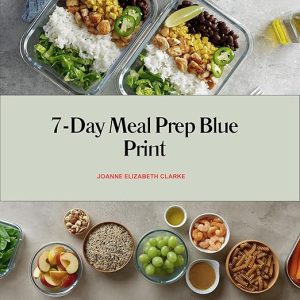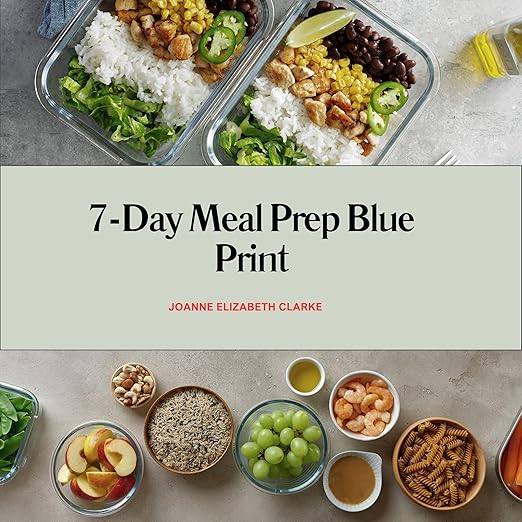
Meal prep books have a reliability problem. The ideas are appealing in concept, unrealistic in practice, and usually abandoned by the third week when real life fails to cooperate with the color-coded schedule. I picked up the 7-Day Meal Prep Blue Print audiobook with that skepticism intact, mostly because it's short enough to test without much investment: David Reynolds reads Joanne Elizabeth Clarke's guide in exactly one hour, which is either a red flag or a realistic promise not to waste your time. At this length, the audiobook can't afford sprawl.
Clarke's approach is explicitly designed for people who have failed at meal prep before. The framing throughout is flexible rather than prescriptive: no specific diet, no rigid calorie targets, no perfectionism required. The book's pitch is a system rather than a plan, a structure adaptable to whatever your actual schedule, budget, and culinary skill level happens to be. Whether a one-hour audiobook can actually deliver that is a fair question.
The content covers the expected ground efficiently. Pantry setup, grocery strategy, batch cooking principles, storage guidance, reheating techniques, and the mix-and-match logic that prevents a week of prepped food from feeling repetitive. The chapter on reducing food waste through smarter ingredient selection is particularly well-argued: most people who prep food waste more than they save because they overbuy perishables. Clarke's approach to this problem is sensible and practically oriented.
David Reynolds narrates with a pleasant, unhurried quality that suits the material. Meal prep guidance doesn't need dramatic narration; it needs clarity and a sense that the information is being communicated by someone who has actually thought it through. Reynolds delivers that. At one hour, it is no padding in the narration, which is the right call for instructional audio this dense with practical content.
One Hour of Logic, No Fad Diets Required
The audiobook format actually works better for this material than you might expect. The sequential logic of meal prep, how pantry setup feeds into grocery shopping, which feeds into batch cooking order, which feeds into assembly and storage, translates naturally to a linear listening experience. Clarke explains the reasoning behind each step rather than just issuing instructions, which means listeners who absorb the logic will adapt it more successfully than those who follow a rigid plan.
The 'no fad diets, no perfection required' positioning is meaningful. Meal prep content is saturated with aspirational impossibility, and books that refuse to participate in that pattern tend to be more useful to real people with variable schedules and ordinary kitchens. Clarke's decision to frame the guide around flexibility rather than optimization is genuinely refreshing in the genre.
At one hour, this audiobook functions well as a reset rather than a deep dive. If you've fallen out of meal prep habits and need a practical reminder of the system rather than a comprehensive re-education, the concise format is a feature. Listen once, implement the core logic, and you have what you need.
Zero-Waste Pantry Logic Beats the Blueprint Promise
The one-hour runtime is the primary limitation. Clarke moves through content quickly enough that some topics, particularly the grocery strategy and the mix-and-match flavor principles, would benefit from more worked examples. Listeners who need concrete recipe structure rather than general principles may find the guidance too abstract to implement directly.
No listener reviews are available at time of writing, which means we're evaluating the audiobook against its stated goals rather than against community consensus. For a practical guide in a crowded genre, that's worth noting: the proof of concept is in the implementation, and this short audiobook can't demonstrate results, only describe an approach.
The title's 'blueprint' framing sets expectations for architectural specificity that the audiobook only partially meets. If you want detailed meal-by-meal plans with quantities and timing, this isn't that. If you want the organizing logic that makes those plans possible, this is a reasonable starting point.
The zero-waste framing in Clarke's guide also addresses a problem that meal prep content typically ignores. Most prep guides assume you will buy exactly what you plan to cook, which assumes a consistency of schedule, appetite, and circumstances that real weeks rarely provide. Clarke's approach builds in flexibility from the start: the system works when you deviate from the original plan because it's organized around adaptable components rather than rigid meals. That design philosophy is more sophisticated than the one-hour runtime might suggest, and it's the element most likely to make the audiobook's guidance actually stick past the first week of implementation. David Reynolds's narration gives this flexibility framing a practical warmth that suits the material's intentions.
The pantry setup chapter in particular makes an argument that longer meal prep guides often bury under recipes: that the single most important investment in cooking efficiency is a well-organized base of ingredients rather than any particular meal plan. Clarke's approach to building a flexible pantry, stocking staples that can go in multiple directions depending on what else you have on hand, is the kind of foundational principle that saves more time over a year than any optimized schedule. At one hour, the audiobook can't demonstrate this in the depth a book-length treatment would, but David Reynolds reads it with enough clarity that the principle lands and invites application.
Quick Reset for Preppers, Skip for Recipes
This audiobook is for listeners who want a quick practical framework to build or rebuild a meal prep habit, especially those who have found longer guides overwhelming or previous prep systems too rigid to sustain. The one-hour format makes it easy to revisit when you need a reset.
Skip it if you need detailed recipes and specific quantities. This is a systems guide, not a cookbook, and it's best understood as a supplement to your existing cooking knowledge rather than a standalone instruction set. Listeners expecting substantial depth on any single topic will find the pace too compressed.
Questions Listeners Ask
Is a one-hour audiobook long enough to actually teach meal prep principles?
It covers the core logic efficiently without padding. Whether it's sufficient depends on what you need: if you want conceptual framework and practical priorities, yes. If you want detailed recipes and step-by-step plans, this isn't that.
How does this audiobook compare to longer meal prep guides on the same topic?
It trades depth for accessibility. A guide like this covers the essential logic in a single session rather than asking for multiple hours of investment. The tradeoff is less worked example and fewer concrete recipes.
Is the 7-Day Meal Prep Blue Print audiobook suitable for complete cooking beginners?
The guide assumes basic kitchen familiarity. True beginners may want a cooking fundamentals resource alongside it. For people who cook regularly but struggle with consistency and planning, it's well-targeted.