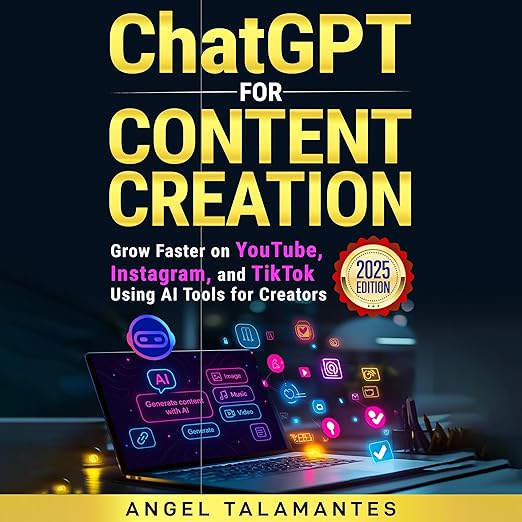
Thumbnails, Canva designs and Midjourney images are three of the eleven things this book promises to teach, and all three are pictures. The audiobook runs three hours and fifty-two minutes, which means the visual half of the curriculum arrives as description. A companion PDF ships to your library with the download, and how much of the value sits inside that document rather than inside the recording is the first question a buyer ought to ask.
Repurposing One Video Into Ten Pieces Is the Core
Angel Talamantes has built a workflow book rather than a theory book. The stated method is ChatGPT for hooks, captions and scripts, Canva AI and Midjourney for visuals, CapCut for editing, Notion AI for organization and Zapier for automation, then repurposing one video into ten or more pieces. That is a real production pipeline, and naming specific tools serves a beginner far better than a hundred pages about the future of creativity ever would.
The strongest section by design is repurposing. Turning one recording into a clip, a caption set, a carousel and a script for a different platform is the actual skill separating people who post daily from people who post monthly, and it is a process rather than an aesthetic, which means it survives being explained out loud. The thirty-day strategy assembled in fifteen minutes is the same kind of promise: a template, not a talent.
Where the book earns trust is in refusing to pretend the tools do the work. The pitch is more content in less time and consistency without burnout, which is an honest description of what generative software changes for a small creator. The pitch is not that the software makes you interesting. Anybody wanting permission to automate the whole job will not find it here; anybody wanting a system for shipping will.
Jacob Baird Suits Strategy You Absorb on a Walk
Jacob Baird reads it, hired by an author who also publishes the title, and the material suits a professional voice well: instructional, sequential and free of the anecdote-heavy digressions that make so many business books tiring to hear. A workflow explained aloud in order is easy to follow when your hands are occupied elsewhere, which is precisely when a creator would want it, since the work being described otherwise happens at a desk.
Strategy is where the listening case is genuinely strong. Trend analysis, algorithm-friendly formats, building a personal brand with a consistent tone, converting followers into income through digital products and partnerships: none of that needs a screen, and all of it benefits from arriving while you do something mechanical. Play the strategy chapters on a walk and the template chapters at a desk, and the book divides cleanly along that seam.
Templates in the Companion PDF Justify the Purchase
The companion PDF is what makes the purchase work at all. Proven caption, hook and script templates are the advertised differentiator, and a template is a thing you copy rather than a thing you memorize. That document lands in your library alongside the audio, so the copy-and-paste workflows the description promises stay available in the only format they can survive. Confirm you can open it before you rely on it, because the recording alone will not hand you the strings.
Released Nine Days Before Its Own Year Ended
The clock is the biggest risk here. The description says content creation in 2025 and advertises material updated for 2025 tools, trends and algorithms, on a title released December 22, 2025, nine days before the year it describes ended. Nothing in that is wrong; it is simply pinned to a moment. Algorithm behavior and tool feature sets move quarterly, and this is the fastest-decaying category on any technology shelf.
The visual instruction is the structural problem. Designing thumbnails and visuals in Canva AI and Midjourney is a matter of composition, contrast and iteration, all of which need something to look at. A spoken account of a good thumbnail describes a rule rather than demonstrating a result, and the same limitation applies to editing in CapCut. Assume the design and video chapters are the weakest stretch of the listening experience.
Two ratings, both five stars, and no written responses of any kind, on a page that has been live since December 2025. Two votes carry no information, and nobody has said anything about the PDF, the templates, or whether these workflows survive contact with a real posting schedule. The series slot compounds it: AI Business Blueprint Series with no number attached, leaving a purchaser no way to place this among whatever else carries that label.
Byline and publisher read as one name here, so the page asserts no following, no client list and no results for somebody teaching other people to produce all three. In a category where the numbers are supposed to be the credential, that absence is worth registering. It does not make the workflows wrong, and the tool list is specific enough to verify independently, but judge the method here rather than the authority behind it.
Creators on Three Platforms With Time for One
Creators who already post and cannot keep up are the audience, and they will take the most from the repurposing and automation material. It suits small business owners told to be on three platforms with time for one, and it suits anyone who has opened a chat window and produced something generic because they did not know what to ask for. Beginners who have never posted at all still get an orderly starting map.
Set it aside if you already run an AI-assisted workflow, since you will know the tool list already and the templates are the only real differentiator left. Anyone hoping for design instruction should buy a video course instead, since the visual half cannot be taught this way. And buyers who want durable principles rather than current tactics should understand that half of what is here is dated by design.
What Talamantes is actually selling is a starting system, delivered fast, with a document of templates attached to it. Taken that way it is a fair purchase for somebody stuck at the blank-page stage, particularly since the whole thing fits inside an afternoon and the strategy chapters replay well. Taken as a lasting reference it will not hold, and the honest advice is to use it now rather than shelving it for later.
In Brief
- Performance: Jacob Baird is a hired voice on a self-published title, so the credit tests delivery while the templates the book depends on sit in a separate document.
- What it covers: AI-assisted content production, repurposing one video into many, platform strategy, turning followers into income.
- Feel: Fast, practical, tool-forward.
- Our call: Useful now and dated soon, worth buying only if you intend to start this month.
Good to Know
Do you need paid accounts to use what this audiobook teaches?
You need accounts, and free tiers will carry you part of the way. The named stack is ChatGPT, Canva AI, CapCut, Midjourney, Notion AI and Zapier, and only some of those offer a usable free level. Nothing in the description promises a budget version of the workflow, so price the toolkit before you price the book.
Is this aimed at total beginners or at people already posting?
Both, a little awkwardly. The copy says even if you are a total beginner, while the material assumes you know what a hook, a caption and a carousel are. Somebody a month into posting will move fastest through it. Somebody who has never posted gets an orderly map of the whole job and then has to learn each tool separately.
Does the audiobook cover making money, or only making content?
Both, and the money material is a full section rather than a footnote. Converting an audience into revenue through digital products, services and partnerships is one of the eleven advertised outcomes, and it sits at the end of the sequence rather than the start. Expect the shape of an approach rather than a business plan: what to sell and to whom, not pricing or delivery mechanics.