Before You Press Play
- Narrator: George Guidall brings decades of experience to Twain's late-life reinvention without ever slipping into impersonation.
- Subjects: financial ruin, reinvention, comedic legacy
- Tone: Bittersweet and richly detailed
- Bottom line: A meticulously researched biography for Twain devotees willing to sit with 16-plus hours of one difficult chapter.
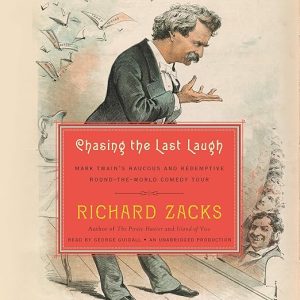
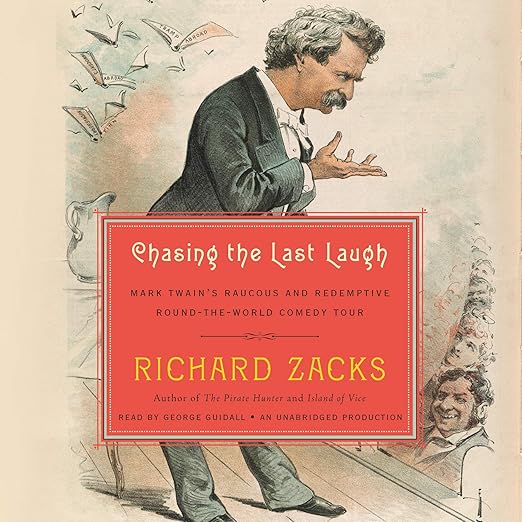
Livy Clemens wrote of 'a perfect horror and heart-sickness' when her husband's publishing company collapsed in the 1890s, and this audiobook of Chasing the Last Laugh builds outward from exactly that despair. Mark Twain, fifty-nine years old and the highest-paid writer in America, had lost hundreds of thousands of dollars through catastrophic business decisions, and rather than settling into the literary lionhood he'd earned, he forced himself back onto what he called the platform for something no famous author had attempted before: a round-the-world stand-up comedy tour built from his own best stories. The title itself carries a double meaning worth noting: chasing the last laugh refers both to Twain's literal comedy tour and to his longer effort to have the last word over his own financial disaster, proving his creditors and his own self-doubt wrong by paying every debt back in full. Zacks builds the entire narrative around that double payoff, comedic and financial, arriving together by the book's end.
A Report of Twain's Death, Called an Exaggeration
Richard Zacks, drawing on unpublished notebooks and letters from Berkeley's ongoing Mark Twain Project, follows Twain across the American West and onward by ship through Australia, New Zealand, Tasmania, India, Ceylon, and South Africa. He rode an elephant twice, visited the Taj Mahal, watched Zulu dancers, and helped sort diamonds at the Kimberley mines without managing to slip away with a souvenir. Zacks favors the same specific, vivid details Twain himself used onstage, the stolen watermelon story, the bucking bronco, and builds them into a portrait of a man reinventing himself in real time under genuine financial and emotional duress. Word traveled slowly enough during the tour that one American paper reported Twain had died penniless in London, prompting his famous line that the report of his death was an exaggeration. Twain's specific choice of material for the tour itself is worth noting: rather than debuting new work, he mined his own decades-old stories for an international crowd meeting him for the first time, a shrewd, unsentimental understanding of what actually sells tickets, prioritizing proven material over creative risk during a genuine financial emergency. The book's title also plays against that same famous quip about his death being exaggerated; both moments share the same underlying instinct, using humor to publicly reclaim control over a narrative that was, in each case, spiraling without his input. That instinct for turning crisis into material runs through nearly every chapter: financial ruin becomes stage material, and a premature obituary becomes one of his most quoted lines.
Twain's support system on this journey is its own story: Standard Oil tycoon H.H. Rogers became a close, steadying friend and financial advisor through the crisis, while Twain's own lawyer, and future secretary of state, Bainbridge Colby, drew Twain's private scorn as the 'head idiot of this century.' That kind of specific, quotable detail, drawn from real correspondence, is what elevates Chasing the Last Laugh above a straightforward biographical summary into something closer to a well-researched character study. Richard Zacks has built a career writing narrative history from unglamorous, overlooked corners of well-known eras, and his prior books on piracy and Gilded Age vice share this one's instinct for finding a propulsive true story inside dense archival material. That track record shows in how confidently he moves between intimate letters and larger historical currents, the Panic of 1893, global colonial travel routes, without losing momentum in either direction.
Guidall Never Tries to Impersonate Twain's Drawl
George Guidall brings decades of narration experience to this material, and the smartest choice he makes is the one he doesn't make: he never attempts to impersonate Twain's famous drawl or performative platform voice. Instead he narrates Zacks's own energetic journalism prose on its own terms, letting Twain's real words, pulled from letters and notebooks, carry their own distinct register within the larger narration. That restraint is exactly what this kind of long-form historical biography needs, and it's consistent with how Guidall has handled other formal or difficult material elsewhere, never over-dramatizing, always trusting the source material to do the emotional work. At sixteen hours and thirty-seven minutes, his steady pacing keeps that trust from ever curdling into monotony.
Reviewer Glynn Young adds valuable context around the Panic of 1893, tracing how European banking anxiety and an Argentine wheat crop failure spread into a severe American depression, with more than 500 banks closing and farms abandoned. That's the same economic storm that swallowed Twain's fortune, and understanding its scale makes his recovery feel even more improbable by the book's end. Zacks also resists the temptation to tie everything up too neatly; Twain's later years still held real sorrow, and the book doesn't pretend the world tour alone fixed everything that had gone wrong, which keeps its ultimately hopeful arc honest rather than tidy. The travel sections function as a kind of accidental global snapshot, Twain observing colonial India, South Africa near the end of the diamond rush, and the Pacific from the specific vantage point of a bankrupt American celebrity trying to sell tickets, which gives the book an unusual double lens: simultaneously a personal financial-recovery story and a period travelogue filtered through one of the era's sharpest observers.
Not Really a Comedy Despite the Genre Tag
The comedy-humor genre tag undersells what this book actually is. Reviewer Richard S. Wells describes it as 'almost Shakespearean in combining the elements of humor, tragedy, death, misfortune, luck,' and that's a far more accurate description than comedy alone suggests. This is a serious, well-documented biography with real grief and genuine financial terror running through it, not a collection of Twain's best jokes. Listeners who come in expecting a lighthearted comedy album built from Twain's stage material should recalibrate toward something closer to a poignant late-life reinvention story that happens to be very funny in places rather than funny throughout.
Sixteen-plus hours devoted to one relatively contained chapter of Twain's long life is a real ask, even for devoted readers, and the pacing occasionally slows through extensive travel-logistics detail. Listeners who want a full-life biography rather than this specific comeback-tour period should know upfront that this book stays tightly focused on the 1890s financial recovery years.
Twain Devotees Over Readers Wanting Pure Comedy
Twain devotees, narrative-history readers, fans of Zacks's other work including Island of Vice and The Pirate Hunter, and anyone drawn to genuine comeback stories will find this audiobook deeply rewarding. It's especially strong for listeners who already know Twain's public persona and want the harder, more human story behind it.
Skip it if you want pure gag-a-minute comedy content rather than a fully researched biography, or if sixteen-plus hours focused on one life chapter feels like too deep a dive. Readers wanting a cradle-to-grave account of Twain's entire career should look for a broader biography instead of this tightly focused one.
Common Questions
Does this audiobook cover Mark Twain's entire life or just one period?
Just one period. It stays tightly focused on Twain's financial collapse and round-the-world comedy tour in the 1890s rather than covering his full life story.
How does George Guidall's narration handle Mark Twain's voice in this audiobook?
He deliberately avoids impersonating Twain, instead narrating Zacks's prose on its own terms and letting Twain's actual quoted words carry their own register.