Key Details
- Narration: John Edward McGee Jr. and Robert Hilland both narrate their own alternating perspectives, giving genuine tonal contrast between investigator caution and intuitive conviction.
- Themes: FBI cold case investigation, psychic collaboration, unlikely trust and partnership
- Mood: Tense but ultimately hopeful, sincere rather than skeptical
- Verdict: A distinctive true crime listen for readers open to psychic elements, less suited to listeners who need sustained skepticism.
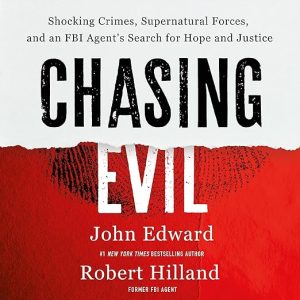
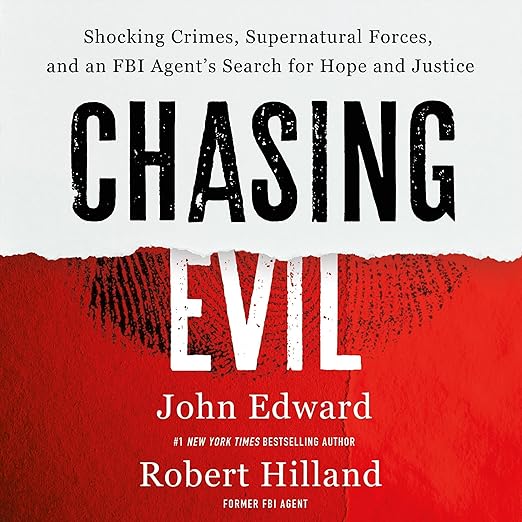
Bob Hilland spent years working a cold case that refused to close, until a phone call to a well-known psychic named John Edward changed the direction of his FBI career and, eventually, became the subject of Chasing Evil. The audiobook's narrator field credits only John Edward, listed here under his full name, John Edward McGee Jr., but the synopsis confirms the program is read by the authors, meaning both Edward and Hilland narrate their own alternating halves of this twenty-five-year partnership rather than handing the story to a single outside performer.
Listeners Can Picture His Expression
Having both men narrate their own sides of the story is a real structural asset for a true story built entirely around trust between two very different professional worldviews, an FBI agent trained in evidence and a psychic medium trained in something far less falsifiable. An AudioFile review quoted in the product materials notes that Edward narrates dialogue naturally enough that listeners can picture his expression as he redirects Hilland's focus, and that Hilland himself becomes a believer over the course of the story, a transformation listeners are positioned to experience alongside him rather than being told about secondhand.
The book's genre tags span true crime, memoir, and spirituality, and that blend is accurate to the listening experience rather than a marketing compromise. This is not a procedural that happens to mention a psychic as a minor detail; the collaboration between Hilland and Edward is the entire structural spine of the book, and the emotional and spiritual throughline, healing and resolution and unexpected trust, carries as much narrative weight as the mechanics of any individual case.
Decades of Live, Unscripted Television Experience
Edward's narration benefits from decades of live, unscripted television experience hosting Crossing Over, the program that first made him a recognizable name to a national audience. That background shows in how comfortably he handles first-person emotional material without over-rehearsing it, a skill honed by years of reading real audience reactions in real time rather than performing from a fixed script.
The production also carries the backing of a major publisher line, Macmillan Audio through St. Martin's Press Essentials, which is worth noting for listeners weighing this against smaller independent true crime releases; the resources behind a release like this typically show up in tighter editing and stronger audio engineering than a self-published equivalent.
An Investigator's Caution, a Psychic's Register
The origin story alone justifies the listen: in the summer of 1998, a skeptical Hilland reluctantly called Edward for help on a case he had exhausted every conventional lead on. What follows is a twenty-five-year partnership that the book centers on its most demanding case specifically, the investigation into the John Smith murders, presented with the pacing and stakes of a true crime page-turner rather than a slow procedural recap.
Listener reviews describe struggling to put the book down once started, with one describing planning to read only a chapter a night before bed and abandoning that plan entirely within the first sitting. Another calls it a powerful blend of unsolved crime investigation and psychic guidance, praising how naturally the two threads, cold case procedure and Edward's readings, reinforce rather than compete with each other across the runtime.
At just over eleven hours, both men's perspectives get enough room to breathe, and the dual narration means listeners get real tonal variation between Hilland's investigator's caution and Edward's more intuitive register, rather than one voice trying to imitate both.
Though the John Smith murders anchor the book's most sustained narrative stretch, the broader twenty-five-year partnership also touches on other cases the two men worked together, giving listeners a sense of how their working method evolved over time rather than presenting a single isolated success. That accumulated history helps explain why an initially skeptical FBI agent eventually became, in his own account, a genuine believer in his partner's abilities.
The Narrative Treats That Trust as Earned
This book asks listeners to accept psychic phenomena as a working premise rather than a question up for debate. It is not a skeptic's investigation or a debunking account; it is written from inside a genuine, decades-long collaboration by two men who both came to trust the process, and the narrative treats that trust as earned rather than interrogating it further. Listeners who need sustained skepticism maintained throughout a true crime book should know that going in.
The genre blend that makes this distinctive, true crime, memoir, and spirituality together, also means it will not fully satisfy readers looking for a pure procedural. Some stretches focus more on the emotional and relational development between Hilland and Edward than on case mechanics, which is a deliberate structural choice consistent with the book's framing as a story about trust and partnership as much as about solving crimes.
Listeners already familiar with John Edward from his television work will find this a natural extension of that persona into a longer-form, case-specific narrative, while newcomers to his work get a self-contained introduction that does not require any prior familiarity with his television career to follow.
Not a Side Element But the Entire Premise
This audiobook suits true crime listeners who are open to, or already fans of, psychic and paranormal elements in nonfiction, along with John Edward's existing television audience from his long-running Crossing Over program. FBI procedural fans interested in how cold cases actually get reopened and solved will also find real substance here alongside the more spiritual material.
Skip it if you need your true crime free of any paranormal framing, since the psychic collaboration is not a side element here but the entire premise. For listeners willing to meet the book on its own terms, the dual narration and the specificity of the John Smith murders case make for a distinctive listen that a standard true crime title, procedural cover to cover, does not usually offer.
Frequently Asked Questions
Does psychic John Edward narrate the Chasing Evil audiobook himself?
Yes, under his full name, John Edward McGee Jr. The synopsis confirms the program is read by both authors, so Robert Hilland also narrates his own sections.
Does this audiobook require believing in psychic phenomena to enjoy it?
It helps. The book is written from inside a genuine partnership both men came to trust, not as a skeptical investigation, so listeners who need debunking or heavy skepticism should adjust expectations.