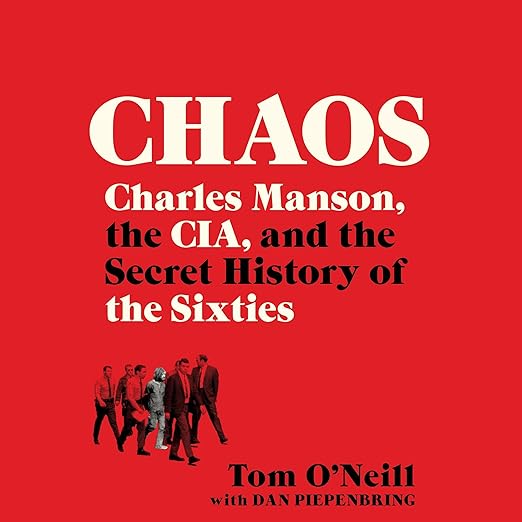
Tom O'Neill spent twenty years on what began as a magazine piece about the Manson murders, and the audiobook that came out the other end runs sixteen hours and fifteen minutes. Kevin Stillwell reads all of it. That combination, a reporter's two-decade detour and one unhurried voice, is the whole proposition, and it will suit some listeners exactly and lose others by hour five.
Conversational Type Writing Keeps It Flowing
Kevin Stillwell has an unusual job on this one. Chaos is not narrative true crime with a body, a suspect and a trial; it is an account of a reporter reading files, chasing sources and running into doors that close. The prose moves between three modes, sometimes inside a single chapter: reconstruction of the two nights in Los Angeles in which seven people were killed, documentary summary of what the LAPD, the FBI and the CIA produced on paper, and first-person account of what the reporting cost. A reader has to signal which mode is running without stopping to explain it.
The best evidence that the delivery works is Chris's response, which puts a finger on the exact quality the recording depends on: the subject matter is heavy, but "the conversational type writing keeps the story and information flowing". That conversational register is what makes sixteen hours of document-work listenable at all. A drier voice against this material would produce an audio filing cabinet, and the pages are dense enough that the risk was real.
Twenty years of reporting produces a specific structural problem, and Kristina Love names it better than the jacket copy does: the book "becomes just as much a story of his own experience of having the Manson case consume his life as it is about the substance of the case itself". Love flags that this might sound off-putting, then argues the opposite. The double structure is real, and anyone who wants only the case will feel the memoir intruding, while anyone who wants the memoir gets a great deal of case file.
Sounds Like Someone Off Their Rocker
What O'Neill delivers is a demolition rather than a replacement. The official account, built by prosecutor Vincent Bugliosi and sold to the public in Helter Skelter, comes apart piece by piece: police carelessness, legal misconduct, the possibility of surveillance by intelligence agents, and a parole officer who had chances to act on Manson and did not. The interview with Bugliosi that turned a friendly source into a nemesis is the hinge of the book, and hearing it read aloud gives it the temperature of a scene rather than of a footnote.
Iris Robinson's response captures what makes the middle third so strange to sit with. A listener arrives knowing roughly what the Manson Family did and leaves holding Charles Manson, the CIA, the JFK assassination and a rogue psychiatrist injecting unwitting people and elephants with LSD in the same hand. Robinson, who mentions a degree in Criminal Justice, admits the combination sounds like something a person off their rocker would say, then reports that the documentation holds. The tension between how the material sounds and how it is sourced is the listening experience in one sentence.
Bugliosi is not the only authority the book takes on. The publisher's copy quotes Los Angeles Deputy District Attorney Steven Kay saying the argument could be strong enough to overturn the verdicts on the Manson murders, which is an extraordinary sentence to print on a jacket. The audio edition delivers it in the same even sequence as everything else, which is arguably the honest choice: hundreds of new interviews and dozens of previously unseen documents accumulate, and no conclusion is handed to anyone.
Hollywood is where the book finds its second engine. The publisher's own copy asks who Manson's real friends in the industry were and how far they would go to hide those ties, and O'Neill treats the question as reportable rather than rhetorical, moving from reclusive celebrities to seasoned spies to the shadowy sites of the CIA's mind-control experiments. David McDowell, who lived through the period, writes that "the amount of BS we were fed was unbelievable" and takes the whole thing as "a good reminder to not trust the news". Whether that reading is fair to the evidence is something listeners will settle for themselves, but it explains why a 2019 title was still collecting five-star responses in 2026.
The Refusal to Fill In Blanks Is the Virtue
Not every listener will forgive the lack of an ending. David McDowell, who came to the book after hearing Joe Rogan mention it, describes getting frustrated at the density and wanting to move on with the story while still calling the connect-the-dots work impressive. Take that as the fair warning it is. The reporting is exhaustive by design, and exhaustive reporting in audio has no skimming setting. A page lets you skip a paragraph of sourcing; sixteen hours of narration does not.
SergioB's headline, "Slow to start, then its gets really interesting!", carries more information than the body underneath it, which reads in full: "Good read." Two words of text beneath a five-star grade is not much to weigh, but the headline matches McDowell's complaint and points at a real shape. The opening hours establish a reporter, a magazine assignment and a case everyone assumed was settled, and the payoff arrives well after most true-crime listeners expect their hook.
Kristina Love's entry is also the one that stops mid-word, cut off inside a sentence about what O'Neill declines to do, and it is not the only response on this page truncated that way. Weigh what survives rather than guessing at the rest. What survives is the sharpest reading of the book anywhere in the column: an argument that the refusal to fill in blanks is the virtue, from a reviewer who nonetheless landed on four stars rather than five.
A Dozen Names Across Sixteen Hours
Patience is the entry requirement. Anyone who reads for archival texture, who enjoys watching a reporter's certainty erode over two decades, and who can hold a dozen names across sixteen hours will get an enormous amount here. The history and politics shelving this listing also carries sits closer to the truth than the True Crime tag does, and that distinction is worth weighing before spending a credit.
Skip it if you want the Manson case explained in four hours, or if unresolved endings make you angry. The first third suffices if what happened on those two nights in Los Angeles is all you want; the remainder is a different book entirely. Sixteen hours of unresolved evidence is a demanding shape for a true-crime listen, and O'Neill never pretends otherwise.
Quick Take
- Voice: Kevin Stillwell carries sixteen hours and fifteen minutes of investigative reporting in one unhurried voice, the right call for a book that is half case file and half memoir.
- Big ideas: Charles Manson and the murders, institutional cover-up, a reporter's twenty-year obsession, evidence that never resolves.
- Atmosphere: Patient, accumulating, deliberately unfinished.
- Worth it?: Outstanding if you want the archive rather than the verdict, frustrating if you need an ending.
Questions Listeners Ask
Does the Chaos audiobook actually solve the Manson case?
No, and the author never claims to. What the book does is dismantle the official account rather than replace it, laying out police carelessness, legal misconduct and possible intelligence surveillance as an accumulation. One reviewer praises exactly that restraint, noting the refusal to hand over neat, overconfident answers. Expect an argument, not a verdict.
How long is the Chaos audiobook and who reads it?
Sixteen hours and fifteen minutes, read by Kevin Stillwell. That runtime covers two decades of legwork, hundreds of interviews and paperwork drawn from three agencies. One voice handles crime reconstruction, documentary summary and first-person memoir, moving between the three without pausing to flag which one is running.
Why do reviewers say the opening of this audiobook is slow?
Because it is. One five-star headline says so outright before the body offers two words of praise, and another response describes wanting to move on with the story while the sourcing keeps piling up. The early hours establish a reporter, an assignment and a case everyone assumed was closed. Payoff arrives late.