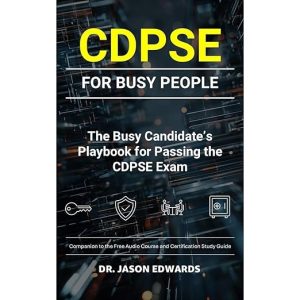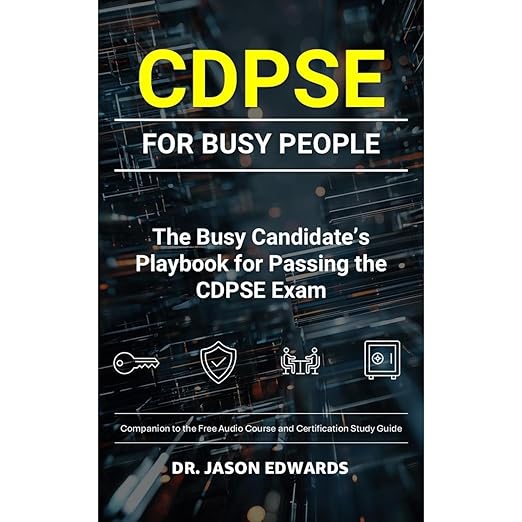
Twenty-one hours and forty-nine minutes is a long stretch to spend with an exam syllabus, and that is what this audiobook asks of anyone preparing for the ISACA privacy engineering certification. Jason Edwards has built the material around four domains and around a single practical promise: that you will learn to recognize what a question is really asking before you reach for an answer. The file went out in March 2026 under an independent imprint, part of a run called Bare Metal Cyber Study Guides. What complicates the purchase is that the description on the page keeps describing a slightly different product.
Virtual Voice Struggles With CDPSE's Planned Revisits
That pitch is unusually honest for a certification guide, and that is the first thing worth saying. It refuses to promise shortcuts. It states outright that the goal is not to drown you in theory or quote long legal passages, and that examples stay short on purpose, because, in the copy's own phrase, the point is not story time. Restraint like that is rare on a certification shelf, where an enormous amount of study time gets burned on padding.
Tension sits between that design and the runtime. Nearly twenty-two hours of audio is not a lean product by any measure, and the material is explicitly built for short sessions that add up, a section at a time, with planned revisits to strengthen weak spots. Audio is the worst format for planned revisits. Finding a section again means scrubbing a timeline rather than opening to a page, and the guide's own study method assumes you can jump to the domain you need most, which is a print affordance more than a listening one.
Privacy Failures Rarely Stay in One Lane
The audience is precisely drawn, and if you are inside it the value is real. The copy names privacy professionals, security leaders, architects, engineers, auditors and GRC practitioners, which is to say people who already touch personal information at work and need to formalize what they half know. That is a different listener from someone approaching privacy cold, and the material assumes the difference rather than apologizing for it.
Its structural argument is the strongest thing on the page. CDPSE spans four domains, and the guide's position is that the exam expects you to connect them, because privacy failures rarely stay in one lane. Everything downstream follows from that: how principles turn into requirements, how inventories and dataflows support risk decisions, how assessments drive engineering work, how controls end up as repeatable system behaviors. That chain is genuinely well suited to listening, because it is a sequence of causes rather than a table to memorize.
Used the way the copy suggests, as reinforcement rather than as a primary text, the length starts to make sense. Twenty-two hours of spoken explanation is a lot of exposure to exam-shaped reasoning during hours you could not otherwise study, and repetition is the actual mechanism a certification rewards.
Called CDPSE for Busy People and for Jobs
The title problem comes first. The listing calls this CDPSE For Busy People. The description, in its own opening paragraph, calls the book CDPSE for People With Jobs and never uses the listing title once. One product is carrying two names, and a buyer searching for either has no way to know they have landed on the same guide, or whether they have landed on a different one from the same author.
Bigger than the naming problem is what the description is actually describing. It repeatedly refers to the main book, tells you that you can read front to back, and explains that the main book pairs with a free audio course, then adds that you also get a Kindle ebook containing a thousand flashcards. Read literally, the audio is a companion to a print volume, and this file may or may not be the course in question. Nothing on the record resolves it. If the flashcard set and the free course matter to your study plan, confirm what actually arrives before you buy, because the copy was clearly written for a different shelf.
Voice is the third variable. The reader field says Virtual Voice, which is a synthetic text-to-speech product rather than a person, and this is the material where that choice bites hardest. Twenty-two hours of acronym-dense content means ISACA, CDPSE, GRC and a stream of framework names delivered without the small emphases a human reader uses to mark a distinction, and exam wording often turns on exactly one such word. Sample a few minutes at the speed you plan to use.
Hold Off if CDPSE Is Your Only Resource
Candidates sitting the CDPSE inside the next few months, who already have a written text and want the reasoning drilled into them during hours that would otherwise be dead, are the clear buyers here. So are working privacy and security practitioners who want a structured refresh on how the four domains interlock, exam or no exam. The independent publishing route is not a mark against it: the framing is disciplined, the scope is deliberately narrow, and the guide is upfront that it will not make the work smaller.
Hold off if this would be your only resource. The copy assumes a book in your hands, and the study rhythm it recommends depends on being able to reread a section and drill missed cards back to the exact pages that produced them. Hold off too if synthetic delivery over that many hours is something you already know you cannot tolerate, or if you need dataflows and inventories rendered visually rather than described. For everyone else, the reasonable move is to treat this as the second half of a study kit and to buy the first half elsewhere.
Before You Press Play
- What it covers: privacy governance, exam-language recognition, inventories and dataflows, controls as repeatable behavior
- Feel: Disciplined and unglamorous, built for repetition rather than interest
- Our call: A serious exam companion undercut by a listing that names the book twice and describes a printed edition, best bought as reinforcement alongside a written text.