Key Details
- Narrator: Virtual Voice delivers neutral and consistent throughout, the right profile for active recall drilling over nearly 30 hours.
- Subjects: ISACA CDPSE exam preparation, data privacy recall, spaced repetition methodology
- Tone: Focused and deliberate
- Bottom line: A well-constructed retrieval-practice tool for CDPSE candidates who study in daily increments around demanding work schedules.
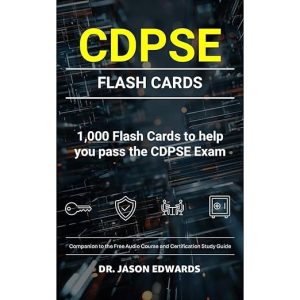
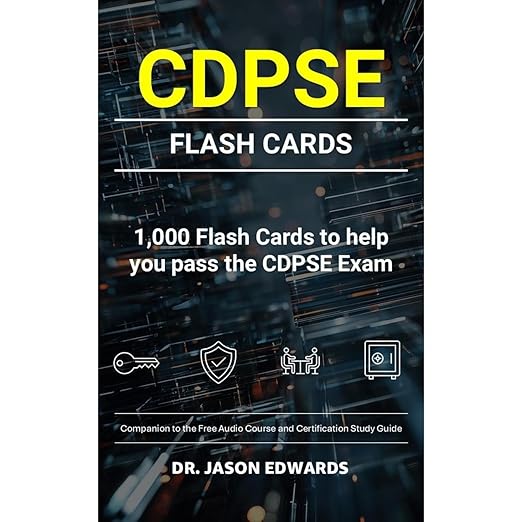
Retention is the specific problem the ISACA CDPSE exam exposes. Candidates who have studied the material thoroughly often find that the exam tests not whether they learned something but whether they can produce the right answer under time pressure, after a day of work, when their concentration is not at its peak. CDPSE Flash Cards, the Jason Edwards audiobook from the Bare Metal Cyber Study Guides series, is engineered for exactly that scenario. At 29 hours and 26 minutes of Virtual Voice narration, it delivers 1,000 practice cards built around recognition, terminology, decision cues, and the fine distinctions between almost-right and best-answer responses that define the ISACA exam format.
CDPSE Terminology Survives Virtual Voice Narration
Edwards understands the CDPSE exam's specific challenge: it is less a test of memory than a test of whether you can apply privacy engineering and data governance principles to specific scenarios with speed and precision. The judgment cards in this audiobook serve that demand directly. Rather than testing only whether you can recall what a data minimization principle is, they test whether you know which principle applies when two approaches both seem reasonable. That is the level of preparation that separates candidates who pass comfortably from candidates who scrape through or miss. The balance between recall cards and judgment cards is one of the more thoughtful structural choices in the Bare Metal Cyber series.
Virtual Voice narration for a 29-hour study tool requires honest appraisal. The delivery is consistent, neutral, and clear, which is what a drill format demands. Listeners should not approach this as a narrative experience but as a timed exercise in active recall. Pause before each answer is delivered, attempt the response mentally, then compare. That active engagement is the mechanism that produces the retention benefit, and it works regardless of whether the narrator is human or AI. For the CDPSE exam's privacy engineering and data lifecycle domains, the terminology-heavy content is delivered without stumbling, which is a basic competence threshold the Virtual Voice narration meets throughout.
Missed Cards Show Where Performance Breaks Down
The portability of this format is its primary advantage for busy professionals. CDPSE candidates are typically working in data privacy or information security roles and studying outside of work hours. Commute time, travel, and the dead intervals in a full workday become study sessions when the flashcard set is accessible through a listening device. Edwards frames the usage methodology around a calendar-habit approach: consistent small sessions rather than occasional marathon reviews, with deliberate tracking of missed cards as a self-generated priority queue. The CDPSE domains covered, privacy governance, privacy architecture, data lifecycle management, and privacy engineering, each have their own density of terminology and scenario types, and the ability to run targeted domain drills by returning to specific sections gives the audio format more flexibility than it might initially appear to offer.
The design principle of using misses as feedback deserves emphasis. A card you answer correctly on the first attempt is confirming existing knowledge. A card you miss is identifying a gap between your understanding and your retrieval, which is the precise location where exam performance breaks down. Returning to those cards in subsequent sessions, as Edwards recommends, is how the 29 hours of content become progressively more targeted to your actual weak areas rather than uniformly covering ground you have already mastered. That shift from broad coverage to targeted drilling is what converts study time into preparation that actually improves exam outcomes.
Edwards also recommends pairing this audiobook with the CDPSE for People With Jobs main text and its free companion audio course. The three-part loop, conceptual reading, active reinforcement through audio, and retrieval practice through flashcards, is a sound instructional structure that maps well onto how adult learners with jobs actually study.
Foundation First, Retrieval Practice Second
Active listening is not optional with this format. Passive background listening will not produce the retrieval-practice effect. The listener needs to engage with each card as a genuine recall challenge before hearing the answer, which means this audiobook requires a different kind of attention than a podcast or a narrative listen. Commutes and travel with focused attention work well; distracted or multitasking listening will waste the runtime without producing the intended benefit. That is a structural feature of the flashcard format in any medium, but it is worth stating clearly for listeners who approach audiobooks primarily as background content.
As with all Edwards's flashcard audiobooks in the Bare Metal Cyber series, this title is transparent about what it does not do: it does not replace understanding the concepts. Candidates who approach the flashcards cold without building the underlying model first will find the cards more frustrating than productive. Foundation first, retrieval practice second, is the intended sequence. The 29-hour runtime is most valuable to candidates who already have the conceptual framework in place and need to stress-test their ability to retrieve it quickly and accurately under conditions that resemble the actual exam environment.
Return Here Only for the Retrieval Phase
Data privacy professionals and information security practitioners actively preparing for the ISACA CDPSE exam who have completed foundational study of the main material are the primary audience. Candidates in the final weeks before exam day who need targeted recall drilling will find the format well-suited to that preparation phase. Professionals studying in short daily windows, whether commuting, traveling, or working in gaps between meetings, get a portable drill tool that keeps exam concepts active between deeper study sessions. Listeners who have not yet built their CDPSE conceptual foundation should complete the main text first and return to this audiobook for the retrieval phase, which is where the 1,000-card set is designed to do its most effective work.
What makes CDPSE Flash Cards different from the other Bare Metal Cyber flashcard audiobooks by Jason Edwards?
The content is specific to the ISACA CDPSE certification and its domains: privacy governance, privacy architecture, data lifecycle management, and privacy engineering. The format and methodology are consistent across the series, but the card content is entirely distinct.
Is this audiobook effective for someone who has already taken the CDPSE exam once and is preparing to retake?
Yes, and potentially more effective than for a first-time candidate. Retakers typically have a clearer sense of which domains gave them the most trouble, and the flashcard format allows targeted drilling of weak areas more efficiently than rereading entire chapters.
Can I use this audiobook while doing other tasks, or does it require dedicated listening?
Dedicated, active listening is required. The retrieval-practice benefit depends on attempting each answer mentally before the card delivers it. Passive listening while multitasking will not produce meaningful retention. Commutes and travel with focused attention work; distracted background listening does not.
How long should my daily CDPSE Flash Cards sessions be?
Edwards recommends starting with a small manageable set and increasing volume only when accuracy stabilizes. Many exam candidates find that 20 to 40 minutes of focused flashcard audio per day is sustainable and produces better retention than occasional longer sessions.