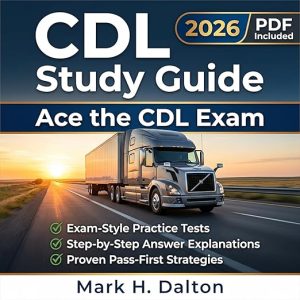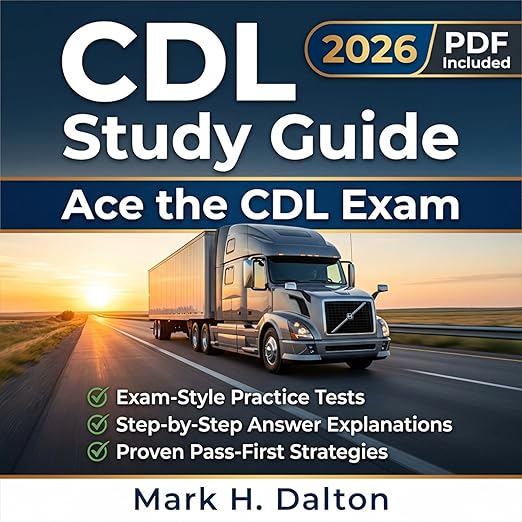
Mark H. Dalton opens the CDL Study Guide 2026 audiobook with a diagnostic that is more accurate than most test prep marketing: most CDL candidates fail not because they are underprepared in general, but because they studied the wrong material with the wrong emphasis. The air brake system is where the CDL exam loses more candidates than any other single section, and the guides that allocate two paragraphs to it while spending chapters on CB radio terminology are not preparing drivers for the test they are actually going to take. Jason Haines narrates this corrective over twelve hours and nineteen minutes with the methodical precision that exam prep requires.
The premise is structurally honest. Dalton has organized the guide around the actual failure points of the CDL examination rather than around the conventional organization of a trucking manual. The full air brake chapter - covering parts, pre-trip checks, warning signs, and safety systems - comes first and receives proportional treatment. From there, the guide moves through general knowledge, combination vehicles, HazMat, tankers, doubles and triples, and school bus endorsements. Every major endorsement category is present, organized for exam focus rather than operational sequence.
Haines Organizes Air Brakes for Fragmented Study Time
The audiobook format for a CDL study guide is not an obvious choice, and Dalton makes the case for it explicitly. CDL candidates study under conditions that do not always permit screen time - driving to a current job, working a shift, exercising during the only hour of the day that is free. Twelve hours of professional narration that can be absorbed during those windows, reinforced by the review questions and quick prompts that end each section, represents a genuinely different study methodology from reading the same content on a page. Haines's delivery makes the technical material - dual air brake systems, HazMat placard requirements, combination vehicle coupling procedures - audibly organized in a way that supports retention across listening sessions.
The guide aligns with current national CDL standards, which matters for a 2026 edition because regulatory updates can shift exam content in ways that older guides do not reflect. The 5.0 rating across 48 reviews suggests an audience that is finding the material useful for its stated purpose, though the sample size is small enough that the rating should be taken as an indicator rather than a definitive measure. No individual reviews offer extended critical analysis, but the consistent five-star response from a technical audience suggests the content is meeting the practical standard it sets for itself.
Review Questions Turn Listening Into Retrieval Practice
The companion PDF is included with the Audible purchase and is the appropriate format for the visual elements - vehicle diagrams, brake system illustrations, combination vehicle coupling sequences - that the audio cannot replicate. The design intention is clearly two-format: audio for the explanatory content during windows when a screen is unavailable, PDF for the reference review when you are at a desk. Neither format is complete without the other if you want full coverage, and downloading the PDF at the point of purchase rather than treating it as optional is the right approach for serious candidates.
The review question structure at the end of each section is the audiobook's most functionally valuable design choice. Haines reads the questions with enough separation from the surrounding explanatory content that they function as genuine retrieval practice rather than as part of the flow. Retrieval practice - being required to produce the answer rather than re-read it - is one of the most research-supported study techniques for retention, and its inclusion in the audiobook format means that passive listening is not the only cognitive mode the guide supports.
Breadth Over Depth Leaves HazMat Underserved
At twelve hours and nineteen minutes, this guide covers comprehensive CDL content, but the per-section depth is proportional to a survey rather than a specialist study. Candidates who need deep preparation on a specific endorsement - HazMat especially, where regulatory complexity is high - may find the audio overview useful as an orienting layer but insufficient as the only preparation resource. Dalton's organization is sound, but the endorsement sections toward the later hours cover their material at a pace that reflects the guide's breadth-over-depth approach.
The audiobook format also means that candidates who need to revisit a specific section - the dual air brake system question that appeared in a practice test, for instance - must navigate by chapter structure rather than by searching a text. Planning your listening with the table of contents as a reference, and noting which chapters you want to return to, makes the twelve hours more manageable as a study tool rather than a sequential listen.
Fragmented Study Time Is This Guide's Target
This audiobook is for CDL candidates whose study time is fragmented across commute windows, work breaks, and gym sessions, and who need a guide organized around actual exam failure points rather than conventional trucking manual structure. The emphasis on air brakes specifically is the most practical organizational choice Dalton makes, and candidates who have failed on that section will find the dedicated treatment immediately useful. Skip this guide if you can study with a screen available most of the time - the visual materials in the PDF companion are necessary enough that a candidate with regular screen access should probably study from the PDF as the primary format and use the audio as supplemental review rather than the reverse. But for candidates whose daily windows are behind the wheel or away from a desk, twelve hours of focused narration aligned with current exam standards is a genuinely useful investment.
Before You Listen
Is the CDL Study Guide 2026 audiobook sufficient as a standalone study resource, or is the companion PDF also necessary?
The audio is the primary study layer for content you can absorb during commute or workout time, but the companion PDF - included with the Audible purchase - contains visual materials like brake system diagrams and vehicle coupling sequences that the audio cannot fully substitute for. Serious candidates should use both.
Does the audiobook version of CDL Study Guide 2026 cover all the major endorsements, or just the general knowledge sections?
All major endorsements are covered: air brakes (treated as the priority section), general knowledge, combination vehicles, HazMat, tankers, doubles and triples, and school bus. The coverage is organized for exam focus rather than operational sequence, which means the sections receiving the most attention are the ones responsible for the most exam failures.