In Brief
- Big ideas: Security operations, detection and response, governance and risk, exam reasoning under time pressure.
- Atmosphere: Methodical, plain and unhurried.
- Worth it?: A well-structured twenty-four-hour companion for a working candidate, undercut by machine delivery of material made of acronyms.
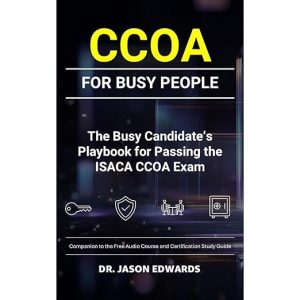
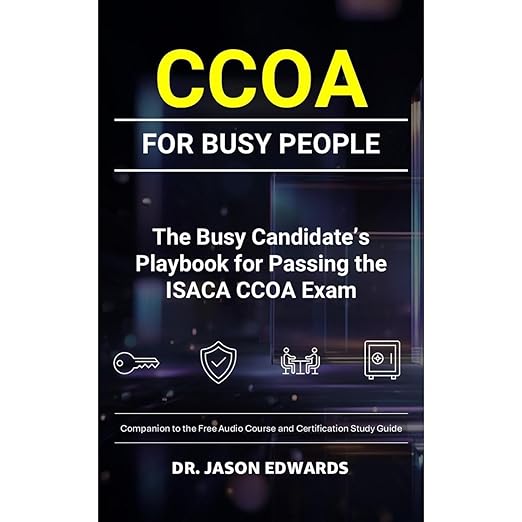
Who studies for a certification exam by ear? That is the question this record puts to a buyer before anything else, because the file runs twenty-three hours and fifty-seven minutes and every one of them is exam preparation. Jason Edwards has designed the audiobook around short sessions rather than long ones, with chapters broken into four sections each and every section written to be finished in a single sitting, which is a real attempt to fit study around a working week.
Detection and Response Is Where Candidates Get Stuck
The coverage list is specific and it is organized by dependency rather than alphabetically, which matters for a subject where everything connects. Foundations first, aimed at teaching a candidate to think like an analyst. Then technology essentials, meaning networks, operating systems, cloud concepts and APIs. Then governance and risk, then threat landscape and intelligence basics, and finally detection and response, which the copy identifies as the point where most candidates either gain confidence or get stuck. That ordering is the argument for this book over a list of definitions.
The record cannot agree with itself about the title, though. The listing is called CCOA For Busy People; the description inside calls the book CCOA for People With Jobs. One product, two names, and a buyer who heard about it under either one has an even chance of matching the page. The description also breaks off in the middle of a sentence, cutting out mid-clause while giving advice about how to work through a section.
CCOA Never Once Gets Spelled Out
Nowhere in the copy is the acronym expanded. CCOA appears as a credential, an exam and a body of knowledge, and never as words. Anyone already studying will know what it stands for; anyone weighing whether this certification is worth pursuing gets no help at all from the page, which is a strange omission on a product whose entire market is defined by that one string of letters.
Forbidding as a Block, Manageable as a Schedule
Session design is the real feature. Four sections per chapter, each written to be completed in one go, maps cleanly onto the way people actually study around a job: a drive, a walk, a lunch break. Twenty-four hours sounds forbidding as a block and becomes manageable as a schedule, which is precisely the reframing the copy is selling, and it is more honest than the usual promise that a subject can be mastered quickly.
The pedagogy claim is also the right one for the format. The copy insists the exam is not a terminology test but a test of whether you can connect technology basics to real detection and response work, then prioritize and act. Reasoning travels through headphones far better than definitions do, and tradeoffs explained in plain English with short supporting examples is a description of material that suits listening rather than fighting it.
The intended reader is named plainly too: someone in a security operations center, on an incident response team, in IT, or in any role where security problems arrive uninvited. A study guide that knows its reader already has operational instincts can spend its length sharpening judgment rather than defining terms, and the stated outcome here is exactly that, stronger operational judgment and better decisions under exam conditions.
Virtual Voice and the Near-Homophone Problem
Virtual Voice is declared in the reader credit, which is this record saying the file was voiced by software. Twenty-four hours of security operations material is built from acronyms, protocol names, command syntax and vendor terminology, each of which is a place where a synthetic reading can produce a string that means nothing. The subject also runs on near-homophones that change meaning entirely, and no human judgment sits in the file to separate them. Sample a technical chapter, not the introduction.
Ratings have yet to appear against this March 2026 release, and no written response has been left either, so nothing on the page reports how the material works in practice for anyone sitting the exam. The series field names Bare Metal Cyber Study Guides and leaves the number blank, which means a candidate cannot tell whether this is the only guide in the run or one of several covering different credentials.
The format's own limits deserve a hard look before you buy. The copy advises highlighting the parts that make you pause, which is advice for a page and cannot be followed in a file. Nothing on the record mentions practice questions, mock exams, answer keys or a companion document, and exam preparation without retrieval practice is a partial tool at best. Treat this as the explanation layer and plan to buy the question bank somewhere else.
Not for Anyone Starting From Zero in Security
Working candidates are exactly the audience, and specifically those who already spend hours a week in a car or on a train and want that time doing something. If you have the concepts roughly and need them ordered, connected and reinforced, twenty-four hours of structured explanation is a genuinely efficient way to spend commuting time that would otherwise be spent on nothing.
Anyone starting from zero in security should think twice, since the copy assumes a reader who already meets security problems at work and builds from there. Candidates who learn by drilling questions will need a second resource regardless of how good this one is. And anyone unsure whether this credential is the right one should settle that elsewhere first, because the listing never once says what the letters stand for.
Before You Listen
Who reads the CCOA For Busy People audiobook?
No human reader is attached to this file; the credit field holds Virtual Voice. Across twenty-four hours of acronyms, protocol names and command terminology, machine pronunciation is the largest single risk on the record, and sampling a technical chapter is the cheapest way to test it.
How is the audiobook structured for short study sessions?
Chapters are split into four sections each, and the copy says every section is written to be finished in one sitting. The sequence runs from analyst foundations through technology essentials, governance and risk, and threat intelligence, closing on the detection material the copy flags as the usual sticking point.
Do the title and the description match?
They do not. The name on the listing differs from the name used throughout the description, and neither is presented as a subtitle or an alternate. Searching under one gives no guarantee of reaching the page, and the description itself breaks off partway through a clause.
Are practice questions included?
None is advertised. The copy describes explanations, tradeoffs and short worked examples written to support reasoning, and never mentions question banks, mock exams or answer keys. Retrieval practice is the one component exam preparation cannot skip, so plan on sourcing that separately from this file.