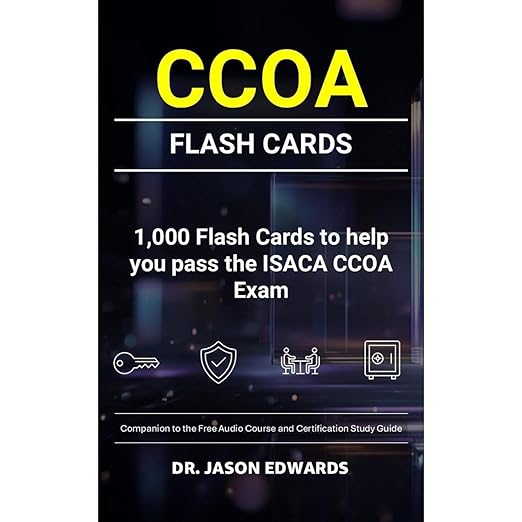
Can a flashcard system delivered as an audiobook actually help you pass a cybersecurity certification exam? Jason Edwards's CCOA Flash Cards is built on the premise that it can, and the design choices behind this production make a genuine case for audio as an underutilised tool in exam preparation. This is not a passive listen. It is an active recall system adapted for audio consumption, and it fills a specific gap in the CCOA candidate's study toolkit. The production uses a Virtual Voice AI narrator throughout, which is appropriate to note given the format's study-aid purpose.
Cross-Domain Reasoning Is CCOA's Most Demanding Part
The book's fundamental insight is simple: rereading material is among the least efficient ways to retain it, while active recall, being forced to retrieve information from memory rather than simply recognising it when presented, builds retention dramatically more effectively. The 1,000 flashcards in this collection are designed to operationalise that principle in a format that works for candidates with constrained study schedules, those squeezing review into commutes, lunch breaks, or the scattered minutes between other commitments that characterise the life of a working professional pursuing certification.
The subject matter coverage maps directly to the CCOA exam domains, touching definitions, distinctions, workflows, and operational decision points across technology, risk, threat behaviour, detection, and response. The cross-linking of concepts between domains is explicitly highlighted as one of the collection's design priorities, because that cross-domain reasoning is precisely where CCOA exam questions tend to become most demanding. A candidate who understands each domain in isolation but struggles to see how risk concepts connect to detection workflows, or how threat behaviour analysis informs response decisions, is not yet exam-ready, and this collection directly targets that specific gap in preparation.
The recommended use model is daily sets of 10 to 15 minutes rather than marathon sessions, with explicit attention to the cards that cause hesitation. The spaced repetition dynamic builds naturally when candidates track their misses and return to them before adding new material, and the book provides a clear framework for implementing that discipline without requiring complex planning or additional software. For candidates who find formal spaced repetition applications high-friction, this simplified version of the method offers a practical alternative that is immediately actionable.
Nearly Twenty-Eight Hours Away From a Desk
The audio format serves this material in a specific way that print flashcards cannot fully replicate. Exam candidates who are strong visual learners may genuinely prefer physical cards or digital spaced repetition applications. But for candidates who commute, exercise, or have jobs that involve significant time away from a desk, having a structured recall loop available in audio form extends the study window in ways that other formats cannot. The audiobook runs nearly 28 hours across the full set, which means substantial material is available for sustained daily use over the weeks of preparation leading up to the exam.
The book is part of Jason Edwards's Bare Metal Cyber Study Guides series and is explicitly designed to be paired with the main CCOA textbook and an accompanying audio course. The three-format loop, read a section in the main book, listen to the related audio course segment when it fits the day, use flashcards for active recall of the same concepts, is described as the optimal implementation, and the logic is sound. Each format reinforces the others and targets different modes of memory encoding, which is exactly what certification candidates need when the exam covers a broad and interconnected domain.
The Virtual Voice AI narration is adequate for content of this type. Flashcard prompts do not benefit from interpretive nuance in the way that narrative prose does. What matters is clear pronunciation, consistent pacing, and intelligibility under less-than-ideal listening conditions such as background noise during a commute. The Virtual Voice delivery meets those functional standards, though listeners who find AI narration fatiguing over long sessions may want to work through the material in shorter daily chunks, which aligns with the book's own methodology anyway.
This Supplements CCOA Coursework, Never Replaces It
This is a study aid, not a comprehensive textbook, and it is designed to supplement the main CCOA course material rather than replace it. Candidates who try to use this collection as their primary or sole study resource will find significant gaps. The format is one of reinforcement and recall, not initial instruction, and it works best when used after a candidate has built foundational understanding through other means. That dependency is by design and clearly stated in the book's framing, but it is important for candidates to understand before purchasing.
The Virtual Voice narration is a feature that suits some listeners and frustrates others. For purely functional study use, it is workable. For listeners who find AI-generated voices distracting or fatiguing, the material may be better accessed in print or digital card format, though those formats require additional tools and planning to implement effectively.
Final Weeks Call for Targeted Repetition
The primary audience is CCOA certification candidates who want a structured active recall component in their study plan and who have time for listening but limited time for desk-based study sessions. It is particularly well-suited to candidates who commute regularly, who work in environments with downtime during which listening is practical, or who learn well through audio reinforcement of concepts previously encountered in text. Anyone already using the Bare Metal Cyber Study Guides main textbook will find this companion collection a natural and well-integrated extension of that material. Candidates in the final weeks before their exam date, looking to sharpen recognition and reduce weak areas through targeted repetition, represent exactly the use case this audiobook was built for.
In Brief
- Performance: Virtual Voice AI narration is functional for study-aid content where pronunciation clarity and consistent pacing matter more than interpretive performance. Adequate for the purpose.
- What it covers: Active recall methodology, CCOA exam domain coverage, cross-linking of cybersecurity concepts, and building sustainable daily study habits for working certification candidates.
- Feel: Functional and methodical, designed for practical use rather than enjoyment. The study-aid nature makes utility the primary criterion for evaluation.
- Our call: A well-designed active recall companion for CCOA exam candidates, best used in daily short sessions alongside the main textbook. Strong complement to the Bare Metal Cyber Study Guides series.
Before You Listen
Can this audiobook replace the main CCOA textbook for exam preparation?
No. It is explicitly a supplementary active recall tool designed to reinforce material learned through the main textbook and audio course. Candidates who rely on it as their sole resource will encounter significant gaps. It works best as one component of a structured three-format study approach.
Does Virtual Voice narration work well for flashcard-format audiobook content?
Better than it does for narrative or emotionally complex material. Flashcard prompts require clear pronunciation and consistent pacing rather than interpretive nuance, and the AI narration meets those functional standards. Listeners who find AI voices fatiguing should plan for shorter daily listening sessions.