Quick Take
- Big ideas: the ISC2 Certified in Cybersecurity domains, exam logic ahead of memorization, revision built around a working week.
- Atmosphere: Plain, methodical and deliberately unglamorous.
- Worth it?: A sensible plan for a candidate with a job, on a listing that cannot agree what the book is called and hands the reading to a machine.
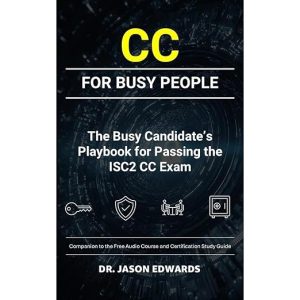
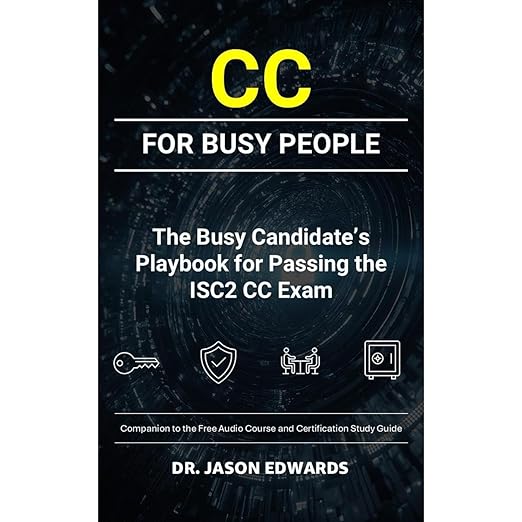
Open the description and this book changes its name. The record is filed as CC For Busy People. The copy calls it CC for People With Jobs, twice, once in its opening paragraph and once in its last. Jason Edwards has written a study guide for the ISC2 Certified in Cybersecurity credential, and this audiobook runs sixteen hours and forty-eight minutes under a reading credit that says Virtual Voice. Each of those three facts changes what a buyer is being offered, and none of them is explained anywhere on the page.
Deciding Whether CIA Means Agency or Acronym
Two names for one product is a practical problem rather than a pedantic one. A candidate who hears the book recommended under one title will search for the other and come up empty, and a page that cannot agree with itself offers no way to tell which name the author intended. The series fields compound it: the record belongs to Bare Metal Cyber Study Guides and carries no volume number, so where it sits in that sequence is unknowable from here.
Virtual Voice sits where a performer's name would normally go, which means the reading was generated by machine rather than delivered by a person. The disclosure itself is fair and deserves credit for existing. What it costs is worth spelling out on this particular book, because a certification guide is built out of abbreviations: a synthetic reading has to decide, every single time, whether CIA is an agency or confidentiality, integrity and availability, whether MFA gets spelled out or pronounced, and where one bulleted control ends and the next begins.
None of that is hypothetical for an exam candidate. This book's whole argument is that you should stop memorizing and start recognizing what a question is really testing, and that requires precise vocabulary delivered precisely. A mangled standard or a run-on list is not a cosmetic irritation when the words themselves are the material. Sampling before buying matters more here than on almost any other kind of audio.
Steady Effort Beats Intensity, Understanding Beats Memorization
The premise is well judged. Edwards is writing for people holding down full-time work who need a plan rather than more pages, and the structure follows from that: each chapter uses four content-specific sections, sized so one fits into a short block and two can be batched on a weekend. Study material that acknowledges a calendar is rarer than it ought to be, and this one is explicit that steady effort beats intensity and that understanding beats memorization.
The syllabus coverage is stated plainly too. Security principles, business continuity and disaster recovery, incident response basics, access control concepts, network security fundamentals and security operations are the domains named, which is the entry-level territory this credential covers. The copy also promises to teach why controls exist and how identity and permissions bound what people and systems can do rather than simply listing them, and that is the right emphasis for a test built on choosing the best of several plausible answers.
Length works in its favor in a way it would not on a narrative title. Sixteen hours and forty-eight minutes comes to roughly seventeen days at an hour a day, which maps onto a realistic revision run rather than a weekend cram. A guide expecting to be heard twice, in short blocks, is using audio the way working adults actually use it.
An Audio Course Advertised Beside Audio Itself
The description advertises two other products, and one of them will confuse buyers of this one. A free audio course is offered as an optional companion to the book, which is a strange sentence to encounter on an audio listing, since the thing being sold here already is audio. A Kindle ebook of a thousand flashcards is the second. Neither is included, neither is priced, and the copy never distinguishes that free audio course from the paid audio product on the same page.
The rest of the copy was written for a printed book and never adapted. It talks about pages, about reopening the book, about returning to the relevant section for a quick clarification pass. Each of those actions is harder by ear, and the four-section chapter design the whole plan depends on only works if the file is chaptered to match. Nothing on the listing says whether it is, which is the single piece of information a study-guide buyer most needs.
Practice is the other gap. The copy promises you will finish able to read a question, recognize what it is testing and eliminate distractors with purpose, and the mechanism described for building that skill is reasoning rather than drilling. The repetition lives in the flashcards, which are sold separately. A listener who wants question practice should plan on sourcing it elsewhere.
Sixteen Hours of Synthetic Narration Under Test
Exam candidates already in motion are the right audience: somebody who has seen the syllabus, knows the vocabulary well enough to hear it correctly, and wants a structured second pass while walking or driving. The four-section chapter design supports exactly that use. Career changers coming in cold would do better starting with text they can see, because a first encounter with access control models and network fundamentals is not the moment to let a machine decide how a term is pronounced.
Buy the sample first, and give it the abbreviation test rather than the pleasantness test. Sixteen hours of synthetic narration on material where the terminology is the point will stand or fall on how those letters come out, and that is a two-minute question with a sixteen-hour consequence.
Good to Know
How should I schedule this audiobook around a job?
Sixteen hours and forty-eight minutes, released in March 2026. At an hour a day that is roughly seventeen days, which suits the book's own advice to take one chapter section at a time and batch two on weekends rather than attempting a single weekend cram.
Why do the title and the description disagree?
Nothing on the page explains it. The record is filed as CC For Busy People while the copy calls the book CC for People With Jobs in both its first paragraph and its last. Search under either name and you may miss the product entirely, and that is what a two-name listing costs a buyer.
Is the audiobook enough on its own for the exam?
The copy positions it as the core, with a free audio course and a separate Kindle ebook of a thousand flashcards offered as companions. Neither is included in this purchase. Since the drilling lives in those flashcards, plan on adding practice questions from somewhere rather than relying on the recording alone.