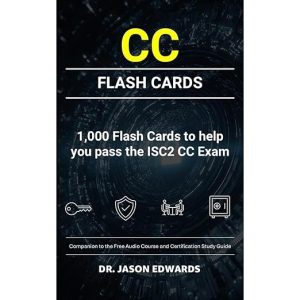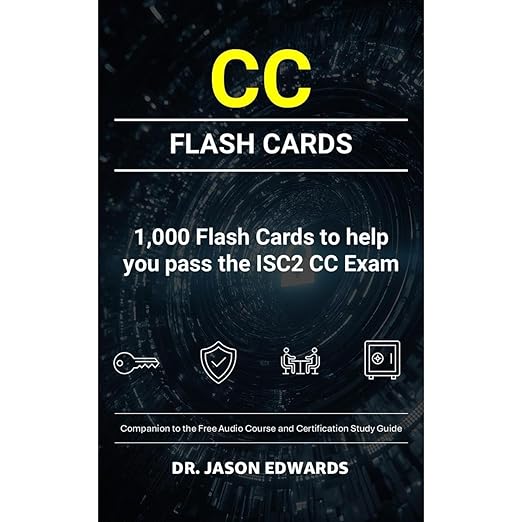
One thousand flashcards, read end to end, comes to twenty-five hours and forty minutes. That works out at roughly ninety seconds per card, which is a useful figure to have before buying, because it is the figure nobody puts on the listing. This audiobook is a drill set for the ISC(2) Certified in Cybersecurity exam, and the product title reads CC Flash Cards while the description calls the book CC Flashcards for People With Jobs. One product, two names, and only the shorter one is searchable from this page.
This Study Routine Needs a Pen
Recall is the entire pedagogy, and the description states it in its first line: forcing yourself to produce an answer beats rereading pages and hoping something sticks. Every card is built to isolate one distinction or one decision point, which is the correct unit for an exam that tests judgment rather than memory. The topic list follows the parent guide exactly, covering security principles, access control concepts, network security fundamentals, business continuity and disaster recovery, incident response basics, and security operations. Nothing about the selection is idiosyncratic, which for a study aid is the correct kind of dull: a candidate wants coverage that maps onto the syllabus, not a personal reading of it.
Method is where the format begins fighting the content. The copy prescribes a specific routine: twenty-five to forty cards a day, a running list of everything you missed, and those missed cards repeated the following day before any new ones are added. That routine needs a pen. Keeping a written list of misses while a file plays is workable in a parked car and impossible while driving, and the description names commuters as a target audience in the same paragraph. The study system on offer and the format it arrives in do not entirely fit together.
Cycling by Subject Beats the Daily-Set Routine
Twenty-five cards a day works out at roughly thirty-eight minutes of listening, forty cards at about sixty-two, and the complete set at that pace takes somewhere between twenty-five and forty days. That is an actual study plan with actual numbers behind it, which is more than most exam companions offer. Anyone with a certification date six weeks out can look at those figures and know immediately whether this is the right tool or the wrong one. The arithmetic is the most honest thing on the page.
Topic drilling is the second use the copy describes, and it suits audio considerably better than the daily-set routine does. Two or three days on access controls when permission models feel fuzzy, then a shift to network security when the tools start blurring into each other. Cycling by subject means replaying a section rather than tracking individual cards, which a linear file handles perfectly well. Anyone in last-mile review a week before the exam is the listener this product genuinely fits. Playing a single domain three times on the way to and from work is the one study behavior audio does better than paper, and the copy arrives at it almost by accident while describing weak-area drilling.
Learning the Wrong Sound a Hundred Times
Cards have two sides and audio has one. That is the structural problem, and the production choice sharpens it: this file was generated by a text-to-speech system, with Virtual Voice sitting in the narrator slot. A flashcard only works when the gap between prompt and answer is long enough to think in and clearly marked at both ends. A person reading signals that with a pause and a shift in pitch. A generated reading has no dependable way to do either, across a thousand consecutive opportunities to get it wrong.
Acronyms are the second thing to test in a sample. Security vocabulary is thick with initialisms, control model names and product terminology, and a synthesized reader either spells them out, says them as words, or produces something in between that a candidate has to decode before answering. Across a thousand cards, a systematic mispronunciation of one control family would be quietly corrosive: you would learn the wrong sound for the right concept and then hear it a hundred more times.
Title and series information are both incomplete. The listing shows CC Flash Cards. The description shows CC Flashcards for People With Jobs, a different compound word plus a subtitle that never reaches the product page. The series field reads Bare Metal Cyber Study Guides with no number attached, and the copy repeatedly refers to a main book and a main guide it never names. A buyer wanting the companion volume these cards were drawn from has nothing here to search with.
Zero ratings and zero written responses sit on this record five months after a March 2026 release. For a study aid, that matters more than it would for a novel, since the only question worth asking about an exam companion is whether the people who used it passed. Nobody has answered it. The description is confident and specific about method, and confidence in a description is not evidence of anything except care in the writing of it.
Twenty-Five Hours Becomes a Month of Sessions
Candidates already working through the parent guide who want a recall layer on top of it are the intended buyer, and the design is sound for exactly that. Anyone at the stage where almost-right answers are still catching them out is the ideal case, since the copy specifically targets confusion between similar ideas. Spread across the recommended pace, twenty-five hours turns into a month of short daily sessions rather than a marathon nobody would attempt. The daily-dose framing in the description is not marketing language; it is the only way a set this size is survivable, and the copy is refreshingly direct about saying so.
Pass on this if you intend to study while your hands are busy, because the routine the copy prescribes requires writing things down. Pass as well if you have not already worked through a full syllabus for the exam, since a thousand recall prompts assume a foundation to recall from. Listeners who need a human voice for twenty-five hours of technical vocabulary should play the sample first, because an acronym-dense set is the hardest possible thing to hand a synthetic reader.