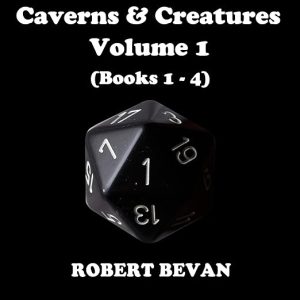
Tim, Dave, Julian, and Cooper roll dice around a table one moment and wake up wearing their characters' bodies the next, their game master already sitting back and eating their abandoned fried chicken. That's the premise driving this thirty-two-hour-and-forty-three-minute audiobook, a single bundled collection of the first four Caverns and Creatures novels, Critical Failures, Fail Harder, A Storm of S-Words, and a fourth entry the synopsis only partially names. Robert Bevan's LitRPG comedy asks a genuinely funny question buried under all the crude jokes: what happens when the guys who always play the game for laughs suddenly have to survive inside it for real.
Jonathan Sleep narrates the full omnibus, a real endurance test given the ensemble cast: four distinct comic voices need to stay differentiated across thirty-two-plus hours without blurring into one generic funny-guy register, on top of a sadistic game master antagonist and whatever cast of fantasy-world characters the group encounters along the way. The synopsis doesn't undersell the tone either, opening with three blunt one-word declarations, swords, sorcery, and a cruder word for raunchy jokes, about as honest a content warning as a comedy fantasy audiobook can offer.
The bundle format itself signals something about audience expectations: packaging four books together as a single Volume I purchase assumes listeners will want to consume the opening arc in one continuous binge rather than sampling a single entry first, a reasonable bet given how tightly serialized comedy usually needs sequential momentum to land its recurring jokes and character dynamics.
The Best Parts of Caverns and Creatures: Volume I (Books 1-4)
Reviewer Gandy makes the sharpest craft case for why this works as LitRPG specifically: the characters are interesting, fun, and a little crass, drawn as 'a cast of multiple characters, instead of a single Mary Sue/Gary Stu style uber-mensch,' rooted in classic paper and dice role-playing rather than the conventions of many other entries in the genre. That's a real structural distinction worth understanding if you've bounced off other LitRPG titles: this leans on tabletop D&D's specific culture and inside jokes rather than the loot-grinding, stat-block obsession that defines a lot of video-game-inspired entries in the genre.
The ensemble structure is the book's biggest asset over a lot of comparable comedy fantasy. With four distinct protagonists instead of one overpowered hero, Bevan can distribute the comedy, the incompetence, and the occasional genuine heroic moment across a group dynamic that feels more like an actual friend group's chaotic energy than a single wish-fulfillment character's journey. Reviewer Dylan F., a self-described non-fan of crude humor generally, still calls the book a riot and credits the nostalgia of real tabletop sessions with friends for winning him over despite reservations about the raunchier jokes specifically.
Bundling four full novels into one thirty-two-hour package gives listeners the entire opening arc of the series in a single purchase, and reviewer Edge1973's practical note, that the individual books are also available separately at a lower per-book cost, is useful for anyone trying to decide between the bundle and buying entries individually as they go.
LitRPG as a genre emerged largely from web-serial fiction communities before crossing into traditional and audio publishing, and it typically leans hard into explicit game-mechanic bookkeeping, experience points, stat blocks, level-ups, presented as if narrating an actual game session. Bevan's choice to keep that mechanical apparatus mostly in the background, foregrounding character comedy instead, puts this closer to broad ensemble comedy that happens to use a game-trapped premise than to the numbers-heavy end of the genre, worth knowing before diving into thirty-two hours expecting heavy stat-tracking detail.
The sadistic game master functions as the series' most consistent antagonist, and turning a GM, normally a neutral or collaborative figure at a real tabletop, into an active, taunting villain who profits from the players' suffering is a sharp, specific inversion of actual tabletop gaming culture that will land hardest for listeners who have their own real-world GM stories to compare it against.
The synopsis frames its own core question with real specificity, whether these characters have the strength, wisdom, and even charisma to survive, borrowing the actual stat categories a tabletop character sheet would track and turning them into genuine narrative stakes rather than abstract game terms. That's a small but telling craft choice: the comedy stays grounded in real D&D mechanics even while mocking the characters who obsess over them.
Weak Spots in Caverns and Creatures: Volume I (Books 1-4)
The crude humor is not incidental or occasional; it's the book's stated organizing principle from the very first line of its own synopsis. Listeners sensitive to raunchy, sexually crude comedy, the synopsis's own comparison lands somewhere between beloved fantasy epics and a much cheaper, much cruder joke, should treat that description as a genuine content warning rather than marketing exaggeration.
Thirty-two hours and forty-three minutes is a serious time commitment even bundled as four books, and Jonathan Sleep does not appear to have other narration credits to judge his stamina and ensemble-differentiation skills against. Listeners who prioritize narrator consistency across a long comedic ensemble cast, four very different voices sustained over half a full workweek's worth of listening, should sample an early chapter before committing to the full bundle.
This Volume I framing in the title implies the series continues beyond these first four books, and listeners who fall for Tim, Dave, Julian, and Cooper here should expect to look for additional entries beyond this specific bundle rather than assuming the story wraps up completely within these thirty-two hours.
Comedy audiobooks built on ensemble banter place unusual demands on a narrator's comic timing specifically, distinct from the world-building or emotional-range demands of straight fantasy; jokes need enough space to land without dragging pace, and a full thirty-two-hour bundle offers Jonathan Sleep considerable room to develop that timing but also considerable room for it to grow repetitive if the comic rhythm doesn't vary across four full books.
It's also worth noting that the listeners who left reviews here skew toward genuinely engaged tabletop-culture fans rather than a broad general audience, which is a reasonably honest signal about who actually finishes and enjoys a thirty-two-hour comedy bundle: this rewards patience and genre affection more than casual sampling.
The Right Listener for Caverns and Creatures: Volume I (Books 1-4)
This is a strong fit for D&D veterans and tabletop gaming fans specifically, listeners who enjoy ensemble comedy over single-hero power fantasies, and anyone who wants LitRPG rooted in genuine tabletop culture rather than video-game mechanics.
Listeners who enjoyed other real-people-trapped-in-a-game comedy properties, or who simply want fantasy adventure that doesn't take itself remotely seriously, will find this bundle's four-book scope a satisfying, substantial commitment rather than a brief taste of the format.
Skip it if crude, sexually explicit humor is a hard pass regardless of the fantasy-adventure wrapping around it, or if you specifically want a single, clearly heroic protagonist to root for rather than four flawed, bickering friends muddling through together.
In Brief
- Performance: I could not find a prior track record for Jonathan Sleep, tasked here with differentiating four distinct comic voices across thirty-two hours without letting any one of them blur into the others.
- What it covers: Tabletop-RPG-turned-real-life absurdity, found-family friendship under a sadistic game master, crude comedy layered over genuine fantasy stakes
- Feel: Raunchy, fast, and unapologetically silly
- Our call: A genuinely funny LitRPG entry point for D&D veterans who want an ensemble cast instead of one overpowered hero, but the crude humor is not for every listener.
Frequently Asked Questions
Does this Caverns and Creatures audiobook include all four books in the series?
Yes, this bundle collects the first four novels, Critical Failures, Fail Harder, A Storm of S-Words, and a fourth entry, in one thirty-two-hour-and-forty-three-minute package.
How crude is the humor in this audiobook?
Very, by the synopsis's own description. It opens by naming its own tone bluntly, and reviewers confirm the comedy leans raunchy and sexually crude throughout rather than as an occasional aside.