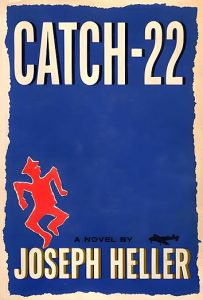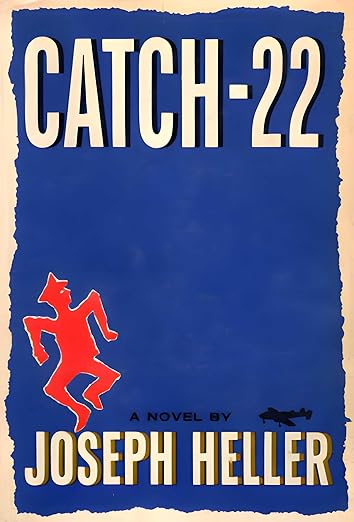
Six hundred and one pages sit in the metadata of this listing, alongside an ISBN, a narrator credit for Jay O. Sanders and a runtime two minutes short of twenty hours. Print identifiers and audio identifiers have been stacked on the same record, which is worth knowing before you buy this audiobook, because it means some of the numbers you can see describe a physical object rather than the recording. The novel underneath all of that was published in 1961 and has needed no help from a catalog since.
Captain John Yossarian is a bombardier on a fictional Mediterranean island during the Second World War, and he would like to stop flying missions. The regulation that stops him is the one the book gave its name to. Heller's method is to take that single piece of circular logic and grow an entire bureaucracy out of it, until the war itself reads as an administrative accident that nobody can be held responsible for.
Circular Jokes Become Machinery for Killing People
Sanity is the joke and the wound at once, which is why I would call this both the funniest novel about the Second World War and one of the bleakest. B. J. Turk gets closest to the mechanism in a review that is itself constructed as a loop: "It's all madness, and madness is sanity in Heller's Catch-22." Joey Phillips describes the same thing from the other direction, noting that "no matter how silly or vulgar or repetitive it gets, it's a book about war."
Joey Phillips is also the reviewer who identifies the structural turn, and it is the thing that separates Heller from ordinary satirists. For a long stretch the deaths are abstractions and the repetition is comic. Then characters you have been laughing at start dying, the joke stops being available, and the same circular conversations that were absurd on page one read as machinery for killing people. That inversion is the whole design, and it only works because the comedy was allowed to run so long first.
Arturo Hernandez files the honest dissent, awarding three stars: "I pushed through it. It was not what i expected." Sean C. reports the same collision across a long gap, having "Tried to read this as a kid and failed," then finding as an adult that the complexity and harsh reality landed. Both reactions are correct. This is a book with a genuine entry barrier, and the barrier is not vocabulary or period detail. It is the repetition, which asks you to trust that a pattern going nowhere is going somewhere.
Sanders Alone Keeps the Drone Out of Hour Six
One reviewer, writing eight days after this edition appeared, handed me the strongest argument for hearing rather than reading it. The book, that reviewer says, "sometimes feels like a very old radio show with silly characters before TV was invented." That is a shrewd description of Heller's dialogue, which runs on interruption, repetition and characters talking directly past each other, all of it built for the ear long before anyone recorded it.
Circular dialogue is also the specific production problem this text hands a narrator. Joey Phillips names "the absurdity of the circular conversations" as the novel's default mode and describes the texture as "silly or vulgar or repetitive," while the August reviewer points at "the laws and rules that keep them all trapped in a system." Repetition of that sort has to stay alive across a very long program. Either each return of a joke arrives fractionally different, or the whole thing settles into a drone somewhere in hour six. Jay O. Sanders is the only name on the credit, which means every voice in every one of those exchanges comes from a single reader.
Twenty hours is a serious commitment, and the pool suggests this particular book tolerates fragmented listening far better than most literary fiction does. The August reviewer calls it "a slow burn" and admits to "reading it and coming back to it" without being able to stop, which is the behavior of somebody dipping in rather than driving through. Joey Phillips describes an experience organized by recurrence instead of forward motion. Neither of those describes a book whose thread you lose after putting it down for three days.
You Would Have to Be Crazy to Read It
Numbers on this listing do not add up, and it is worth saying so plainly. A 4.2 average is displayed against a single rating, which is arithmetically impossible, since one rating can only ever produce a whole number. Five written reviews are visible under a rating count of exactly one. Whatever the display is aggregating, it is not counting the population it appears to count, so ignore the average entirely and read the five paragraphs instead.
Which edition you are buying is the second open question. This listing carries a 2024 publication date, an ISBN and the page count mentioned earlier, all attached to a novel first published sixty-odd years before that. The description is not publisher marketing either; it reads as an encyclopedia entry, and its account of the rule does not quite work, stating that a pilot who requests evaluation is "deemed sane, but their desire to avoid danger proves their sanity." Read that twice and it says the same thing twice, which is not what a paradox does. Check the edition details before you commit, since the recording, the text and the catalog data here are not obviously the same product.
Difficulty is the last honest warning. One reviewer pushed through without enjoying it and another failed to finish it as a child before succeeding as an adult, so difficulty is a documented feature rather than a rumor. The book is repetitive by design, vulgar by intention and uninterested in helping you keep track of when anything happens. B. J. Turk puts the entry requirement about as well as anyone: "You would have to be crazy to read it."
Heller Writes the Sharpest Thing on Institutions
First-time adult readers of Heller should begin here rather than with the paperback they abandoned at school, on the evidence of Sean C.'s two attempts. Fans of comic ensemble writing, from workplace farce to service comedy, will recognize the ancestor of a great deal of what came later; one reviewer writes that "I feel like this book was the inspiration for the show Mash." And anyone interested in how institutions manufacture their own logic will find this the sharpest thing ever written on the subject.
Approach with caution if you want plot momentum, because the two reviewers who describe the book's shape both describe recurrence rather than advance. Approach with caution too if repetition irritates you, since repetition is not a stylistic tic here but the argument itself. In return for the commitment you get a comedy that turns, at the point Joey Phillips identifies, into something you never agreed to feel, plus the origin of a phrase you already use without thinking about where it came from.