In Brief
- Narrator: Tony Roberts captures Vonnegut's deadpan apocalyptic rhythm with good instincts, dry without being flat, which is exactly what the text demands.
- Subjects: Religion as human invention, the absurdity of progress, complicity in annihilation
- Tone: Darkly comic and deeply unsettled, Vonnegut's nihilism delivered with a smile
- Bottom line: One of the great satirical novels of the twentieth century, as relevant now as it was in 1963, and enormously effective in audio.
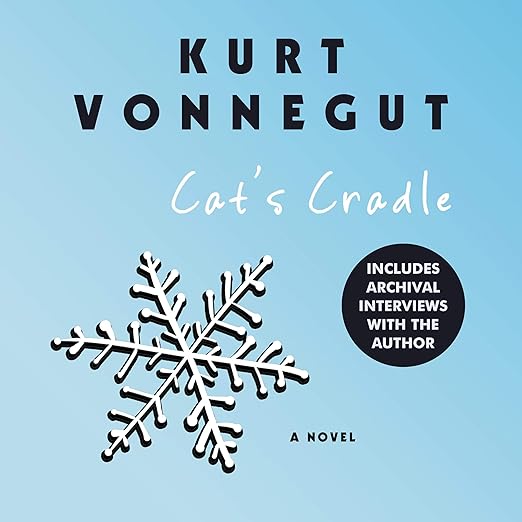
I have returned to Cat's Cradle at several different points in my life and found something different each time. I was probably nineteen the first time, and I thought it was funny, which it is, in a surface way that satisfied the part of me that wanted literature to be irreverent. Somewhere in my late twenties I came back to it and understood what Vonnegut was actually doing with Bokonon's invented religion, with ice-nine, with the complete narrative architecture of the novel. Listening to Tony Roberts' audio version recently, what struck me most was how precise the satire is. It is not a broad swipe at modernity. It is a scalpel.
The premise, compressed: a narrator attempts to write a book about what the father of the atomic bomb did on the day Hiroshima was bombed. He ends up in a small Caribbean island republic, entangled with the remnants of the scientist's family and an invented religion called Bokononism, whose founder openly acknowledges that everything he preaches is a lie and whose followers find this truth-telling deeply comforting. The apocalypse, when it arrives, comes not from a bomb but from a fictional substance called ice-nine that the scientist invented almost as an afterthought.
How Cat's Cradle Holds Up
Vonnegut described the novel as satirical commentary on modern man and his madness, and the description is accurate if incomplete. What distinguishes Cat's Cradle from simply being satirical is the quality of Vonnegut's grief underneath the comedy. He is not sneering at his characters, he loves them, hopelessly, in the way that one loves people who are doing terrible things without quite understanding that they are doing them. The scientist's children are fools and innocents and instruments of catastrophe. The narrator is a witness who can see what is happening and cannot stop it. Bokononism exists because human beings need comfort and meaning more urgently than they need truth.
The reviewer who described Vonnegut as "satirical, whimsical, deadly earnest in a half-joking kind of way, not particularly optimistic about the future of us People" has put it well. The novel is not hopeful. It does not pretend to be. What it offers instead is the strange comfort of complete clarity, of being shown exactly what we are capable of by someone who has decided to find it funny because the alternative is unbearable.
Why Cat's Cradle Works as an Audiobook
Tony Roberts' narration has a quality that is hard to quantify but immediately recognizable: he understands the rhythm of Vonnegut's sentences. Vonnegut writes in short declarative units that accumulate into something much larger than any individual statement, and Roberts honors that structure without trying to impose drama on top of it. The novel's famous short chapters, there are 127 of them across just over seven hours, are handled with the right lightness of touch. Roberts does not oversell the dark jokes. He delivers them and lets them sit.
The audio format is particularly effective for Vonnegut because his prose style is so strongly spoken in register, it sounds like someone talking to you, and has always sounded that way. Roberts channels that quality naturally, and the result is a listening experience that feels more intimate than reading the text on the page.
Weak Spots in Cat's Cradle
This is not a conventionally plotted novel. It builds toward an apocalypse through apparent tangents and digressions, accumulating its argument through juxtaposition rather than causation. Listeners accustomed to tightly plotted narrative will need to surrender to Vonnegut's structural logic, which rewards patience. The payoff is enormous, the novel's ending is one of the great closing sequences in American fiction, but arriving there requires accepting the journey on its own terms.
The theology of Bokononism is also central rather than incidental. Listeners who find extended engagement with fictional religion tedious will miss large portions of what the novel is actually doing. Vonnegut is using Bokononism to make an argument about the relationship between meaning and truth that is neither dismissible nor simple.
The Right Listener for Cat's Cradle
Anyone who has not yet read Vonnegut should start here. It is the novel where his distinctive voice, the dark comedy, the compressed prose, the grief disguised as satire, is most fully realized in a short space. At seven hours, it asks very little in terms of time and delivers a great deal in terms of thought and feeling.
Listeners who came to Vonnegut first through Slaughterhouse-Five will find Cat's Cradle both familiar and different, the same moral seriousness, a different formal solution. Those who already love the novel will find Roberts' narration a genuinely good reason to revisit it in this format.
A Few Questions About Cat's Cradle
Is Bokononism a major part of the novel, or can it be treated as background detail?
It is central to everything Vonnegut is doing. Bokononism, an invented religion whose founder admits everything he preaches is a lie, is the novel's main vehicle for its argument about meaning, truth, and human need for comfort. Treating it as background means missing the novel's argument.
How dark is Cat's Cradle, is it the kind of apocalyptic satire that leaves listeners genuinely unsettled?
Yes, but in a specifically Vonnegut way. The darkness is real and the apocalypse is complete, but the delivery is so dry and the comedy so precise that the unsettlement tends to arrive after the listening rather than during it. One reviewer described Vonnegut as 'deadly earnest in a half-joking kind of way,' which captures it accurately.