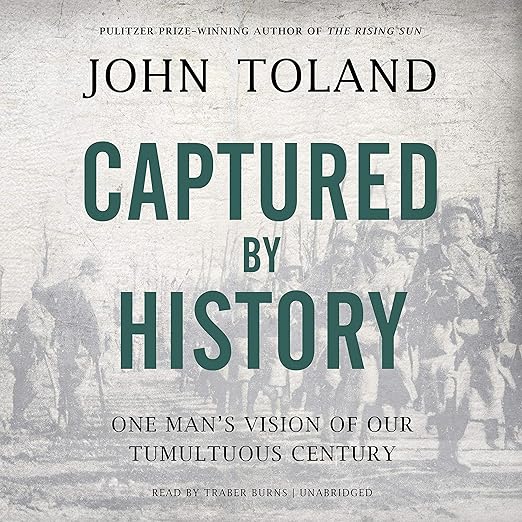
Before You Press Play
- Narrator: Traber Burns narrates with appropriate gravity and warmth, honoring the personal tone of Toland's prose without losing its conversational directness.
- Subjects: The ethics and mechanics of historical access, the transformation of an artistic temperament into a historical one, the weight of twentieth-century testimony.
- Tone: Reflective and quietly extraordinary, with moments of genuine tension whenever Toland describes persuading reluctant sources to speak.
- Bottom line: A rare historian's memoir that earns its runtime by centering the question of how major history gets made and who agrees to participate in its making.
Captured by History is one of the most unusual and rewarding audiobooks I have spent time with in the biography and memoir category, and I say that as someone who has worked through a substantial number of historians' memoirs over the years. John Toland's account of his own life reads less like self-congratulation and more like a sustained meditation on the strange alchemy of access, and his story of moving from struggling playwright to Pulitzer Prize-winning historian gives this audiobook an arc that feels more like a novel than a conventional autobiography.
How to Get People to Tell You the Truth
What distinguishes this book from other historians' memoirs is Toland's central preoccupation: not his own life in the abstract, but the specific question of how he persuaded the people who shaped the twentieth century to talk to him. The subtitle might as well be 'how to get people to tell you the truth,' because that is what Toland returns to again and again. From disgraced Japanese generals in the years after World War Two to the German doctor who came closer than almost anyone to assassinating Hitler, his sources stand out not just for who they are but for what they chose to reveal specifically to him.
Toland's approach to interviewing was rooted in a kind of respectful patience that he describes with disarming frankness. He was not aggressive or confrontational. He listened, he returned, and he built trust over time in ways that opened doors other historians never found. The book is as much a manual for human connection as it is a memoir, and that dimension gives it a practical resonance that purely narrative memoirs often lack.
Hooked on Toland After The Rising Sun
Traber Burns narrates with a gravity appropriate to the material without losing the personal warmth that makes Toland's voice distinctive on the page. Arnold Howard's review captures the appeal well: after reading The Rising Sun, he was 'hooked on John Toland' and came to this book specifically to understand how that masterwork was researched. Captured by History answers that question with generosity and specificity.
The book's account of Toland's early years as a struggling playwright is more than mere scene-setting. Understanding how a man trained in drama and narrative tension eventually applied those instincts to historical research explains much about why his books read the way they do. He learned to make history feel inhabited before he learned to make it accurate, and both skills are present in full measure in his major works.
Prose With a Speaking Quality, Respected by Burns
The audio format serves this book particularly well because Toland's prose has a speaking quality to it. He wrote for readers who would feel the cadence of his sentences, and Burns's narration respects that quality without imposing on it. The seventeen-plus hours of runtime is significant, but the content justifies it: the progression from Toland's early theatrical ambitions through his gradual discovery that he had a historian's instincts is consistently absorbing, with no padding chapters to navigate.
For listeners who have read any of Toland's major works, including The Rising Sun, In Mortal Combat, or his biography of Adolf Hitler, this audiobook provides a behind-the-scenes account of how those books were built. The access he describes, including sitting with sources who had never spoken on the record and who revealed things that would have been dangerous to admit even decades after the fact, gives his research a human dimension that the finished histories necessarily obscure. You come to understand the detective work behind the sentences.
An Admiring Eye Rather Than a Critical One
The book's chronological structure is fairly conventional for memoir, which means the early chapters covering Toland's theatrical years and his gradual transition to historical writing are less immediately compelling than the later sections dealing with specific sources and interviews. Listeners who come for the WWII access stories may find the first few hours require some patience before the material reaches its full stride.
Toland's perspective on his sources is admiring and generally uncritical. He was skilled at building trust, and that skill occasionally means he presents his subjects in the most favorable light available to him. Readers who have engaged critically with his historical work and its occasional controversies should bear in mind that this is a memoir written from the inside, and Toland is not particularly inclined toward deep self-examination about his own interpretive choices.
The book was originally published in the mid-1990s, and Burns's narration does not update or contextualize any of the historical claims for contemporary listeners. That is entirely appropriate, but it means some of the political context around Toland's sources has shifted in the intervening decades, and listeners may want to supplement with more recent scholarship on specific figures.
The Practical Mechanics of Building Access and Trust
This audiobook is essential listening for anyone who has read and admired Toland's historical work and wants to understand how it was built. It is equally valuable for writers, historians, and journalists interested in the practical mechanics of building access and trust with reluctant or sensitive sources. Toland's methods are described in enough detail to be genuinely instructive for anyone whose work depends on persuading people to speak honestly.
General readers who enjoy historian memoirs and are drawn to the behind-the-scenes dimensions of major historical writing will find this deeply satisfying. It covers one of the most significant periods of twentieth-century history through the back door, via the people who were inside it, and that makes it a richer and stranger document than a conventional autobiography could be. For listeners new to Toland's work, it functions as an excellent introduction that sends you directly to his histories.
Do I need to have read John Toland's historical books before listening to this audiobook?
No prior reading is required, though listeners who have read works like The Rising Sun or his Hitler biography will get considerably more out of the behind-the-scenes sections. The memoir works as a standalone introduction to Toland's life and methods.
Is this audiobook more of a personal memoir or a book about historical research methodology?
Both, substantially. The first portion covers Toland's personal journey from playwright to historian, while the later sections are as much a case study in research access as they are autobiography.
At nearly 18 hours, is this audiobook worth the time commitment for a listener new to Toland's work?
Yes, particularly if you have an interest in twentieth-century history or the craft of historical writing. The runtime is substantial but the content is consistently substantive, and most listeners finish it wanting to seek out his historical books.