Before You Press Play
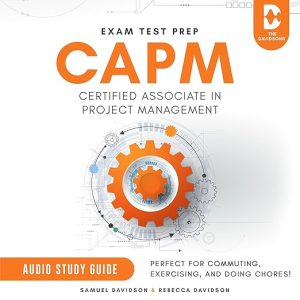
- Read by: Sunny Patel narrates Davidson's study material with clear diction and deliberate pacing that suits the CAPM's four exam domains, making 18 hours of certification content manageable in real-world listening conditions.
- At its heart: Project management methodology, agile and predictive frameworks, exam confidence and career preparation
- Vibe: Structured and encouraging, like a study partner who has done this before and knows exactly where the exam tries to trip you
- Short version: An ambitious audio study guide at 18 hours that covers all four CAPM exam domains with current practice questions, designed for learners who want to convert commute and exercise time into effective certification preparation.
The CAPM Exam Test Prep Certified Associate in Project Management - Audio Study Guide opens with a proposition that deserves to be taken seriously before you dismiss it as marketing language: that project management certification preparation should fit naturally into the rhythm of daily life, and that this audiobook is designed for learners who are constantly in motion. Samuel Davidson and Davidsons Audiobooks have built their exam prep series around the specific thesis that commutes, workouts, and daily chores are not dead time but study time, and that audio activates a different kind of attention than reading alone.
At 18 hours and 8 minutes, this is a substantial commitment. That runtime reflects the actual scope of the CAPM exam rather than padding, and the question worth asking before you begin is whether the audio format is the right match for your preparation approach, not whether the content is comprehensive. The comprehensiveness is not in doubt. The four major exam domains are all covered, the practice questions are aligned to the current exam structure, and the audio walkthrough approach to answer explanation builds exam reasoning rather than answer memorization.
Agile Domains Get Real Weight Here
The four CAPM exam domains receive full coverage: Project Management Fundamentals and Core Concepts, Predictive Plan-Based Methodologies, Agile Frameworks and Methodologies, and Business Analysis Frameworks. The coverage of the Agile and Business Analysis domains is where this guide's alignment with the current exam becomes particularly important. The CAPM has shifted significantly toward agile and hybrid methodologies in recent years, and preparation materials that treat these as secondary subjects behind traditional Gantt-chart-era scheduling are leaving candidates underprepared for where the actual exam now sits.
Davidson's design philosophy centers on audio as a distinct cognitive mode rather than a convenience substitution for reading. The argument is that the rhythm of narration and spaced repetition through audio activates attention and supports retention differently than visual reading, and that complex concepts like predictive scheduling, agile iteration planning, and business analysis workflows can become intuitive through sustained audio exposure in a way that differs from reading-based learning. Whether you find that framing compelling will depend on your own learning history, but the design choices in the audiobook reflect the philosophy consistently: concepts are introduced, explained, and then returned to in practice question contexts rather than presented once and left.
Patel Avoids Monotony Across Eighteen Hours
Sunny Patel narrates with the precision that certification study material requires. Technical terminology, methodology names, and process framework distinctions need clear enunciation to be absorbed reliably, and Patel delivers that throughout the 18-hour runtime without the monotony that can develop when a narrator works through dense study material for extended periods. The pacing is deliberate rather than brisk, which suits a format where the listener needs time to process concepts as they're presented rather than reviewing the text after reading.
The audio walkthroughs of practice questions are the most directly practical component of the production. The CAPM exam tests reasoning about project management situations rather than simple recall of definitions, and having the reasoning behind correct answers explained verbally builds the decision-making skills the exam actually tests. That distinction, between understanding why an answer is right and simply knowing that it is, is what separates candidates who pass with confidence from those who pass narrowly and remain uncertain about their actual competence in the domain.
Business Analysis Rewards Focused, Active Listening
Eighteen hours is substantial for an audio study guide, and the investment pays off most for candidates who approach it actively rather than passively. The design assumes learners who are processing and building mental models as they listen, not using the audio as background sound. Several sections covering predictive versus agile methodology tradeoffs, stakeholder management, and the Business Analysis domain in particular benefit from focused listening rather than multitasking. Those sections are where the exam tends to produce the most challenging questions, and they are also where Davidson's reasoning-based approach to explanation adds the most value.
Revisiting Hard Domains Beats a Single Pass
The guide positions itself as suitable for both first-time CAPM candidates and those building foundations for future certifications like the PMP. The foundational methodology content does overlap meaningfully between the two certifications, and CAPM preparation provides a legitimate foundation for future PMP work. However, the PMP exam has substantially higher experience requirements and a different scope, so candidates targeting the PMP directly should treat this as foundational context rather than sufficient preparation for that more advanced certification.
A practical note on format: the audio is most effective when you return to challenging sections actively rather than listening once through and considering the preparation complete. The repetition effect Davidson describes works when you deliberately revisit the domains you find most difficult rather than treating each domain as checked off after a single pass.
Commute-Heavy Schedules Convert Into Structured Study
Professionals preparing for the CAPM certification who have mobile, commute-heavy, or exercise-intensive schedules and want to convert that time into structured exam preparation will find this audiobook well-matched to their situation. Project management professionals building toward their first formal credential will find the comprehensive domain coverage and reasoning-based practice question format directly applicable to both exam preparation and real-world project work.
Those who absorb information more effectively through listening than through reading will find the audio format a genuine advantage rather than a compromise. Learners who need heavy diagram and flowchart support for process group memory work should note that the audio format addresses visual components verbally rather than graphically, which requires the kind of spatial reasoning capability that not all learners bring equally to certification study. The most effective approach for most candidates will combine this audiobook's comprehensive coverage with supplementary visual materials for the frameworks and process diagrams that the exam tests most heavily.
Good to Know
Does this audiobook cover the current CAPM exam content outline including the agile and business analysis domains?
Yes, Davidson explicitly structures the guide around the current four-domain exam outline: Project Management Fundamentals and Core Concepts, Predictive Plan-Based Methodologies, Agile Frameworks and Methodologies, and Business Analysis Frameworks. The emphasis on current-style practice questions and up-to-date exam alignment is a stated design principle of the material.
Is this audiobook useful for PMP preparation, or is it strictly focused on the CAPM certification level?
Davidson positions the guide as suitable for CAPM candidates and those building foundations for future certifications including the PMP. The foundational methodology content overlaps meaningfully between the two certifications, but the CAPM-level framing and scope mean PMP candidates should supplement with materials specifically addressing the PMP's broader experience and depth requirements rather than treating this as sufficient PMP preparation on its own.