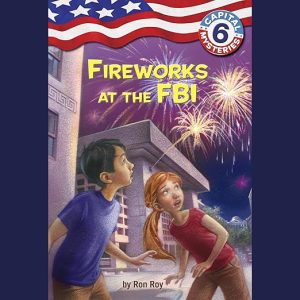
Seventy-five minutes is a short audiobook by any measure, and for an early chapter book written for emerging readers that length is exactly right. Ron Roy has been at this a long time, and the sixth Capital Mysteries puts KC at the White House for the Fourth of July, where she spots fireworks going up from the wrong building altogether. FBI headquarters, to be precise. The president calls it an accident. KC and her friend Marshall are certain the display was covering something up. That is the entire apparatus, and at this length the apparatus is the point rather than scaffolding for something bigger.
Fireworks Over a Real Washington Landmark
What separates Capital Mysteries from the enormous field it competes in is geography. Every installment is pinned to a real Washington building, museum or monument, and the puzzle is engineered to walk a young reader through it. Here the landmark is the FBI, and the Fourth of July hands Roy a legitimate reason to put fireworks in the sky and a crime underneath them. The design is tidy: the facts arrive attached to a plot instead of pasted into a sidebar, which is the whole difference between a child absorbing something and a child turning the page. A February 2018 five-star points readers toward another book, A Spy in the White House, which is a fair signal that these get consumed in runs and not one at a time.
One line in the publisher copy deserves a pause. The book is pitched as a red, white and blue mystery perfect for the election season, which is a curious thing to say about a story set on Independence Day. Those are not the same civic occasion, and a parent shopping for a summer holiday book would never think to search the other term. It reads like copy written to catch a seasonal wave that had very little to do with the contents. The story makes no election argument whatsoever. It is a fireworks mystery with a federal building in it, and the patriotic coloring is decoration rather than theme.
Mayer Balances Character Voices and Field-Trip Facts
John H. Mayer reads it. The job at this age level is narrower than it looks and easy to miss in two directions at once. Push too hard on character voices and an early chapter book becomes a cartoon that a seven-year-old enjoys and a nine-year-old feels patronized by. Play it too straight and the passages explaining a federal building start sounding like a field trip. What the material wants is a reader who can hand over a fact about the FBI in the same breath as a plot beat, with no change of gear announcing that the educational part has begun. Seventy-five minutes also leaves no room to recover from a misjudgment, since the whole thing finishes before a listener has properly settled.
These books work hardest on children who know the places. An August 2010 entry describes buying the whole series for a kindergartener specifically because the stories happen in the family's own city, and notes the child was getting through one a day and then starting them over again. Recognition is the series mechanism, and a child who has stood in front of the building on the cover reads differently from a child who has not. Audio widens that reach slightly, since a landmark you have never visited is easier to picture while somebody describes it aloud and you look out of a car window at somewhere else entirely.
Printed-Edition Reviews Standing In for This Recording
The one substantive complaint in the written column is a good one. The only four-star there notes that this installment carries a few inaccurate details in the plot, calls it not a big deal, and then lands the point that matters: on a series whose entire selling proposition is real facts about real Washington sites, you may as well get the details right. That is exactly the exposure a fact-forward children's series takes on. A child who learns something wrong here has no reason to doubt it, and the format is what lent the wrong thing its authority in the first place.
Five entries sit in that column and every one of them is grading a book that was read off a page. None describes a recording, which means the four point four at the top of the listing is doing double duty it was never built for. A hundred and forty grades have collected behind that number, and the people who explained themselves were all discussing a printed edition, so a buyer reading it learns something real about Roy's plotting and nothing at all about seventy-five minutes of audio. This is a common arrangement on children's titles, where a book has usually existed in print for years before anyone records it. It is not deceptive. It is a different product being scored than the one on sale.
Families Driving Into Washington Get the Best Fit
Give it to a child of six to nine who has started reading alone and still enjoys being read to, which is a wider band than it sounds. An August 2023 five-star describes a seven-year-old finishing it inside a day as assigned summer reading before entering second grade, and that is about the right calibration. Families driving into Washington have the ideal use case, because the book hands a child something specific to look for on arrival. Teachers after a short, self-contained mystery that carries civic content without a worksheet attached will find seventy-five minutes fits neatly inside a couple of sessions.
The mystery itself is slight, and an older child already reading full-length novels will solve it early and drift off before the fireworks accomplish anything. Adults hoping for a Washington story with grit in it should understand the register: the president is a benign presence, the crime is a puzzle and not a threat, and nobody is ever in real danger. If you are buying chiefly for the educational content, keep in mind that a story built to carry facts is only as good as its fact-checking, and that this is the single place where a series like this one is genuinely exposed.
Will a seventy-five-minute audiobook hold a six-year-old's attention?
Most of the time, and the length is the reason. The plot gets from the White House to the FBI building quickly, the chapters are short by design, and nothing asks a listener to hold information across a long gap. A March 2024 five-star describes a fourth grader reading well above this level who stays devoted to the series anyway.
Do you need the earlier Capital Mysteries books first?
No. Each installment attaches itself to a different Washington landmark and resolves inside its own covers, so starting at the sixth costs you nothing beyond a little familiarity with KC and Marshall. The series is built for children to pick up wherever a school library happens to have a copy sitting on the shelf.
Does the audiobook teach anything real about Washington?
That is the design intent and mostly it delivers, since each installment is pinned to an actual museum, building or monument and the material arrives inside the story instead of in a sidebar. Treat it as an introduction rather than a reference, and expect a child to finish with an impression of a place rather than a set of verified figures.
What age is this pitched at?
Roughly six to nine, the band where a child reads independently but still likes being read to. Younger listeners follow the story and miss the civic material entirely. Older ones solve the puzzle early and get bored. The publisher aims it squarely at emerging readers, and everything written underneath supports that calibration.