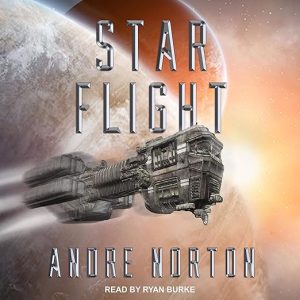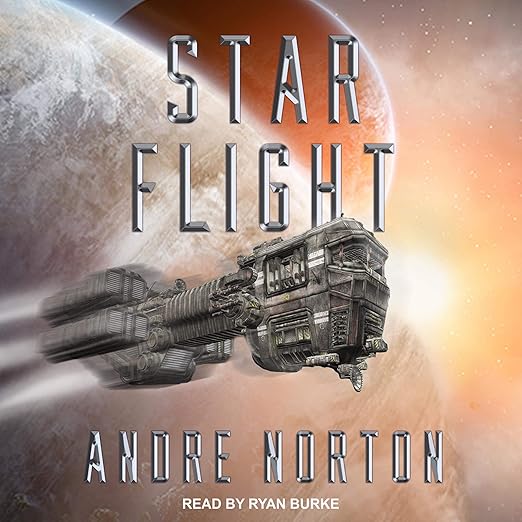
Can an omnibus edition justify its length if both halves are genuinely good? That is the quiet question underneath Star Flight, and this audiobook answers it in a way that surprised me. I came to Andre Norton's Astra duology knowing her reputation as a foundational voice in mid-century science fiction but having read very little of her work directly. Ryan Burke's narration made for a perfect reintroduction, and by the time I had finished both The Stars Are Ours and Star Born over a weekend of listening, I understood why readers keep returning to Norton's particular brand of adventure.
Star Flight collects two novels that were originally published decades apart but share a continuous timeline and a single galactic arc. The first, The Stars Are Ours, follows Dard Nordis in a near-future Earth where scientists have been blamed for a catastrophic global war and are now hunted by a totalitarian state called Pax. The premise has the clean moral logic of classic SF: knowledge persecuted, refuge sought among the stars. Norton does not complicate this setup so much as execute it with real urgency. Dard is not a particularly complex protagonist, but his situation is consistently kinetic, and the novel moves at a pace that suits audio well.
First, the Big Picture
The second novel, Star Born, is the stronger of the two and benefits from the foundation the first half builds. Centuries have passed. Pax has been overthrown on Earth, and humanity reaches for the stars again. When a new crew lands on Astra, they do not know that human colonists from the original flight have been living there for generations, and they do not know that the apparently welcoming native species are actually the remnants of a corrupt civilization with deeply hostile intentions. Norton layers the dramatic irony carefully: both the colonists and the new arrivals understand less than the reader does, which creates a sustained tension that the first novel's more linear structure does not achieve.
For listeners new to Norton, this omnibus is a well-chosen entry point. Her prose is economical in a way that translates cleanly to audio, and she trusts her readers to keep up with shifts in setting and cast without over-explaining. Star Born in particular makes real demands on the listener's ability to track three distinct communities with different relationships to each other and to the truth, and Ryan Burke's performance is what makes this manageable across the final third of the collection.
The Best Parts of Star Flight
Burke's narration is calibrated for adventure-forward material. He does not impose emotional signposting on scenes that Norton leaves deliberately spare, but he does use pace and register to differentiate between Dard's hunted urgency in The Stars Are Ours and the more complex ensemble dynamics of Star Born. The voice differentiation is effective rather than theatrical. Burke is not doing full character voices in the sense of a dramatized production, but you always know whose perspective you are in and what the stakes are for that character in the moment.
One reviewer noted some proofreading irregularities in the text, likely artifacts of digital conversion from older print editions. These surface occasionally in the audio as slight stumbles over unusual word choices, but they do not meaningfully interrupt the narrative. Norton's underlying sentences are sturdy enough that minor textual oddities become background rather than foreground. The reviewer also noted finding Andre Norton again after a few years away, which captures how this audiobook tends to function: as a reentry point for lapsed readers and an accessible first door for newcomers to her catalog.
A Few Reservations
The first novel, The Stars Are Ours, has the structure of a sprint: introduction, flight, escape, arrival. It does not linger on its world or its characters in ways that literary SF fans might expect. Listeners who come to Norton from contemporary character-driven space opera like Ann Leckie's Ancillary series or Becky Chambers' Monk and Robot books may find the sparseness registers as a period style to adjust to rather than a deficit. It is more useful to approach Norton the way you would approach John Wyndham or early Isaac Asimov: as a writer who trusted the premise to carry emotional weight that contemporary writers distribute more explicitly across character interiority.
Star Born manages this structural economy better because its premise genuinely requires multiple perspectives, and the dramatic irony is built into the plot rather than the atmosphere. Listeners who find The Stars Are Ours too lean may want to note that around the halfway mark of the audiobook the register shifts meaningfully. The second half earns its runtime in ways the first half sets up but does not fully achieve on its own terms.
Who Should Listen to Star Flight
Younger listeners aged ten and up with an appetite for classic science fiction adventure will find both novels accessible and engaging without being condescending. Adult listeners who grew up reading Norton and want to revisit her through audio will find Burke's narration a worthy vehicle for that return. Fans of mid-century SF who have worked through Heinlein's juveniles and want to explore Norton's parallel body of work will be well served here. Listeners who need contemporary levels of character depth and worldbuilding intricacy from their SF should probably start elsewhere, though Star Born specifically may surprise them. At twelve hours across both novels, the audiobook represents strong value as a dual-feature omnibus that holds together as a coherent listening experience.
Before You Press Play
- Read by: Ryan Burke handles the dual-novel structure cleanly, differentiating between the sprint pacing of The Stars Are Ours and the more layered Star Born without over-performing either.
- At its heart: Scientific persecution, survival and escape, colonial encounter, hidden histories
- Vibe: Adventure-forward and propulsive with moments of genuine suspense
- Short version: A worthwhile audiobook for fans of mid-century SF and younger listeners ready for classic science fiction adventure, especially once Star Born picks up in the second half.