Quick Take
- Narration: Polly Adams captures Ms. Frizzle’s energy without overdoing it, keeping the character’s manic enthusiasm recognizable while making the climate science legible.
- Themes: Climate change science, fossil fuels, renewable energy, civic responsibility
- Mood: Energetic and educational, with the series’ signature blend of fiction and classroom nonfiction
- Verdict: A brief but substantive introduction to climate science that uses the Magic School Bus format to its full advantage, best as a starting point for a longer conversation.
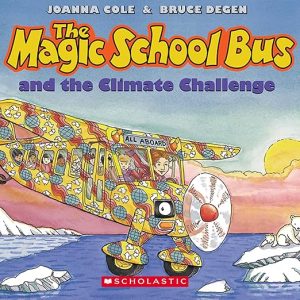
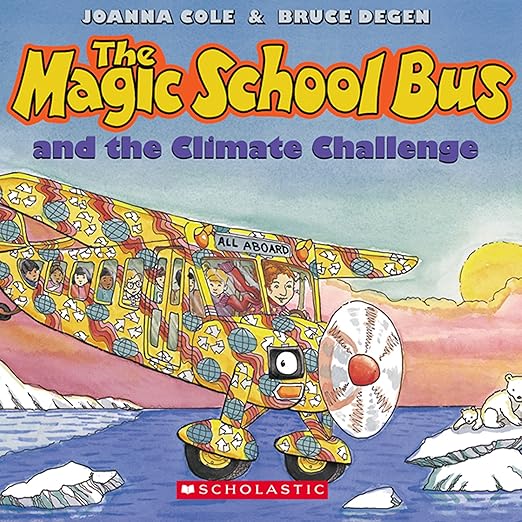
My introduction to the Magic School Bus was through the animated television series in the 1990s, and Lily Tomlin’s voice as Ms. Frizzle set an impossibly high standard. I say that upfront because it shapes how I came to this audiobook, which at twenty-six minutes is one of the shorter standalone children’s science listens in the Joanna Cole canon. I played it during breakfast on a Saturday morning with my neighbor’s daughter, who is six, and by the end she had questions about carbon dioxide that I was genuinely not prepared to answer. Which is, I think, exactly the outcome this book is designed to produce.
The premise follows the series format: Ms. Frizzle’s class boards the magical school bus and goes somewhere impossible to learn about a real scientific topic. Here, the topic is climate change, and Cole makes no attempt to soften the science. The causes, the mechanisms, and the consequences of global warming are explained accurately and at a level appropriate for young children. The synopsis notes that this is the teacher kids like the most tackling a hot topic, which captures both the opportunity and the obligation the book is trying to meet.
Twenty-Six Minutes and the Case for Brevity
The runtime demands honest framing. This is not a comprehensive treatment of climate science. At twenty-six minutes, it is an introduction, a door-opener, designed to generate curiosity and provide a foundation vocabulary. The Magic School Bus books have always worked this way. The classroom nonfiction inserts scattered through the original picture books were similarly compressed. For very young listeners, that compression is a feature rather than a limitation. The goal is not to produce climate scientists but to produce children who understand why the topic matters and are curious to learn more.
Polly Adams handles the book’s dual register effectively. The fictional classroom-adventure frame requires Ms. Frizzle’s characteristic exuberance, while the embedded facts require clarity and precision. Adams moves between these registers without losing the momentum that makes the series enjoyable for young listeners who might otherwise tune out when the science gets direct.
What the Science Actually Covers
For a twenty-six-minute children’s audiobook, the climate science is reasonably thorough. The book addresses the greenhouse effect, the role of fossil fuels, the consequences of warming, and the possibility of renewable alternatives. It avoids both the alarmism that can overwhelm young children and the false balance that dilutes the scientific consensus. Cole’s approach is consistent with how she has always handled science in this series: accurate, clear, and appropriately scaled to the audience without being misleading about the stakes.
Reviewers have praised the book’s integration of fiction and nonfiction, which is the series’ core innovation. The fictional class-trip frame makes the information memorable in a way that straightforward nonfiction for young children often isn’t. One classroom teacher notes using this series from kindergarten through fourth grade, which suggests the material works across a wider age range than the picture-book format might imply.
Framing This for Diverse Households
It is worth noting that some families may be navigating climate communication with children in the context of adults who hold varying views on the topic. Cole’s book presents the science as settled, which it is, while framing the response to it as something individuals can participate in, which is a more empowering angle than pure catastrophism. The book doesn’t assign political blame. It explains mechanisms. That approach may make it more accessible across a range of households, even where climate policy views differ.
Who Should Play This and When
Young listeners aged 4 to 8 are the sweet spot, though classroom use extends to fourth grade. It works well as a brief introduction before a longer conversation, as a car audiobook, or as part of a homeschool or classroom unit on environmental science. The twenty-six-minute runtime means it fits nearly any context. Adults looking for a substantial deep dive won’t find it here, but as a child’s first encounter with climate science delivered by a trusted fictional teacher, it does what it needs to do.
Frequently Asked Questions
Is the climate science in this Magic School Bus book accurate and up to date?
The book presents the scientific consensus on climate change accurately, covering the greenhouse effect, fossil fuel emissions, and the warming of the planet. It was published in 2010, so some specific data points have been updated by subsequent research, but the core scientific explanation remains sound.
Is this version of the Magic School Bus related to the TV series?
It’s based on the same Joanna Cole book series that inspired the animated television show. The audiobook features the same characters and teaching style, though the voice of Ms. Frizzle differs from Lily Tomlin’s iconic TV performance. Polly Adams narrates the audiobook edition.
At only 26 minutes, is this worth buying as a standalone audiobook?
For families or classrooms specifically interested in introducing climate science to young children, yes. It’s more effective as a conversation starter than a comprehensive resource, and the Magic School Bus format makes the science memorable. Think of it as a single episode of the TV show in audio form.
What age is this most appropriate for?
The picture-book format targets ages 4 to 8, though teachers report using the Magic School Bus series successfully through fourth grade, around age 9-10. The audio version works well for pre-readers listening with adults, or for slightly older independent listeners.