Quick Take
- Narration: Carol Jordan Stewart reads with a warm, unhurried clarity that serves the book’s introspective first-person voice, ideal for the quiet, close observation that defines Konigsburg’s style.
- Themes: outsider identity, the power of imagination, female friendship in childhood
- Mood: Quietly enchanting and nostalgic, with a thread of gentle melancholy
- Verdict: A genuine children’s classic that holds up across decades, its insight into the social dynamics of childhood remains completely accurate and its heart is irreplaceable.
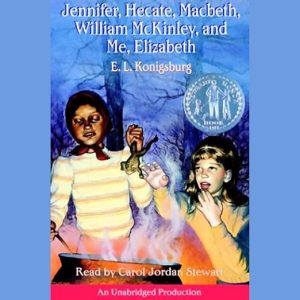
I first read Jennifer, Hecate, Macbeth, William McKinley, and Me, Elizabeth as a child in circumstances very similar to Elizabeth’s own, new school, no friends, watching the social landscape from the outside trying to figure out the rules. Finding this audiobook version as an adult, narrated by Carol Jordan Stewart, I was struck by how precisely E.L. Konigsburg had captured something I never quite had words for at the time: the particular relief of finding one strange, self-possessed person who decides to take you seriously, and how that single friendship can reorganize your entire experience of being somewhere new.
Elizabeth is an only child who has just moved to a new apartment building. She is lonely in the specific way children are lonely when they have no natural social entry point, she knows exactly one girl, Cynthia, who is performatively nice in front of adults and dismissive the moment they leave the room. And then she meets Jennifer. Jennifer sits alone in a tree at recess. Jennifer wears a pilgrim hat. Jennifer informs Elizabeth, matter-of-factly, that she is a witch, and offers Elizabeth the position of apprentice.
Our Take on Jennifer, Hecate, Macbeth, William McKinley, and Me, Elizabeth
Konigsburg, who also wrote From the Mixed-Up Files of Mrs. Basil E. Frankweiler, has a gift for taking children’s interior lives completely seriously without romanticizing them. Jennifer is not a magical child in any literal sense; her witchcraft is a social framework she has constructed to give herself power over her own narrative, and the rituals she invents are a way of transforming the boring and painful parts of childhood into something with ceremony and meaning. The book is a 1967 Newbery Honor book, and it has the structural confidence of something written by an author who trusts her readers to understand subtext. Elizabeth’s gradual realization that the friendship matters more than the witchcraft is handled with the lightest possible touch, and arrives not through a dramatic confrontation but through a quiet moment of genuine connection.
Why Listen to Jennifer, Hecate, Macbeth, William McKinley, and Me, Elizabeth
Carol Jordan Stewart’s narration is well chosen. She reads Elizabeth’s first-person voice with an earnestness that never tips into precociousness, and her pacing gives Konigsburg’s observations the space they need. The book is barely two and a half hours, which makes it an ideal single-session or two-session listen for children, and an easy nostalgic revisit for adults. Multiple reviewers noted returning to it from childhood and finding it exactly as they remembered, that is the mark of a book that did not use its era as a crutch.
What to Watch For in Jennifer, Hecate, Macbeth, William McKinley, and Me, Elizabeth
The witchcraft framework and the Saturday rituals, including a rather unpleasant instruction involving a raw egg, may require some parental context for very young listeners who are not yet fluent in the genre of childhood imagination-as-power. The plot is deliberately slight, this is a book about a friendship, not a series of events, and its climax is interior rather than external. Readers expecting genre fantasy beats will be confused; readers expecting the social texture of realistic fiction will find Konigsburg’s observation precise and occasionally piercing. One reader mentioned their twin nine-year-olds loved it, which suggests it holds across the middle years of childhood.
Who Should Listen to Jennifer, Hecate, Macbeth, William McKinley, and Me, Elizabeth
This is a book for children aged seven to eleven who have ever felt like outsiders, and for adults who remember that feeling with any clarity. It is particularly well suited for kids navigating new schools or unfamiliar social environments, not because it offers practical strategies, but because it offers the more useful thing: the durable feeling of being genuinely understood. Grandparents who remember it will find it unchanged. Parents discovering it for the first time alongside their children are in for a small, quietly excellent surprise, the kind of book that earns a permanent place on a shelf.
Frequently Asked Questions
Is Jennifer, Hecate, Macbeth, William McKinley, and Me, Elizabeth appropriate for listeners younger than the middle-grade range?
It can work from about age six or seven with a parent present, but the book’s pleasures are most fully accessible to children who have started navigating school social dynamics on their own, roughly eight and up. The first-person voice assumes a reader capable of some interior reflection.
Does the witchcraft content present any concern for parents or educators?
No. Jennifer’s witchcraft is entirely a product of childhood imagination, a social and narrative framework she constructs for herself and Elizabeth. There is nothing occult or supernatural. The rituals are elaborate games, including one involving raw egg that plays for gentle comedy.
How does Carol Jordan Stewart’s narration hold up compared to reading the text aloud to a child?
Very well. Stewart reads with the right quality of quiet attentiveness that Konigsburg’s narrator voice requires. She does not perform the text theatrically but rather inhabits it, which respects the book’s understated emotional register.
Is this a Newbery winner, and how does it compare to Konigsburg’s other books?
It is a 1967 Newbery Honor book, not the Medal winner. Konigsburg won the Newbery Medal that same year for From the Mixed-Up Files of Mrs. Basil E. Frankweiler, making her one of the very few authors to win and honor in the same year. Both books are essential Konigsburg, but Jennifer, Hecate is quieter and more inward.