Quick Take
- Narration: George Guidall brings the Gothic atmosphere of Bellairs’s world to life with understated authority, never over-dramatizing the horror but letting the dread accumulate naturally through his measured pace.
- Themes: Forbidden knowledge and its consequences, necromancy as the ultimate transgression, the courage of ordinary children facing supernatural malice
- Mood: Pleasantly eerie and classically Gothic
- Verdict: A reliable entry in a beloved series, elevated by Guidall’s narration and a premise that links haunted music to the undead in ways that feel genuinely imaginative.
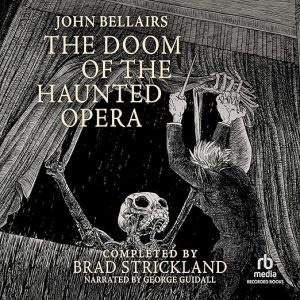
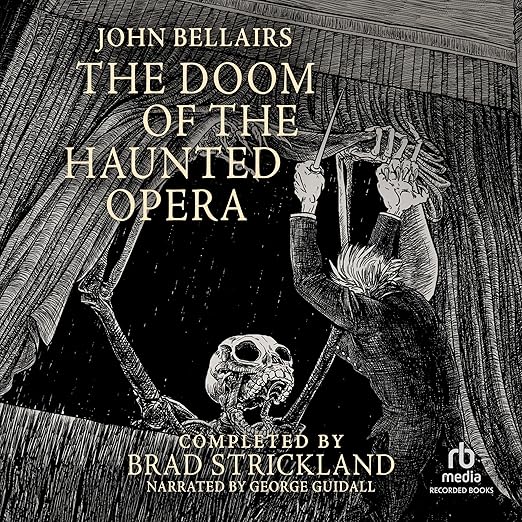
I was probably twelve the first time I encountered the Lewis Barnavelt books, working through a library shelf of Gothic horror for children in roughly the order they were shelved. John Bellairs had a particular gift that I did not have the vocabulary for at that age but understand better now: he knew that the most effective horror for children is not about monsters who appear, but about the slow, dawning recognition that something is wrong with a place or an object or a person you thought you knew. The Doom of the Haunted Opera is the sixth book in the series, completed by Brad Strickland after Bellairs’s death in 1991, and it carries that gift forward.
At three hours and twenty-five minutes, this is a compact production, well-suited for a single afternoon listen or a few evenings before bed. The premise is economical and effective: Lewis Barnavelt and his friend Rose Rita Pottinger explore an abandoned theater, find an unpublished opera score called The Day of Doom, and set in motion a chain of events involving the composer’s sinister grandson and a plan to raise the dead. The horror is never graphic. The menace is always present. This is Gothic fiction operating within the conventions of the form, which for established fans of the series is exactly what it should be.
The Score That Should Not Be Played
The opera score as the central object of dread is a particularly good Bellairs-style choice. It is an artifact that appears innocent, even wonderful: the music teacher who examines it calls it a masterpiece, and for a moment the story allows the reader to share that enthusiasm. Then the grandson arrives, with his plan to use the performance of the opera as a mechanism for awakening the dead, and the apparent masterpiece reveals itself as a trap. This is the classic Gothic inversion: the beautiful thing that is actually terrible, the cultural treasure that is actually a weapon. Bellairs and Strickland execute it cleanly.
George Guidall and the Weight of the Gothic
George Guidall is one of the most experienced voice actors in audiobook history, and his work on Gothic material shows why. He does not perform John Bellairs so much as inhabit the register that Bellairs wrote in: slightly formal, slightly melancholy, attentive to the atmosphere of old houses and abandoned theaters in ways that modern narrators sometimes rush past. His Lewis is appropriately anxious without being fragile. His rendering of the mysterious Henry Vanderhelm, arriving with his plan and his history, has the quality of a figure who has been waiting a long time and is not in any hurry. One reviewer described the book as an exciting story and a great diversion, which is exactly the honest-pleasures register that Guidall helps the production achieve.
A Handbook for Children Who Don’t Tell Adults Things
One reviewer noted with fond irony that the Lewis Barnavelt series functions as a primer in what not to tell your folks, given how consistently Lewis fails to inform his uncle Jonathan about the supernatural dangers he encounters. This is a perennial feature of children’s Gothic horror, from Nancy Drew to the Goosebumps era, and the Barnavelt books are aware of the convention even as they use it. Lewis’s decision in The Doom of the Haunted Opera to not immediately report what he has found in the abandoned theater is the hinge on which the entire plot turns. Guidall reads these moments of dramatic irony with exactly enough weight that adult listeners can enjoy the gap between what Lewis knows and what he should do, while young listeners experience the suspense of watching events spiral.
Who Should Listen and Who Should Skip
The Lewis Barnavelt series is ideal for children ages eight through twelve who enjoy Gothic atmosphere, mild supernatural horror, and mysteries where the danger is genuinely ominous without being traumatic. Listeners who have not encountered the series before can begin with The Doom of the Haunted Opera as a standalone, though the relationship between Lewis, Rose Rita, and Uncle Jonathan benefits from prior context. Fans of Edward Gorey’s aesthetic, of E. Nesbit’s darker moments, or of the lighter end of Neil Gaiman’s children’s work will find this series familiar in the best sense. Listeners who want fast-paced action over atmospheric dread should look elsewhere in the children’s horror catalog.
Frequently Asked Questions
Do I need to read the previous five Lewis Barnavelt books before The Doom of the Haunted Opera makes sense?
The core mystery is self-contained and can be followed without prior knowledge of the series. However, the relationships between Lewis, Rose Rita, and Uncle Jonathan, and the broader mythology of the Barnavelt family’s magical heritage, are richer with prior context. New listeners who enjoy this entry are encouraged to go back to The House with a Clock in Its Walls, the first book in the series.
Was The Doom of the Haunted Opera written entirely by John Bellairs, or was it completed by Brad Strickland?
The book was completed by Brad Strickland after Bellairs’s death in 1991. Strickland continued and expanded the Lewis Barnavelt series for many years, working from Bellairs’s notes and maintaining the series’ established tone and style. The Doom of the Haunted Opera is credited to both authors on most editions.
How scary is this audiobook for a sensitive eight or nine year old?
The horror in the Lewis Barnavelt series is atmospheric rather than graphic. The threat in this book, a necromancer planning to raise the dead using a haunted opera score, is genuinely ominous, but the violence is minimal and the tone stays within the Gothic children’s tradition rather than tipping into genuine horror. Sensitive children who can handle Goosebumps or Scary Stories to Tell in the Dark should be comfortable here.
Is the opera itself performed or described in the audiobook, or is it purely a plot device?
The opera score functions primarily as a plot device and an object of dread. George Guidall describes its effect on characters rather than performing any musical content. The horror of the score comes from what it is designed to do when performed, not from any actual music in the production.