Quick Take
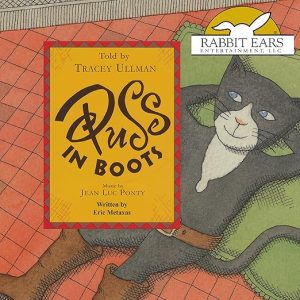
- Narration: Tracey Ullman’s comedienne instincts make her an ideal fit for this sly adaptation, she finds the farce in Perrault’s classic without flattening the story’s cunning wit, and Jean Luc Ponty’s musical score rounds out the production beautifully.
- Themes: Wit over circumstance, social climbing through deception, loyalty between unlikely partners
- Mood: Warmly playful with a sharp comic edge, like a fairy tale told by someone who finds it very funny
- Verdict: One of the Rabbit Ears series’ strongest entries, Ullman’s performance and Ponty’s score make this a proper audio production rather than a simple reading.
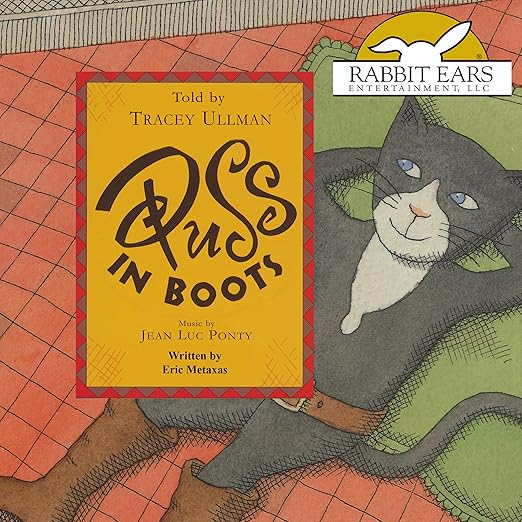
I spent a part of one summer afternoon tracking down the Rabbit Ears series after a colleague mentioned it as a formative childhood listening experience, and Puss in Boots was the entry I kept returning to. The combination of Tracey Ullman narrating and Jean Luc Ponty providing the musical score is either a very strange creative decision or an inspired one, depending on how generous you’re feeling toward late-twentieth-century children’s audio production. Having now listened, I’ll say inspired without qualification. Ullman’s comedic intelligence and Ponty’s jazz-inflected scoring produce a twenty-two-minute listening experience that feels genuinely like an event rather than a book recorded.
The source material is Charles Perrault’s classic French fairy tale, here attributed in this edition to Eric Blair. Claude, the youngest son of a miller, inherits nothing from his father but a retired tomcat. When he considers getting rid of the cat, the creature proposes a scheme: given proper tools, specifically, a pair of boots, the cat will transform his hapless owner into a noble prince. What follows is an escalating sequence of bluffs, misdirections, and social engineering that ends in genuine aristocratic status. The cat is the protagonist in any meaningful sense. Claude is barely a participant in his own good fortune.
Ullman’s Comic Intelligence at Work
Tracey Ullman is primarily known as a television performer and sketch comedian, which makes her an unusual casting choice for a children’s audiobook. It is also exactly the right casting choice. Puss in Boots is fundamentally a farce, and farce requires a performer who understands that the comedy lives in the gap between what characters say and what they mean, between the surface presentation and the underlying scheme. Ullman gets this. Her cat has the particular energy of someone who is very smart surrounded by people who are not, and is quietly amused by this at all times. The pompous marquises and credulous royals get slightly different vocal treatment, not caricature, but a touch of knowingness that signals the audience is in on the joke even when the characters are not.
One reviewer notes their seven-year-old grandson could not take his eyes off this story, which is the highest possible compliment for a twenty-two-minute audio production: that it creates the same absorption that visual media competes for. Another reviewer used it to show their daughter that many films are reinterpretations of time-tested classic stories. The Rabbit Ears original holds up well against those comparisons, largely because Ullman’s performance has a dryness that the animated versions replaced with broader physical comedy.
The Ponty Score as Second Narrative Voice
Jean Luc Ponty is a jazz-fusion violinist, and his score for this production uses that sensibility to interesting effect. The music does not simply underscore the action; it comments on it, punctuating the cat’s schemes with a kind of conspiratorial energy that matches Ullman’s narration. The Rabbit Ears series generally paired strong narrators with strong musicians, and this is one of the better pairings in the catalog. Parents who grew up with the series will find the production quality holds up well; newcomers will likely be pleasantly surprised that a children’s audiobook from this era has such considered musical treatment.
Who Should Listen and Who Should Skip
Puss in Boots in this edition is well-suited for children ages five and up, as the production notes indicate, with the sharp wit of Ullman’s narration providing an additional layer of enjoyment for adults listening alongside. At twenty-two minutes, it fits neatly into a drive, a pre-nap slot, or a before-bed session. The musical score makes it more of a full listening experience than a simple reading, which means it rewards attention rather than background listening.
Listeners who want a longer story, or who prefer narration without musical accompaniment, should note the format here. This is a produced audio experience rather than a plain reading, the music is integral to the pacing and mood. That is, in my view, a strength. But it is worth knowing before you press play.
Frequently Asked Questions
Is Tracey Ullman’s performance in Puss in Boots appropriate for young children, or does her comedic style skew too adult?
Ullman’s performance is genuinely calibrated for children ages five and up, which is the production’s stated target. The wit is dry rather than adult in subject matter, and the comedic sensibility rewards older listeners without confusing or excluding younger ones.
How prominent is Jean Luc Ponty’s musical score, is this primarily a narration or a full audio production?
The score is genuinely integral to the experience rather than background ambient music. Ponty’s jazz-fusion violin style creates a conspiratorial energy that complements Ullman’s narration, making this more of a produced audio event than a simple reading. Listeners who prefer unaccompanied narration should know this going in.
Is this a faithful retelling of Perrault’s original Puss in Boots story?
It follows the essential plot of Perrault’s original, the inheritance of a clever cat, the impersonation scheme, the social climbing, while Ullman’s comedic interpretation gives it particular personality. It is described as a splendid comic adaptation rather than a strict word-for-word retelling.
Is this the same story as the Puss in Boots films connected to the Shrek franchise?
The same core character and situation, but different in tone and detail. The Rabbit Ears version is based directly on Perrault’s French fairy tale and has a drier, more ironic sensibility than the animated films. One reviewer specifically used it to show their daughter that movies are often reinterpretations of original source material.