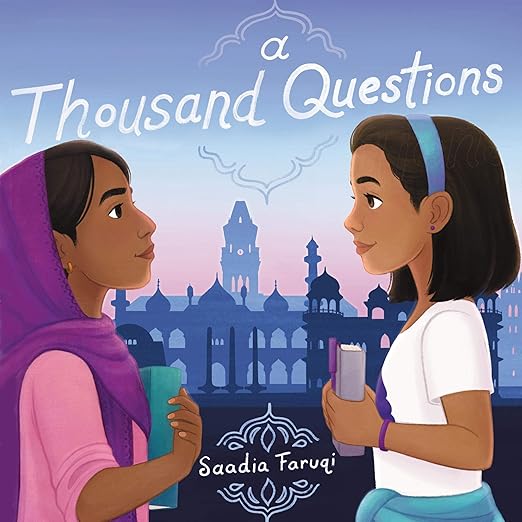
A Kitchen Divides Two Girls' Karachi Summer
Saadia Faruqi sets A Thousand Questions in Karachi, Pakistan, during one summer, and the setting is not decorative. This audiobook, narrated by Gail Shalan and running seven hours and thirty-eight minutes, is a middle grade novel in which the city's social geography does structural work: the divide between the family with the well-staffed kitchen and the cook's daughter who works there, the difference between visiting from America with expectations and living there with economic precarity, these are not backdrop but mechanism. The story depends on those differences being real and consequential, and Faruqi writes them with the specificity of someone who knows Karachi as more than atmosphere.
The two protagonists are Mimi, an American girl spending the summer with grandparents she has never met, who is secretly hoping to find the father who has been absent from her life, and Sakina, the cook's daughter, who has been accepted to school only if she can improve her English score, but cannot tell her parents because the income she earns working alongside her father is not something the family can afford to lose. Both girls are carrying things they are not saying out loud, and both need something the other can provide. That is the architecture of a lot of middle grade fiction, but Faruqi fills it with Karachi-specific texture that makes the familiar structure feel fresh.
Shalan Distinguishes Two Girls by How They Listen
Gail Shalan's narration is careful about the class distinction between Mimi and Sakina without making it the center of every scene. The two voices are differentiated not just in accent or register but in the way each girl listens, which is the subtler and more important distinction. Mimi's questions come from a place of cultural dislocation and personal longing; Sakina's come from practical intelligence and a need to navigate a world that has limited room for her ambitions. Shalan captures that difference without overdoing it, which is exactly what this material requires to avoid flattening the class dynamic into a simplified lesson.
The supplemental enhancement PDF that accompanies the audiobook is worth noting for educators and parents. Faruqi's work is already used in classrooms, and this production comes with resources designed to extend the reading experience, a fairly rare feature at the middle grade level. Reviews consistently single out the cultural specificity as one of the book's strongest features. One reader described being drawn in by the differences between the two cultures and the two socioeconomic classes present in Pakistan, noting that it gave her insight into a context she would not otherwise have encountered. A parent who read it alongside her fourth-grader called it amazing, intense, and well crafted with elegant writing. The frequency of parental co-readers in the reviews suggests this audiobook works particularly well as a shared listening experience.
Why Some Questions Carry Real Risk
The novel's title is not incidental. Both Mimi and Sakina are operating on the understanding that questions can be dangerous, that asking why your father is gone or whether your family can survive you going to school is a risk with real consequences. The questions they ask each other, and the ones they eventually find the courage to ask the adults in their lives, drive the emotional arc of the book. Faruqi does not resolve every thread neatly, which is one of the things that distinguishes this from easier middle grade fare. Mimi's search for her father does not end the way she initially imagines it will, and Sakina's negotiation with her parents about school involves adult complexity rather than easy resolution. That honesty is what several adult readers noticed and valued most.
The novel is compared in its own promotional material to Other Words for Home by Jasmine Warga and Front Desk by Kelly Yang, two middle grade books that have generated significant word-of-mouth for their handling of cultural displacement and economic anxiety in young characters. The comparison is apt. All three books are interested in what it costs to be between worlds, and all three give their young protagonists the dignity of having the problem be real. Shalan's narration supports this by treating the material with the same seriousness the author brought to writing it.
Faruqi's decision to set the novel in Karachi rather than in a generic or composite city is worth emphasizing, because it anchors the book's social observations in a place with specific geography, economics, and culture. The kitchen where Sakina works, the neighborhood where her family lives, the grandparents' household where Mimi is a guest, these are not interchangeable settings; they are locations in a real city with real class dynamics. That specificity is what prevents the friendship narrative from becoming a parable about difference in general and keeps it tethered to the particular, which is where the most honest middle grade fiction lives.
Introducing Young Listeners to South Asian Karachi
This audiobook is appropriate for listeners aged roughly nine and up and works particularly well for family listening sessions. Adults reading or listening alongside middle-grade-aged children will find enough substance to stay genuinely engaged with the class and cultural dynamics Faruqi is working through. The Karachi setting makes it an especially useful choice for introducing young listeners to South Asian urban culture through a story rather than a documentary lens. Educators and librarians looking for middle grade audiobooks that handle class difference and cross-cultural friendship with honesty rather than sentimentality should put this near the top of their lists.
Common Questions
Is A Thousand Questions audiobook suitable for listening to with a child, or is it better as solo listening?
The audiobook works well for family listening and has been specifically enjoyed by parents and children together, as several reviews from parents note. The themes of class, family secrets, and cultural difference are rich enough to generate real conversation, which makes it a strong choice for shared listening rather than background audio.
How does Gail Shalan's narration handle the two different protagonists in this audiobook?
Shalan differentiates Mimi and Sakina through register and emotional texture rather than caricatured accent work. The distinction feels organic and serves the characters' different relationships to Karachi, to each other, and to the problems they are each carrying privately.
Does A Thousand Questions audiobook include the supplemental enhancement PDF?
Yes, a supplemental enhancement PDF is noted as accompanying the audiobook. This material is designed to extend the reading experience and is particularly useful for classroom or educational use, where the book is frequently taught.
Is A Thousand Questions part of a series, or does it stand alone?
A Thousand Questions is a standalone novel. The story of Mimi and Sakina's summer in Karachi is complete within this single audiobook, and no prior or subsequent books are required to follow the narrative.