Quick Take
- Narration: Cary Hite handles the comedic timing and tonal shifts with confidence, matching the material’s irreverent energy without tipping into cartoonishness.
- Themes: Historical rivalry, gender and power dynamics, military insubordination, sibling competition
- Mood: Gleefully chaotic and genuinely funny, with real historical stakes underneath
- Verdict: The third entry in McCormick’s Audible-original series keeps the formula working, adding four feuds worth knowing about, including the Billie Jean King and Bobby Riggs match that belongs in every sports history conversation.
I was helping a twelve-year-old I know prepare for a school project on women in sports history when I remembered this title covered the Battle of the Sexes tennis match. We put it on while she organized her notes, and within ten minutes she had stopped taking notes entirely and was just listening. That is either a failure or a success depending on how you look at it, and I am inclined to call it the latter.
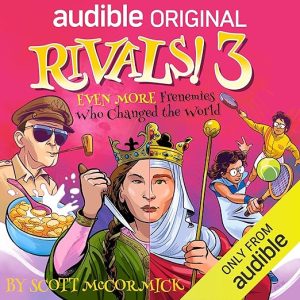
This is the third installment of Scott McCormick’s Rivals! series, an Audible-original audio comedy that looks at historical feuds and what they accidentally produced. Each volume covers four pairs. Here: Billie Jean King versus Bobby Riggs, two medieval queens whose blood feud plunged Europe into war, Will Kellogg versus his brother John Harvey Kellogg and the accidental invention of breakfast cereal, and Harry Truman versus Douglas MacArthur and the nuclear near-miss during the Korean War. That range is a feature, not a bug. McCormick moves deliberately between sports, medieval politics, domestic entrepreneurship, and Cold War military history, and the variety keeps the runtime from feeling monotonous.
The Tennis Match That Holds Up the Mirror
The Billie Jean King and Bobby Riggs segment is the centerpiece, and it earns that placement. McCormick doesn’t reduce the 1973 match to a feel-good gender victory story, though the outcome obviously has that charge. He excavates the cultural moment: what Riggs was actually doing with his outrageous public posturing, what King understood about what was at stake, and why this particular tennis game became a referendum on something much larger than tennis. For a young listener who has never seen footage of that match, this entry does the work of historical context without lecturing.
The medieval queens section is the most genuinely educational of the four. Queens feuding across national borders in the twelfth and thirteenth centuries, with war as the instrument of personal grievance, is the kind of history that rarely appears in middle-grade nonfiction. McCormick frames it with enough period detail to be accurate while keeping the feuding personalities front and center. History as interpersonal drama is his wheelhouse and he executes it well.
Kellogg Brothers and the Accidental Cereal Empire
The Kellogg segment is where the book gets genuinely absurd in the best way. The backstory of corn flakes, involving a sanitarium, a nineteenth-century obsession with bowel regularity, and two brothers with sharply different ideas about the purpose of food, is the kind of history you cannot make up. McCormick leans into the weirdness with obvious relish, and Cary Hite’s narration knows when to let the comedy breathe. The detail about flaming sanitariums is not hyperbole. It is in the record. History is strange and this segment commits to that strangeness fully.
The Truman versus MacArthur story closes the collection and is arguably the most consequential of the four. McCormick explains clearly how MacArthur’s public insubordination during the Korean War brought the United States toward a much larger conflict, and how Truman’s decision to fire a war hero with massive public support was one of the most politically courageous acts of his presidency. For a young listener who knows MacArthur’s name but not the substance of his firing, this segment provides real historical education wrapped in a story about ego and power.
Hite’s Performance and the Audio-First Design
Cary Hite is a different narrator from Prentice Onayemi in the first volume and Bill Andrew Quinn in the second, and the shifts between entries in this series reflect how much the individual narrator’s comic sensibility shapes each installment. Hite is crisp and controlled, and he handles the shifts between genuinely dark material and the comedic framing without letting either register collapse. The Audible-original audio-first design that has characterized the whole series is fully present here: these stories were built to be heard, not read, and the pacing reflects that.
At just under three hours across four stories, the runtime is generous enough for full historical development while short enough to hold an eight-to-twelve-year-old’s attention across a car trip or an afternoon. No prior knowledge of the first two volumes is needed. Each story stands alone.
Who Should Listen and Who Should Skip
Ages eight through fourteen who find standard history books dry but light up when someone explains that two medieval queens caused a war because they personally despised each other. Parents who want audiobooks that generate dinner-table conversation. Anyone who has heard of the Battle of the Sexes but has never had the context explained with actual depth. Skip this if you want straightforward chronological history. McCormick’s approach is relentlessly anecdotal and personality-driven, and that is its entire point.
Frequently Asked Questions
Do I need to have listened to Rivals! 1 and 2 before this one?
No. Each volume in the Rivals! series is fully self-contained. The four feuds covered in this third installment have no narrative connection to the stories in the earlier volumes. You can start anywhere in the series.
Is the Billie Jean King segment appropriate for younger listeners, given its gender politics content?
Yes. McCormick discusses the cultural significance of the 1973 Battle of the Sexes match in terms that are age-appropriate for eight and up. The segment explains what was at stake for women in sports without any content that would concern most parents. It’s a thoughtful treatment of a genuinely important moment.
How does Cary Hite’s narration compare to the other volumes in the series?
The Rivals! series has used a different narrator for each volume. Hite brings a controlled, dry comic delivery that suits the material well. He handles the tonal shifts between comedy and genuine historical drama effectively. Listeners who enjoyed the previous volumes’ narrators should find Hite’s work equally engaging, though his style is slightly more understated.
Is the Kellogg segment really about breakfast cereal, or is it mostly about their family feud?
Both, inseparably. The corn flakes origin story and the brotherly feud are the same story. John Harvey Kellogg ran a health sanitarium with genuinely eccentric dietary beliefs, and his brother Will commercialized their accidental food invention over John Harvey’s objections. The feud produced the cereal industry. McCormick traces both threads simultaneously.