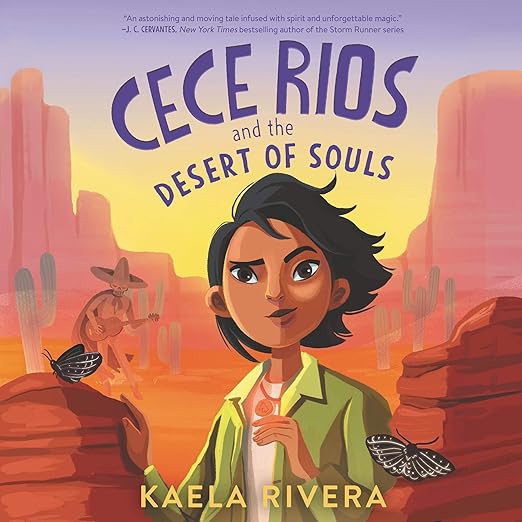
Key Details
- Performance: Almarie Guerra's performance is the audiobook's greatest asset, bringing authentic warmth to Cece's voice while navigating the Spanish-language terms and spirit-world atmosphere of Kaela Rivera's Mexican-inspired fantasy with genuine cultural fluency.
- What it covers: Family loyalty, forbidden magic, cultural mythology reimagined
- Feel: Adventurous and emotionally grounded
- Our call: Cece Rios and the Desert of Souls is a richly imagined middle grade fantasy that delivers on its own-voices premise, and Almarie Guerra's narration makes the audiobook the format of choice for this particular story.
Cece Refuses to Call Criaturas Monsters
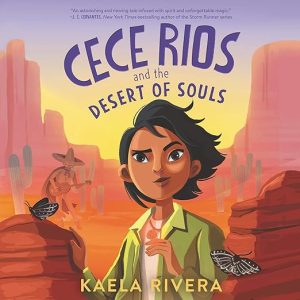
Cecelia Rios has always believed the criaturas are more than monsters, even when every adult in her town of Tierra del Sol treats that belief as dangerous foolishness. Kaela Rivera's debut novel, narrated by Almarie Guerra for the audiobook edition and the first book in the Cece Rios series, builds its emotional core around that simple act of refusing the official story, and it is one of the more genuinely moving middle grade fantasies to reach this format in recent years. Rivera draws on Mexican folklore and mythology in a way that feels lived-in rather than researched, and the result is a world that operates by its own consistent logic rather than borrowing surface details for atmosphere.
The premise is clean and propulsive: Cece's older sister Juana is kidnapped by El Sombrerón, a powerful dark criatura, during the dangerous criatura months when spirits roam the desert and threaten humankind. To enter Devil's Alley and retrieve her, Cece must become a bruja, learning the forbidden magic her community condemns and concealing her quest from her parents, her town, and the other brujas who would see her as a threat. She does this with the help of Coyote, a legendary criatura with a soft spot for humans who agrees to be her guide through the spirit world. Rivera develops this setup with more moral complexity than the summary suggests, and the result earns every minute of its eight and a half hours.
Guerra Handles Spanish Terms Without Feeling Self-Conscious
Almarie Guerra's narration is the primary reason to choose this audiobook over the print edition. She voices Cece with a warmth and specificity that captures both the character's courage and her genuine fear, and she handles the Spanish-language terminology of Rivera's world without the self-conscious pronunciation that can make bilingual texts feel awkward in audio. Reviewer Lynda Allison describes Cece as courageous, taking responsibility for her actions while living in the shadow of her more celebrated older sister, and Guerra tracks that complexity through shifts in register rather than simple emotional signaling. Coyote, as a character, requires a kind of playful gravity that Guerra navigates well: he is ancient and morally unreliable in ways that the story makes visible without making him a simple villain or a straightforward ally.
Rivera is an own-voices author writing from within the cultural tradition she draws on, and that grounding shows in the way the criatura mythology functions throughout the narrative. These are not creatures imported from a different tradition and renamed in Spanish. They operate according to their own internal rules, and the brujas' relationship to them, capturing and controlling criaturas as a form of power, raises genuine ethical questions that the story does not resolve cheaply. Reviewer Brian A. Armstrong describes the audiobook as capturing the journey of family, love, and reliance beautifully, which is an accurate summary of Rivera's thematic ambitions and the emotional register that Guerra maintains across the full runtime.
The Real Villain Is a Fearful System
The book is pitched at middle grade readers, roughly eight to twelve years old, but it works for adult listeners who enjoy richly imagined secondary world fantasy with emotional stakes rooted in family relationships rather than romantic entanglement. Rivera's plotting is clean and the pacing is strong, moving from Tierra del Sol to Devil's Alley and through the various trials Cece must navigate without lingering too long on any single challenge. At eight hours and thirty-four minutes, the audiobook has room to develop its characters and world without feeling rushed, and Guerra's performance gives the full runtime a quality that keeps the listening experience from sagging in the middle acts.
Rivera also does something quietly ambitious with the category of villain. El Sombrerón is genuinely menacing, but the book is more interested in the systemic fear that shapes Tierra del Sol's relationship to the criaturas than in a single antagonist. The bruja hierarchy that Cece must navigate has its own politics and histories, and the way the story refuses to divide the spirit world into simply good and evil entities gives it staying power beyond the resolution of the main plot. The book is comparable in scope and register to the Aru Shah series or Rick Riordan Presents titles, and it stands comfortably alongside those in terms of craft and cultural specificity. A supplemental enhancement PDF accompanies the audiobook and provides additional material to extend the listening experience.
Rivera's choice to make Cece a bruja by necessity rather than by desire is one of the more interesting structural decisions in the book. Cece does not want power for its own sake. She wants her sister back, and the bruja path is simply the only route available. This motivation keeps the story grounded even when the spirit world sequences become genuinely strange, and Guerra's narration never lets the listener forget that a frightened, determined girl is at the center of these events. That grounding is what separates Cece Rios from the category of competent middle grade fantasy into something more durably affecting.
Guerra's Narration Adds Cultural Authenticity
This audiobook is an ideal choice for middle grade listeners, particularly those who are interested in Latin American folklore and mythology, own-voices fantasy, or stories where the central conflict is as much about the protagonist's community as about an external threat. Adult listeners who enjoy middle grade fantasy will find Rivera's world-building sophisticated enough to sustain their interest across the full runtime. The Cece Rios series continues beyond this first entry, and the setup here does genuine narrative work establishing the relationships and stakes that subsequent books develop. Almarie Guerra's narration makes this the recommended format for experiencing Rivera's story: the audio adds a dimension of cultural authenticity and emotional warmth that the print edition cannot fully replicate.