Quick Take
- Narration: Virtual Voice is a significant liability here. The I Escaped series’ signature tension, dropping you into crisis first, then showing how the protagonist got there, requires a human narrator who can modulate pace and urgency. The AI narration flattens both.
- Themes: Survival under language barriers, historical disaster reconstruction, quick thinking in unfamiliar territory
- Mood: Should be propulsive and immediate; lands flat due to narration limitations
- Verdict: The source material is strong, School Library Journal calls the series excellent, but Virtual Voice narration is a genuine obstacle for a story that lives or dies by pacing.
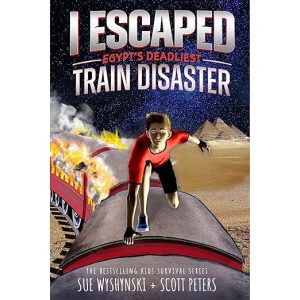
I came to this one already a fan of Scott Peters’ I Escaped series. The structural hook Peters uses, drop the reader into the most intense moment first, then backtrack to show how the protagonist arrived there, is borrowed from thriller fiction, and it works better in middle-grade adventure than most similar approaches because children respond directly to in medias res openings. The Egypt train disaster entry is the ninth title in a series that now stretches to nineteen adventures, and on the page it does everything the series formula promises.
On audio, there’s a problem that has nothing to do with the writing.
Virtual Voice narration is Audible’s AI-generated audio technology, and in most genres it produces something serviceable enough for informational or structured nonfiction content. For survival fiction that depends entirely on pacing and narrative tension, it is close to the worst possible match. The I Escaped series formula requires a narrator who can convey the difference between the calm exposition of backstory and the spiraling urgency of crisis. That modulation, the slight speeding of syllables when the train accelerates, the held-breath quality before a moment of danger, is what makes disaster fiction work as audio. Virtual Voice produces a consistent, measured, emotionally neutral delivery regardless of what the text is doing.
The Story Peters Built
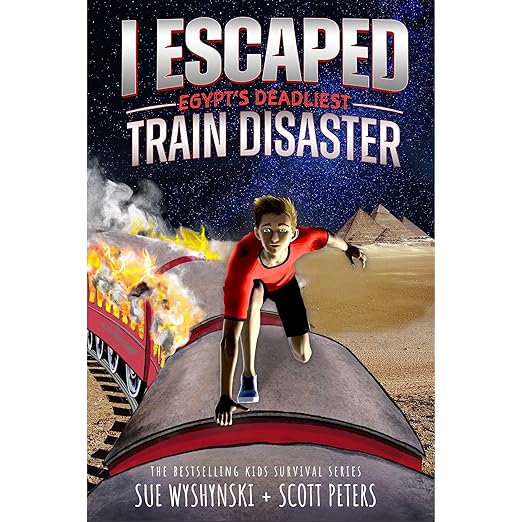
Fifteen-year-old Sam is an American kid visiting Egypt with his family when he boards a local passenger train for the tourist experience. Peters grounds the story in a real historical event, and the care he puts into historical reconstruction is evident from the Ancient Egypt fact section and the study guide available at his website. Reviewer Maria praised how the book “gave a good overview of Egyptian life” from Sam’s perspective alongside the survival narrative, and that texture is genuine. Peters doesn’t use Egypt merely as an exotic backdrop; he uses Sam’s language barrier and cultural unfamiliarity as story material.
The crisis mechanics are well-constructed. When a fire erupts in one of the cars and the train inexplicably accelerates rather than stopping, Sam is separated from his parents in a panicked, smoke-filled crowd where he doesn’t speak the language. The problem-solving that follows is age-appropriate without being condescending, and the Egyptian character Sam allies with gives the story a cross-cultural friendship that doesn’t feel imposed on the disaster plot.
The In Medias Res Formula and Where It Lands
Peters has been direct in his marketing about what differentiates I Escaped from Lauren Tarshis’s I Survived: the in medias res structure, the immediate action hook, and the integration of historical research that makes readers want to look things up after finishing. School Library Journal’s verdict, “A suspenseful survival series based on famous historical events. Excellent.”, applies specifically to the text, and the written series has a real following among the reluctant-reader audience that adventure-history crossovers tend to reach.
Reviewer TargaMan, noting this as their third book in the series, found the author’s attention to detail rewarding even approaching the historical event cold. That’s the series working as intended: using fiction to deliver history through emotional experience. The study guide and fact section at Peters’ website extend the educational component beyond the audiobook itself, a legitimate supplement for classroom or homeschool use.
The Narration Problem in Practical Terms
For parents or teachers considering this as a classroom audio resource, the Virtual Voice limitation matters more than it would for a home listener who can read along in print. In a classroom setting, the flat delivery will compete with children’s natural impulse to disengage during low-energy passages. For a child listening alone on headphones during a car trip, the story’s intrinsic momentum may carry them through despite the narration.
The print or e-book version of this series entry is a more reliable recommendation than the audiobook for this specific reason. If you’re committed to audio, the story’s inherent propulsion will do some of the work Virtual Voice can’t. But it’s not the best showcase for what Peters built.
Who Should Listen and Who Should Skip
Adventure readers ages eight to twelve who enjoy the I Survived series and want something structurally tighter will find the writing satisfying. Children who are particularly sensitive to narrator energy may struggle to stay engaged through Virtual Voice’s flat delivery. For classrooms or read-aloud contexts, the print version is the stronger choice. Existing I Escaped fans who have followed the series in print may find the audiobook useful for convenience, since they already know the formula and the story’s momentum will carry more weight for them.
Frequently Asked Questions
What is the real historical event this story is based on?
The novel draws on a real Egyptian train disaster, one of the deadliest rail accidents in the country’s history. Peters includes an Ancient Egypt fact section and a free study guide at scottpetersbooks.com for readers who want to explore the historical context further.
Is this a standalone story or does it require reading prior entries in the I Escaped series?
Each I Escaped title features a different protagonist and a different historical event, so they are completely standalone. This is the ninth entry in publication order, but there’s no story continuity that requires prior reading.
How does the I Escaped series differ structurally from Lauren Tarshis’s I Survived series?
The core structural difference is the opening hook: I Escaped drops you into the crisis at the very beginning, then backtracks to show how the character arrived in danger. I Survived tends to build to the disaster more gradually. Both use real historical events and fictional child protagonists, but the in medias res structure gives I Escaped a more immediate initial urgency.
Is Virtual Voice narration suitable for children who struggle to follow audio without strong vocal performance cues?
Probably not for this type of content. Virtual Voice delivers an emotionally neutral, consistently paced reading regardless of story tension. Children who need vocal variation in pacing and energy to stay engaged during crisis sequences will find the delivery flat. The print version is a better choice for those readers.