In Brief
- Themes: Nature soundscape, acoustic ecology, sleep and stress relief
- Mood: Still, oceanic, and genuinely restorative
- Verdict: Gordon Hempton's field-recorded Atlantic soundscape is a legitimate listening experience for anyone who needs the ocean and can't get there.
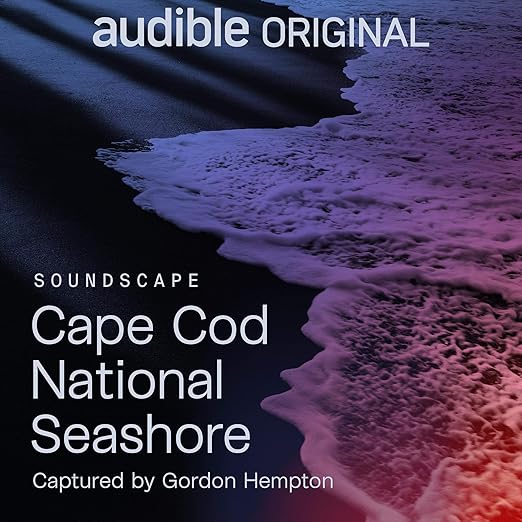
Gordon Hempton's Cape Cod National Seashore is not a narrated audiobook in any conventional sense. No narrator is credited, and none appears; this is a 54-minute acoustic experience consisting entirely of field recordings Hempton made at the Atlantic coast, produced to the same standard he applies throughout his career as a renowned acoustic ecologist. Hempton's mission has always been to preserve the world's endangered quiet places through sound, and the absence of a human narrator voice here is itself part of the design. The format is closer to a curated environmental recording than to a spoken-word production, which makes it a category exception worth explaining before discussing its qualities as a listening experience.
The Physical Specificity of an Actual Atlantic Wave
Hempton distinguishes his recordings from studio-produced nature sound collections in a way that is immediately apparent to anyone who has spent time with both. The waves on this recording have physical specificity: the way wet sand changes the texture of a retreating wave, the variation between sets, the ambient coastal wind that sits beneath the primary oceanic sounds without overwhelming them, the small acoustic signatures of the particular stretch of Atlantic coastline he chose to record. These are the sonic details that studio recreations consistently fail to capture, because they are generated by the physics of a particular place rather than assembled from individually recorded elements. Hempton traveled to Cape Cod to record this, and that presence in the landscape is audible in the result. Listeners who have spent time at the Cape itself will likely find the recording evocative in a specific way: this is not a generic ocean, it is that ocean, with its particular rhythms and tonal qualities.
The production notes position this as part of a sleep collection, created to support rest during difficult times. That framing is accurate but slightly limiting. The recording works as sleep audio for listeners who find ocean sounds genuinely calming, and the 54-minute length is practical for that use case. But it also works as a focused listening experience in its own right, as a way of spending an hour attending to natural sound with the same quality of attention you might bring to music. Hempton's recordings are made with professional field equipment and produced with care that rewards listening on good headphones or speakers rather than treating the audio as background noise. The clinical evidence for natural soundscapes in reducing physiological stress markers is substantial, and recordings at this fidelity level are better able to trigger those responses than compressed or synthetic equivalents.
One review describes missing a place by the ocean and finding this recording genuinely restorative. Another notes having used ocean recordings in a medical context, for the birth of a child, treating natural sound as a reliable relaxation aid even under conditions of significant physical stress. The specificity of these responses points to something real about how high-quality field recording functions differently from generic sound effects: the listener's nervous system responds to the detail in ways that don't require conscious recognition of what that detail consists of.
Fifty-Four Minutes Calibrated for Real Listening
Hempton's recordings carry the authority of a working acoustic ecologist who has spent decades attending to the sonic identity of specific places. His work has been recognized not just as beautiful but as scientifically valuable: he has documented soundscapes that no longer exist as he recorded them, making his archive a kind of acoustic conservation record. This background means that even within the specific brief of a sleep aid collection, Cape Cod National Seashore maintains the quality of attention that characterizes all of Hempton's work. He did not produce this as filler content for a wellness playlist. He applied the same methods he uses when documenting endangered acoustic environments, which is why the result sounds like a place rather than a product.
The 54-minute runtime reflects careful consideration of what the experience requires. Long enough to allow genuine settling and immersion, short enough that it doesn't become background wallpaper if the listener is using it as a focused session. For sleep purposes, looping is obviously possible, but as a single dedicated listening experience the length is exactly right for an extended meditation or rest period.
Pure Soundscape, With No Spoken Word at All
Listeners seeking narrated content, instructional audio, or storytelling will find nothing here. This is pure soundscape, and the value it offers is entirely dependent on whether the listener has a genuine use for ambient natural recordings. The absence of a narrator is a feature for those seeking immersive natural sound and a complete non-starter for anyone looking for spoken-word content. The recording was produced as part of a collection specifically aimed at sleep support, and that context should guide purchasing decisions. Listeners who already know they respond well to nature sounds for sleep or relaxation will find this a higher-quality version of something they already use. Listeners who are indifferent to natural soundscapes will find 54 minutes of Atlantic ocean sounds precisely as engaging as that description suggests.
Wellness Practitioners and Cape Cod Regulars Alike
Anyone who uses natural sounds for sleep, meditation, focused work, or stress relief will find this a higher-quality option than most easily available ocean soundscapes. Listeners who have an existing relationship with Cape Cod or the Atlantic coast will find the specificity of the recording genuinely evocative. Acoustic ecology enthusiasts who are familiar with Hempton's broader catalog will recognize the recording's quality immediately. Wellness practitioners who use soundscapes in therapeutic contexts will find Hempton's production values appropriate for professional settings. Anyone seeking narrated, instructional, or narrative audio content should look elsewhere entirely. This is not a substitute for a spoken-word audiobook; it is a distinct category of listening experience that serves a different purpose and a different kind of need.
Is there any spoken narration in this audiobook?
No. This is a pure field recording with no narration, instruction, or spoken content of any kind. Gordon Hempton recorded the sounds of the Atlantic at Cape Cod National Seashore, and the entire 54-minute experience consists of those environmental sounds. There is no credited narrator for this production.
What equipment or listening setup makes this experience better?
Good headphones or quality speakers improve the experience significantly. Hempton records with professional field equipment and produces to a high audio standard, meaning the textural details of the coastal soundscape are preserved at a resolution that basic earbuds may not fully convey.
How is this audiobook different from typical ocean sounds available as free audio online?
The primary difference is specificity and fidelity. Hempton travels to the location and records it as a unique acoustic environment rather than assembling studio elements. The result captures the particular physics of Cape Cod's coast, including wave variation, wet-sand textures, and ambient wind, in ways that generic ocean sound collections do not replicate.
Can this audiobook recording be used as a sleep aid on a loop throughout the night?
Yes. Many listeners use Hempton's recordings on a loop for extended sleep sessions. The 54-minute runtime is practical as a single session but works equally well looped, since the field recording's natural variation prevents the repetitive predictability that makes some looped nature sounds counterproductive for extended sleep.