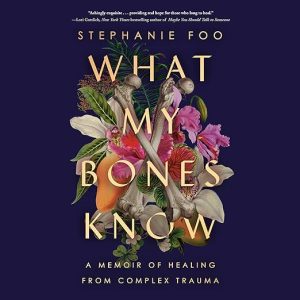
Radio is Stephanie Foo's trade, and it shapes this recording before a word of it plays. The copy introduces her as an award-winning producer at This American Life, and the narrator field on the audiobook names her rather than a hired reader, which means the person describing the mornings she spent sobbing at her desk is the same person who spent a career deciding how long a silence should run. What My Bones Know covers ten hours and two minutes for Random House Audio, released February 22, 2022. Its subject is complex PTSD, the kind that arrives not as an incident but as a decade.
Six ratings. That is the entire quantitative record behind a memoir the copy lists as a New York Times bestseller and a book of the year at The Washington Post, Cosmopolitan, NPR, Mashable, She Reads and Publishers Weekly. Six. And the badge sitting above them, 4.6, cannot be produced by six whole-star votes at all. Twenty-seven stars across six ratings averages 4.5. Twenty-eight averages 4.667, which displays as 4.7. Nothing lands between, because a pool of six moves in jumps of one sixth. The five graded responses visible here read five, five, four, five and five, so whichever value the sixth vote holds, the number printed above them does not follow from the ones underneath.
Five of those six votes carry written text, a saturation rate I almost never run into and the one genuinely useful property of a pool this small. The four-star account of March 26, 2023 is the most valuable of them. It comes from a therapist specializing in complex PTSD, calls the book well-researched, and then objects specifically to its handling of credentials, arguing that a doctorate does not make somebody a good therapist and that relational skill matters more than the diploma behind it. That is a specialist reading the book against the field it describes and finding one section wanting, which is a far more precise objection than any star rating can carry.
What Works
Nobody in this response column is listening. The May 10, 2024 account states it plainly: this reader went through the memoir obsessively across a thirty-six hour stretch after hearing Foo interviewed on a podcast, and calls it the best memoir and one of the best works of nonfiction encountered. That is a reader of pages. Scan the remaining four and the pattern holds, since not one of them describes the recording, its pacing, or what it is like to hear this material delivered in the author's own voice. On a self-narrated memoir about the physical residue of trauma, that is the largest gap in the evidence a buyer gets.
Here is why the self-narration carries more weight than usual. The book's method is investigative: Foo interviews scientists and psychologists, tries therapies, goes back to San Jose to look at what immigrant trauma does to a community, and travels to Malaysia to open family history her parents never explained. All of that is reported speech, other people's arguments, other people's evidence. Underneath it sits a first-person account of abandonment and abuse. A hired reader would have to perform the seam between those two registers; the author already has it, having lived one side and reported the other. The February 10, 2026 account credits the book with more help than twenty-plus years of therapy delivered, which is an enormous claim, and it is made about the writing rather than the reading.
Before You Commit to What My Bones Know
Difficulty is the obvious caveat, and the copy does not disguise it: years of physical and verbal abuse, neglect, both parents leaving while Foo was still a teenager. No content advisory is attached to the record, so the description is the only warning on offer. The January 24, 2026 account speaks directly to people who survived childhood attachment trauma by enduring and adapting, tells them they are not alone, and says the book shows what healing requires and what dropping the sword feels like. That is a recommendation and a caution in one breath. Ten hours of this material asks a lot of a listener carrying the same history, and audio takes away the ability to skim a paragraph you were not ready for.
Turn back to that counter, because it has a practical consequence. A February 2022 release from a major audio house, carrying six named year-end citations and a blurb from Lori Gottlieb, has accumulated six ratings. Four years of availability and six votes do not sit together comfortably, and the record gives no way to tell whether that reflects an edition split, a recently created listing, or a counting artifact. Whatever the cause, do not read 4.6 as a verdict on the book. Read it as a property of a page. The category filing points the same way: Health and Wellness, tagged Psychology and Mental Health, on a work that is half reported journalism and entirely a memoir.
Who It's For
If you carry childhood attachment trauma, or suspect that what you are carrying started before you did, this is the title in its category I would hand you first, and the September 8, 2025 account puts the reason well: it credits the writing with intellectual rigor, grace and feeling at once, three qualities that rarely survive together in one memoir. Listeners who want a treatment manual should adjust their expectations, because Foo is documenting one person's search rather than issuing guidance, and the record's own tagging oversells the self-help angle considerably.
Skip it if you want a clean recovery arc. The conclusion the copy quotes, that you do not move on from trauma but can learn to move with it, is honest and it is not tidy, and ten hours of arriving there involves a great deal of material that refuses to resolve. Buyers who need a settled ending will be happier somewhere else, and buyers who want a clinical overview of complex PTSD should understand that this is one reporter's case study, thoroughly researched and entirely personal. Treat the six-rating badge as noise and the book itself as the reason to be here.
At a Glance
- Voice: Stephanie Foo reads her own memoir, and the copy establishes her as a career radio producer, which makes the credit closer to a qualification than a casting choice.
- Big ideas: Complex PTSD as continuous rather than singular, inherited trauma inside an immigrant family, the distance between a functioning life and a well one
- Atmosphere: Unsparing, methodical, hopeful only on its own terms
- Worth it?: The book earns its reputation, and the six-rating badge attached to this listing tells you nothing about it in either direction.
Why does this audiobook show only six ratings for a New York Times bestseller?
Nothing on the record explains it. The copy lists six separate year-end citations and a February 2022 release from a major audio publisher, which does not square with a six-vote counter. Treat the badge as a property of this particular listing rather than a measure of how the book was received.
Does Stephanie Foo narrate the audiobook herself?
The narrator field names her, so yes. The description also establishes that she worked as an award-winning radio producer at This American Life before writing the book, which makes self-narration a professional decision rather than a budget one. No co-reader or additional cast is credited at all.