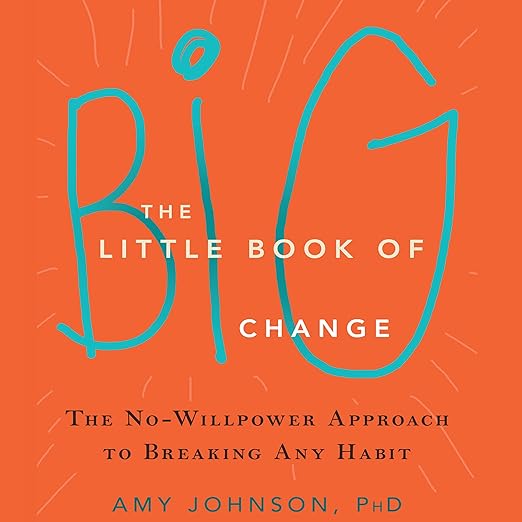
Amy Johnson's The Little Book of Big Change landed in my listening queue during a stretch when I had been absorbing a great deal of standard habit-change literature and grown tired of the willpower model. This audiobook presents something structurally different: a framework built on the premise that you are not your habits, that habits are impersonal brain-wiring problems rather than failures of character, and that the path out runs through understanding your thinking rather than controlling your behavior. At four hours and twenty-five minutes, it is a concentrated listen that does not outstay its welcome.
Johnson is a psychologist, and the neuroscience she draws on is presented accessibly without being dumbed down. The core argument is that anything done repeatedly forms neural circuitry in the brain, and that habits and addictions result from treating habitual thinking as truth and then acting on it. The shift she is proposing moves from an outside-in approach, where you address the behavior directly, to an inside-out one, where you understand the nature of thought itself. One reviewer described it as Amy Johnson helping you see what is really driving your behavior after years of feeling entirely at the mercy of habits.
The spirituality that Johnson incorporates alongside the neuroscience is handled lightly. She draws on principles from the Three Principles framework, which posits that human experience is created from within through thought rather than being a response to external circumstances. Some listeners will find this framing revelatory; others may find it slightly abstract in the early chapters before the practical applications come into focus. Another reviewer who works professionally in psychology described it as essential for the field, noting that it challenges some mainstream mental health assumptions in productive ways and reminds practitioners of their clients' innate wellness.
The audiobook's shorter runtime means Johnson moves fairly quickly between the conceptual underpinnings and the practical guidance. Listeners who need more time with the neuroscience before accepting the framework may want to pause and reflect rather than listening in one continuous session. This is material that rewards slow absorption rather than cover-to-cover speed.
What Works
Kathleen Mary Carthy's narration is a significant asset for this particular material. Habit-change audiobooks often suffer from narrators who pitch their delivery at motivational-speaker intensity, which can feel at odds with content designed to reduce anxiety and increase self-compassion. Carthy takes the opposite approach: calm, clear, with a conversational warmth that does not perform enthusiasm. Her pacing gives the listener space to absorb each concept before the next one arrives. For a book that is fundamentally arguing you should stop fighting yourself, that measured delivery is more than appropriate. It models the approach the text is recommending.
The specific population who will find this most useful are listeners who have tried willpower-based habit change repeatedly and found it ultimately unsustainable. Johnson explicitly addresses this: if you have tried to quit something through sheer discipline and found yourself back at the starting point six months later, she is not offering more of the same. The framework she builds is about changing your relationship to thought rather than your relationship to behavior, and that is a meaningful distinction. Several reviewers with professional backgrounds described the shift as one that opened a door most habit-change literature never locates.
Things to Know Before Starting The Little Book of Big Change
The brevity that makes this audiobook accessible is also its primary limitation. At under four and a half hours, Johnson is necessarily working at a level of abstraction in places. Listeners dealing with severe addiction or deeply entrenched psychological patterns may find the book opens a door without fully walking them through it. It is probably best understood as a framework introduction rather than a complete treatment protocol. Johnson is pointing toward a way of seeing rather than providing a step-by-step behavioral intervention.
The combination of neuroscience and what Johnson calls spirituality is genuinely unusual in the habit-change genre, and it accounts for both the book's most enthusiastic reviews and its occasional criticisms. One listener described the experience as having spent years addressing behavior from the outside in, only to discover that understanding the nature of thought was the key they had been missing. Another, with a more skeptical orientation, found the spiritual dimension less convincing than the neuroscience. Knowing which camp you are in will help you calibrate your expectations before pressing play.
It is worth noting what Johnson is not doing. She is not asking you to white-knuckle your way through cravings. She is not offering a 30-day challenge or a points system. The framework is subtler than that: she is asking you to notice the nature of thought itself, to see that the urge to act on a habit is just thinking, and that thinking passes if you do not engage it as instruction. For listeners who have always experienced their habits as somehow stronger than their will, that reframing is either obvious or transformative, and which one it turns out to be tells you something important about your own relationship to the willpower model. Carthy's narration creates the right quiet space to sit with that question.
Who It's For
This audiobook suits anyone who has cycled through conventional habit-change approaches and found them ineffective over the long term. Listeners open to a framework that combines cognitive neuroscience with contemplative insight will find Johnson's argument genuinely fresh. Those expecting a step-by-step behavioral program with specific daily exercises will likely want to supplement this with more structured material. Mental health professionals looking for a different conceptual lens on habit and addiction will find it a worthwhile four hours, regardless of whether they adopt the Three Principles framework wholesale.
Key Details
- Read by: Kathleen Mary Carthy brings a calm, unhurried authority to the material that reinforces the book's message without tipping into self-help earnestness.
- At its heart: Habit rewiring, neuroscience of behavior, inner wisdom over willpower
- Vibe: Supportive and quietly revolutionary, with a sense of genuine relief
- Short version: Amy Johnson's framework is genuinely different from standard habit-change literature, and Carthy's narration makes the four-hour runtime feel like the right length for what the book is attempting.
Is this audiobook appropriate for someone dealing with serious addiction rather than mild habits?
Johnson's framework applies to habits and addictions across a spectrum, but the book is conceptual rather than clinical. Those dealing with severe substance dependence or other serious addictions should treat this as a complementary perspective rather than a substitute for professional support.
How does this audiobook differ from standard willpower-based habit-change books?
Johnson explicitly rejects the willpower model. Her argument is that habits are impersonal brain-wiring events that result from treating habitual thought as truth, and that the path to change runs through understanding thought itself rather than exerting control over behavior. That inside-out reorientation is the book's central departure from mainstream habit-change literature.
At four hours and twenty-five minutes, does the audiobook feel rushed or complete?
Most reviewers found the length appropriate for the material. Johnson is introducing a framework rather than exhaustively cataloguing every possible application, and Carthy's calm narration pacing makes the runtime feel considered rather than compressed.