
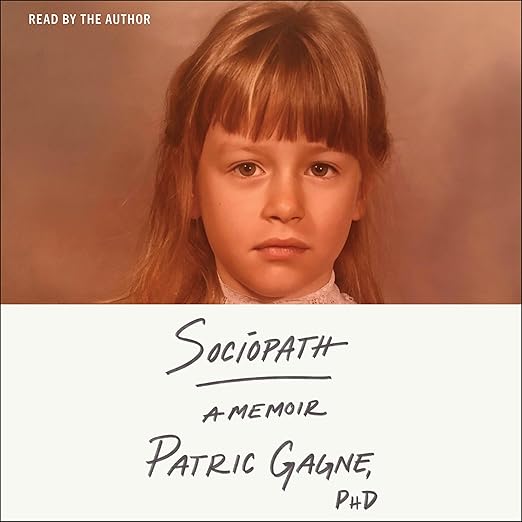
I listened to Patric Gagne's memoir over three days, and I spent most of that time in the particular state of alertness that good nonfiction provokes: agreeing and then reconsidering, finding a framework useful and then noticing its edges. Sociopath is a memoir about growing up knowing you experience emotions differently from the people around you, about finding a clinical diagnosis for that difference, and about constructing a life, marriage, parenthood, quasi-normal social function, around an awareness that what most people feel automatically, Gagne has to approximate through deliberate behavior. It is also, quietly, a book about the limitations of self-knowledge.
Gagne knew before kindergarten that she made others uncomfortable. Fear, guilt, empathy, these were not present in her in the way they were in others. What she felt instead of the nothing she usually experienced was a kind of restless pressure that, she discovered, could be released through theft and other transgressive behaviors. In college she received a diagnosis: sociopathy, a personality disorder that had been neglected by mental health professionals for decades, with no established treatment and, she was told, no path to a normal life. The memoir follows her decision to disprove that prognosis.
Loving David Without Feeling It First
The book's central argument, that sociopaths are not the predatory monsters of true crime mythology, but people with a specific emotional deficit who can build functional, even loving lives, is made compellingly and with genuine evidence. Gagne's description of her relationship with her husband David, who understood her diagnosis before committing to her and whose love she reciprocates through behavior rather than feeling, is genuinely moving. One reviewer astutely described the book as having "attributes of good fiction", a complex character who evolves and is not always consistent, rich in incident. That is high praise for memoir.
Gagne's Flat Delivery Matches Her Flat Affect
Gagne reading her own work is both the most interesting and most complicated aspect of the audio version. Her delivery is measured, slightly flat in emotional register, which could be read as appropriate self-presentation for a narrator describing her own limited affect, or as simply a performance style. Either way, the absence of conventional memoir warmth is a feature here rather than a problem: the voice matches the content. Reviewers consistently describe being "riveted" by the book, and the self-narration contributes to that quality of attention. You are listening to someone describe their own psychology in real time, and Gagne is intelligent enough to make the telling interesting.
Privilege Explains What the Memoir Leaves Out
One extended reviewer note is worth engaging with seriously: Gagne's memoir is necessarily selective. Her self-awareness about her own privilege, she acknowledges explicitly that her intelligence and circumstances shaped outcomes that would not be available to most people with her diagnosis, is present but feels inadequate as a counterweight to the book's optimistic framing. A reviewer in Japan gestured at this obliquely; another noted that the same intelligence and "external beauty" that enabled her partnerships are not universally distributed. The memoir is honest about what Gagne did and what it cost her, but it is more selective about what she may not fully understand about her own impact on others. That does not make it less valuable; it makes it a memoir rather than a clinical account, which is what it sets out to be.
Curious Readers Welcome, Clinical Textbooks Elsewhere
This memoir is for readers who are interested in psychology and personality disorders without wanting a clinical textbook, and for anyone who has carried assumptions about sociopathy from true crime or fictional villains and is willing to have them complicated. Mental health professionals will likely find it useful precisely because of how it describes the experiential gap between diagnosis and daily life. Readers who prefer memoirs with conventional emotional warmth may find Gagne's affect challenging to connect with; that is by design. Anyone who wants the full diagnostic picture rather than one person's account should read it alongside clinical literature rather than treating it as authoritative on its own.
- Voice: Patric Gagne reading her own memoir is an unusual and effective choice, the flat affective quality in her delivery is either very deliberate or a genuine expression of her diagnosis, and either way it serves the material.
- Big ideas: the gap between clinical diagnosis and lived experience, the construction of a self around an emotional deficit, love as behavioral discipline rather than feeling
- Atmosphere: Candid and unsettling, with unexpected moments of dark humor
- Worth it?: A memoir that dismantles the pop-culture sociopath mythology with precision and honesty, though some questions about its selective framing are worth holding alongside your admiration.
Does Patric Gagne's self-narration feel authentic given her diagnosis, or does it distract from the listening experience?
Most listeners find it adds an unusual dimension to the memoir. Her measured, somewhat flat delivery can feel like evidence of the diagnosis she is describing, which creates an interesting feedback loop for the listener. It is different from conventional memoir narration and will not suit everyone, but it is not a distraction so much as an additional layer of meaning.
Does the book engage with the clinical literature on sociopathy or is it purely personal narrative?
Both. Gagne researches her own diagnosis and engages with clinicians, therapists, and researchers throughout the memoir. The clinical engagement is woven into personal narrative rather than presented separately, but it is substantive. The book's framing of sociopathy as akin to an emotional learning disability draws on actual psychological frameworks she encountered.
Is this a safe read for survivors of people who may have been sociopathic or exhibited similar traits?
This is worth considering carefully. Gagne's memoir is sympathetic to the sociopathic experience by design, and while she is honest about the harm her behaviors caused, the book is ultimately an argument for understanding rather than accountability. Readers who have been significantly harmed by someone with similar traits should approach with awareness of the book's perspective.







