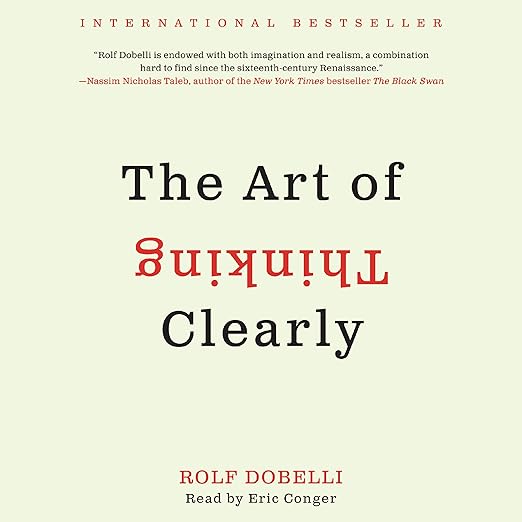
Rolf Dobelli's The Art of Thinking Clearly arrived in my listening queue at exactly the right moment, the audiobook version clocking in just under eight hours, short enough to finish across a few evenings but dense enough to keep a notebook nearby. I had been making a series of decisions at work that I could feel were colored by something irrational, something I couldn't name. Dobelli names it. He names ninety-nine things, actually, and that specificity is both the book's greatest strength and its occasional limitation.
The premise is disarmingly simple: human beings are not rational actors. Psychologists have known this since the 1960s, and behavioral economists have spent decades building the empirical case. What Dobelli does is compress that sprawling literature into a digestible field guide. From survivorship bias to the halo effect, from social proof to the narrative fallacy, each chapter runs roughly four to six minutes in audio and presents one bias, one or two illustrative examples, and a practical takeaway. The format suits the audiobook medium better than most non-fiction in this genre, you can absorb a chapter, sit with it, and come back.
Dobelli opens with a provocation embedded in the synopsis: three out of four appearances at the plate result in an out, so why do we doubt our skills? He is writing about baseball hitters, but the question applies everywhere. The book's organizing argument is that irrationality is not a personal failing but a structural feature of the human brain, shaped by evolutionary pressures that no longer match our environment. Knowing that doesn't fix the problem, but it changes the relationship to it. Once you can name the sunk cost fallacy, the reason you stayed in a bad movie, the relationship that had run its course, the investment you kept doubling down on, you gain at least a fighting chance to interrupt the pattern.
What makes this audiobook stand out from the crowded shelf of behavioral economics books is the breadth of application. Dobelli is equally comfortable in the boardroom and the personal. He discusses why you shouldn't accept a free drink (reciprocity bias), why watching the news may actively harm your decision-making, and why the most successful people you know are often not the most talented, just the ones who survived a volatile selection process. Each insight lands cleanly, without the academic throat-clearing that bogs down longer treatments of the same material.
Conger Reads Rather Than Lectures
Eric Conger's narration is a genuine asset here. The ninety-nine chapters could easily blur into an indistinct catalog of errors, but Conger maintains a steady, slightly conversational register that differentiates each section. He does not over-perform, he reads rather than lectures, which respects the listener's intelligence. For material this conceptually varied, that restraint matters. A more theatrical narrator might have made the shorter chapters feel like listicle items; Conger gives each one a sense of weight.
The audio format also suits the book's episodic structure better than the print version. In print, the temptation is to skim; in audio, each chapter demands at least minimal attention. Dobelli's examples, the eBay auction overbid, the stock sold too late, the credit taken for success while blame is externalized, are vivid enough that they stick in the ear rather than sliding off the page. One reviewer compared this to Wikipedia's cognitive bias list, which is fair in scope but undersells the editorial work. Dobelli has curated, not compiled, and the sequencing of ideas rewards sustained listening.
Subtracting Cunning Instead of Adding Tools
The book is not without friction points. Some reviewers note that the examples can feel culturally specific or dated. Dobelli's background is that of a novelist and entrepreneur, and occasionally the business-world framing dominates in ways that reduce the universality he claims. A few of the ninety-nine chapters are more robust than others, the sections on social proof and on the narrative fallacy are genuinely illuminating, while a handful of the later chapters retread territory covered earlier with diminishing returns.
The synopsis promises that the book will help with everything from personal problems to business negotiations, saving money, earning profits, and working out what you really want in life. That is a broad claim, and the audiobook delivers on most of it, though not evenly. The psychological coverage is solid; the financial applications are suggestive rather than operational. Listeners hoping for specific investment guidance will want to supplement with more targeted material. Listeners who simply want to understand why they keep making the same kinds of mistakes will find the listen genuinely useful.
Dobelli's core thesis, that we need less irrationality rather than more cunning, new gadgets, or frantic productivity, is quietly radical in a self-help market that usually promises to add something rather than subtract something. That inversion gives the book an intellectual integrity that the genre does not always reward. It is a harder sell: the path to better decisions runs through recognizing your own blind spots, not acquiring new tools. But the argument holds up.
Denser than Gladwell, Lighter than Kahneman
This audiobook rewards anyone who makes decisions under uncertainty, which is to say, everyone. It is especially well-suited to listeners who have read Kahneman's Thinking, Fast and Slow and found it too dense, or who have read Malcolm Gladwell and found it too anecdotal. Dobelli occupies the middle ground: rigorous enough to be trustworthy, accessible enough to be genuinely pleasurable to listen to. Listeners looking for a long-form narrative or a single sustained argument may find the chapter-a-minute structure frustrating. But for those who want a working vocabulary for the ways human minds routinely fail, the approximately eight hours here are time well spent.