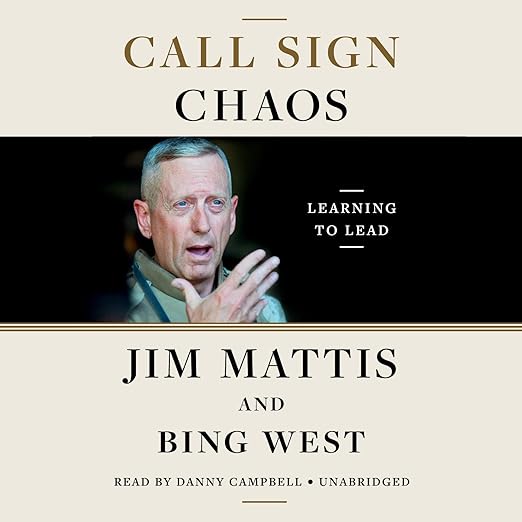
Bing West's name appears in the first sentence of the description, in two of the five reader responses, and nowhere on the byline of this audiobook. The copy is unambiguous: the book is by General Jim Mattis and Bing West, a former assistant secretary of defense and combat Marine. Readers treat the collaboration as a fact about the reading experience, one of them crediting West with a style that is easy to follow and moves quickly. The catalog credits a single author. Whoever you think did the writing, a co-author who shows up in the publisher's own first line and in the reviews should not vanish from the field that names who made the book.
Publisher Copy and a Reader Account Match in Order
Jim Mattis rose from Marine recruit to four-star general, commanded a quarter of a million troops across the Middle East, and finished as Secretary of Defense. Twelve hours and one minute of Random House Audio cover that arc, though the book is not especially interested in the arc as such. It is interested in what each rung taught, and it says so structurally: the memoir is a delivery system for a theory of command, with the biography supplying evidence rather than the other way around.
Three parts do the organizing, and both the description and one of the responses name them in the same order: Direct Leadership, Executive Leadership, Strategic Leadership. The first covers leading Marines into battle while knowing them as well as your own brothers. The second is about commanding thousands, and about making intent clear enough that the most junior troops can own the mission without being told how. The third is the hardest and the most abstract, where military leaders have to square the grim arithmetic of war with what political leaders hope for. Publisher copy and reader account describing the same object in the same order is rarer than it should be, and it suggests the structure genuinely holds on the page.
Seven people have rated the title, and those seven votes total 33 of a possible 35, which puts the book two stars short of a clean sweep. Five have written, four of them at the top mark and one at four stars. That is a small sample producing an unusually stable picture: everybody agrees this is worth reading, and the only argument concerns what it declines to say. None of the seven raters explains a score, so the missing pair of stars stays anonymous.
Nobody Mentions the Reading That Replaced His Voice
Leadership, not combat, is the actual product, and the responses converge on that reading from several directions. One calls it a combination of leadership advice and enjoyable narrative. Another argues the principles are applicable to any field of endeavor despite arriving in Marine Corps packaging, which is exactly the claim the third part of the book makes for itself. Anybody who manages people and has been handed one too many airport-bookstore management texts will find this a considerably harder-edged version of the same conversation.
Julia came to it with no military experience at all, bought it to self-educate, and produced the most detailed response in the column. What impressed was the decentralized leadership style, the clarity of intent, and a commitment to instilling humanity in troops all the way down to the lowest rank. That is a civilian reader locating the transferable part without any help from the publisher's framing, and it is the single best argument on this page for a non-military listener to spend twelve hours here.
Danny Campbell handles the reading, and the choice is more interesting than the page lets on. Mattis is a figure known largely through the way he talks: the call sign in the title, the aphorisms, a clipped delivery quoted for years. Handing that voice to a professional reader rather than to its owner is a genuine trade, steadiness bought at the cost of the thing that made the source famous. Five people wrote paragraphs about this book and not one of them mentions the reading, which leaves the most format-specific question on the page unanswered.
The Collaborator Whose Name the Catalog Dropped
Writing at four stars, S Lux files the only reservation, and it is aimed at what the book withholds. The response argues that Mattis shows clearly how much damage came from an absent strategy in the Middle East over two decades, while deliberately avoiding direct criticism of Bush or Obama by name. The underlying message, on this reading, is that the military cannot compensate for political leaders who never define the end state. Whether that restraint is discipline or evasion is the one live question about the book, and exactly one reader on this page raises it.
Trump appears nowhere in the description, and that gap will matter to some buyers. One reader, writing from Japan, recommends the book specifically to anyone curious about why Mattis lost faith with that administration, and argues it shows why he could never have been an unquestioning follower. The publisher's copy promises no such thing: it promises three wars, three levels of command, and a warning about short-sighted strategic thinking. A response is steering readers toward a payoff the description does not offer.
Two responses credit Bing West with the prose, which cuts both ways. It suggests the sentences move well, and it also suggests that the voice you are hearing for twelve hours has been shaped by a collaborator whose name the catalog dropped. For a memoir, whose entire value proposition is a particular person telling you what happened to them, that is not a trivial piece of missing metadata. The description is honest about it. The byline is not.
Not the General Delivering His Own Aphorisms
Officers, managers, and anyone responsible for people they cannot directly supervise are the natural audience, and the column includes exactly those readers reporting exactly that use. It also works for listeners who want a first-hand account of Iraq and the wider region from someone who commanded there, and for readers of leadership nonfiction who prefer their principles attached to consequences. Twelve hours is a moderate commitment for a book with this much structure to it.
Readers hoping for score-settling or for the resignation letter should recalibrate: the book was built as a leadership text and behaves like one, and the closest thing to score-settling is a careful argument about strategic drift with no names attached. Anyone who wanted the general delivering his own aphorisms will simply not get that on this recording. Leadership readers get more than they came for, and anyone here for the final chapter of that career will find the book ends well before it starts.
Quick Take
- Narrator: Danny Campbell stands in for a general whose clipped delivery is a large part of his public reputation, and the twelve-hour recording goes unmentioned by every reader who wrote in.
- Subjects: command at three scales, allies and coalitions, strategy against tactics, the limits of what force can fix
- Tone: Clipped, unsentimental and instructional
- Bottom line: A leadership manual wearing a memoir's jacket, and stronger at the manual half than the memoir half.
Who narrates the Call Sign Chaos audiobook?
Danny Campbell, across twelve hours and one minute for Random House Audio, published September 3, 2019. Mattis does not read it. Anyone hoping to hear the general deliver his own aphorisms should know in advance that the delivery on this recording is Campbell's work and not the general's own.
Does the audiobook cover the resignation from the Trump administration?
The description says nothing about it, promising instead three wars, three levels of command and a critique of short-sighted strategy. One reader nonetheless recommends the book to anyone curious about that break. Buy it for the leadership material and treat any light it sheds on later events as incidental rather than promised.
Is it worth reading for someone with no military background?
The most detailed response in the column comes from exactly such a reader, who bought it to self-educate and came away impressed by the decentralized command style and the insistence on clear intent. Another argues the principles transfer to any field. The Marine Corps vocabulary is heavy but never becomes a barrier.