Key Details
- Narrator: John N Gully gives the twenty-hour testimony appropriate weight without calling attention to his narration, which is precisely what firsthand war memoir requires to work.
- Subjects: Survival, faith as a framework for what cannot otherwise be explained, the psychological cost of becoming someone who can endure combat, and the burden of coming home.
- Tone: Serious, personal, and unrhetorical, the tone of testimony rather than literature.
- Bottom line: A long but genuine Vietnam War memoir that earns its runtime through the seriousness with which it engages what one man survived and why.
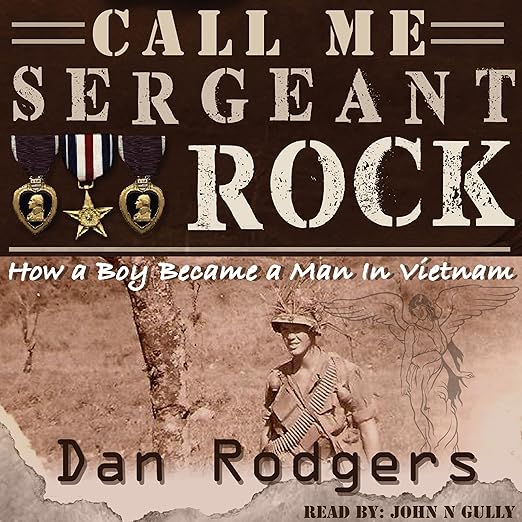
Dan Rodgers's Vietnam War memoir earns its central question in its opening pages: how much can a mind take before it cracks? Sergeant Rock, as his men called him, survived what he frames as survivable only through divine intervention, and this audiobook narrated by John N Gully renders nearly twenty hours of that account with the gravity and patience such a testimony demands. It is a long listen, but Vietnam War memoirs that carry this level of personal reckoning rarely resolve quickly or cleanly.
The Psychological Cost of Becoming Harder
Rodgers writes from inside the experience rather than from the retrospective distance that memoir often provides as a protective measure. The account does not smooth the confusion and violence of Vietnam into a coherent narrative after the fact. It renders them as they were experienced: by a young man who was shaped by the military and by combat into someone who survived by becoming harder than he had any reason to want to become. The psychological cost of that becoming is the book's deepest and most persistent subject.
The faith dimension is present throughout. Rodgers attributes his survival not only to the practical factors of luck, skill, and the actions of the men around him but to something he understands as divine care for his life in moments when no human explanation fully accounts for what happened. This is not a religious tract; it is a sincere personal testimony from a man trying to make sense of why he came home when others did not. Readers who share that theological framework will find it deeply resonant. Readers who do not will find it honest without being imposed on them.
The memoir covers not just combat but the entire experience of being a young American soldier in Vietnam: the training, the unit dynamics, the particular quality of fear that sustained jungle warfare produces, the distorting effect of violence on moral perception over time. Rodgers does not glamorize what he went through. He accounts for it as truthfully as he can, which includes accounting for things he is not entirely proud of in retrospect and cannot fully explain.
Gully's Narration Doesn't Call Attention to Itself
John N Gully's narration gives the memoir an appropriate vocal weight. Vietnam War testimony carries a particular kind of emotional gravity that requires a narrator who can hold the material without either flattening it into recitation or making it feel performed for an audience. Gully handles the long runtime, nearly twenty hours, with consistency and commitment. The narration does not call attention to itself, which is exactly what this kind of firsthand account needs to work as a sustained listening experience.
The audiobook format suits memoirs of this kind particularly well. Reading about combat experience silently can create a cognitive distance that listening sometimes reduces. Gully's voice serves as a mediation between the experience Rodgers is recounting and the listener trying to understand it from a remove, and at its best the narration makes the account feel immediate in the way that the best oral history achieves.
For listeners who have read Tim O'Brien's The Things They Carried or Karl Marlantes's Matterhorn and want a firsthand account alongside those literary treatments of the Vietnam War, Call Me Sergeant Rock provides testimony that is less literary but more direct. It does not have O'Brien's metafictional self-consciousness. It has the rougher authenticity of a man who was there and is doing his honest best to say what that was like.
Nearly Twenty Hours at the Upper End of Memoir
The synopsis available is brief, and the memoir works from a limited public profile. Listeners should know that this is a long audiobook, nearly twenty hours, which is at the upper end for personal memoir. The extended length suggests that Rodgers gives his account room to develop in ways that shorter memoirs compress for accessibility. Whether that length feels earned will depend on a listener's appetite for the sustained, detailed rendering of personal combat experience over a condensed narrative arc.
The faith-based framing of Rodgers's survival is present throughout the narrative and returns consistently rather than appearing only at the conclusion. The memoir does not impose a theological conclusion on readers, but it does return to this dimension as part of how Rodgers understands and recounts what happened to him. It functions as part of the narrative fabric rather than as an addendum to the main story.
The available reviews are limited and personal, including one from someone who knew the book's subject from high school, which suggests the memoir has found an engaged audience among people with direct connection to its world and its era. Listeners coming to it without that connection will approach it as a Vietnam War account among many others, which is a legitimate and rewarding way to engage with it.
Firsthand Testimony Alongside the More Famous Accounts
Primarily suited for listeners with an interest in Vietnam War personal memoir and for those who want firsthand testimony alongside or after reading the more famous literary accounts of the war. Also recommended for readers drawn to memoir that engages seriously with questions of faith, survival, and what combat does to a person's relationship with their own moral life over years of reflection.
At nearly twenty hours, this is a commitment best made by listeners who have found Vietnam War memoir meaningful and want more sustained engagement with a firsthand account than shorter books provide. John N Gully's narration makes the commitment manageable and consistent throughout. For listeners who respect personal testimony and can follow a long, detailed account of one man's experience of a war that still shapes American culture in ways we continue to reckon with, Call Me Sergeant Rock offers something that shorter and more polished accounts do not.
Questions Listeners Ask
Is this audiobook suitable for listeners who have not read other Vietnam War memoirs?
Yes, though context from other accounts of the Vietnam War enriches the experience. Call Me Sergeant Rock does not assume specialist knowledge and listeners coming to the subject for the first time will follow the personal account without difficulty.
How does the faith-based framing in this audiobook affect the overall narrative?
Rodgers consistently attributes his survival to divine intervention alongside practical factors. The religious dimension is genuine and present throughout rather than confined to a concluding reflection, making it part of how the entire memoir understands and interprets events.
Is nineteen hours the right length for this audiobook or does it feel padded?
Vietnam War memoir of this kind benefits from room to develop. The length suggests Rodgers does not compress or select only for the most dramatic moments but accounts for the full arc of his experience. Whether this feels right depends on your appetite for sustained personal testimony.
How does this audiobook compare to other Vietnam War memoirs like The Things They Carried?
Tim O'Brien's work is literary fiction drawing on Vietnam experience with self-conscious craft and metafictional design. Call Me Sergeant Rock is direct personal testimony without that literary mediation. Rodgers gives you what one man remembers and believes, without artistic shaping. Both are worth listening to for different reasons and with different expectations.