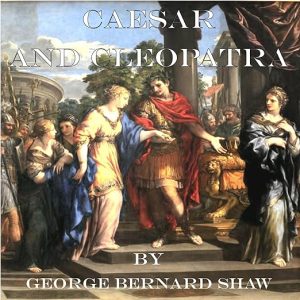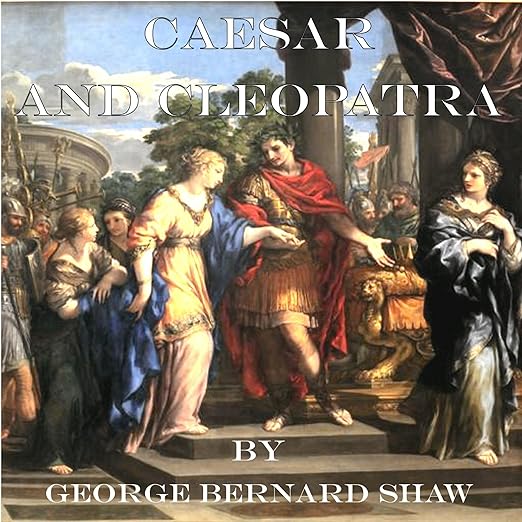
Caesar meets a frightened teenager hiding at the foot of the Sphinx, not yet aware she is Egypt's queen, and the encounter sets the tone for everything George Bernard Shaw does differently with these two historical figures than Shakespeare did centuries earlier. The listing's own description catches the tone well: Caesar as 'a self-doubting cynic' in the middle of a midlife crisis, Cleopatra as 'an imperious and impertinent child on the threshold of womanhood.' Both characterizations land as more comic and more human in this audiobook than the marble-statue version most listeners expect walking in.
Political Education, Set During the Real Alexandrian War
Caesar and Cleopatra belongs to Shaw's Three Plays for Puritans, a grouping he assembled specifically to needle Victorian theatrical conventions, and the play's real subject is less the historical romance most listeners expect and more a study of political mentorship across a steep generational gap. Caesar spends most of the play teaching Cleopatra how power actually works rather than falling into the romantic entanglement the title alone might suggest.
This recording includes Shaw's alternate Prologue along with his post-text notes, both genuinely useful additions rather than scholarly padding. More than one reviewer notes that Shaw's own notes clarify his actual intentions more directly than the play text alone manages, which makes their inclusion here a real value-add for anyone trying to understand what Shaw was actually arguing for.
Reviewer Walter Stanley offers a sharp reframing worth sitting with, describing Caesar as 'the last bastion of democracy in ancient Rome,' a very different image from the imperial ambition audiences typically bring to the character. That is a genuinely Shavian inversion, using a familiar historical figure to argue a specific, contrarian political point rather than simply dramatizing known events.
Shaw remains the only person in history to win both a Nobel Prize in Literature and an Academy Award, the latter for his own screenplay adaptation of Pygmalion, and that dual legacy, serious literary laureate and populist entertainer capable of writing a genuine hit, sits right at the center of what makes Caesar and Cleopatra work as well as it does: real political and philosophical substance delivered through what is, structurally, a very funny play.
The play is set during the real 48 BC Alexandrian War, when Caesar pursued his rival Pompey into Egypt only to find him already assassinated by agents of the Egyptian court, and found himself drawn into a succession dispute between the teenage Cleopatra and her brother Ptolemy XIII. Shaw takes real liberties with chronology and characterization from that history, openly and by design, rather than attempting a documentary account of those events.
Schraf Turns Shaw's Kitten Into an Empress
Kimberly Schraf handles Shaw's ironic theatrical register well, catching the specific dry wit that makes Shaw's dialogue land as satire rather than straight historical drama. That tonal precision matters enormously for a playwright whose entire method depends on the audience catching irony the characters themselves may not.
Shaw is famous for extraordinarily detailed stage directions and descriptive passages that function almost as prose narration in their own right, and a solo audiobook narrator is well positioned to deliver that material with the same authority as the dialogue itself, something a full-cast dramatization would have to handle more awkwardly through a separate narrator role.
Reviewer Joan Scheuer's account confirms Shaw clearly relished writing this particular version of 'the Roman conquest of Egypt,' picturing Cleopatra as 'an irrepressible kitten' who matures into a genuinely formidable empress by the play's end. That character arc, callow to commanding, gives Schraf real range to work with across a relatively compact four-and-a-half-hour runtime.
Shaw was notorious for prefaces and stage directions that sometimes ran longer and argued harder than the plays themselves, treating the printed page as an extension of his argument rather than mere staging instructions, and this recording's inclusion of his post-text notes specifically continues that same instinct into the audio format: Shaw explaining, in his own words, exactly what he was trying to accomplish.
A 4.0 rating from 121 ratings is a solid, respectable result for a play this old, written in dense, unmodernized Edwardian English rather than any updated adaptation, and it suggests Shaw's wit continues to land for a contemporary audience willing to meet the language on its own terms rather than requiring a more accessible retelling.
Single Narrator Against a Full-Cast Shakespeare
This is a single-narrator recording, which means real trade-offs against a full-cast dramatization: the interpretive vision stays unified and intimate throughout, but the crackling scene-partner energy that live back-and-forth casting brings to Shaw's fast, witty exchanges is necessarily reduced to one performer carrying every voice.
Reviewer Delta D. offers the most direct dissent among the attached reviews, calling the play comparatively lightweight and stating a clear preference for Shakespeare's dramatization of the same general period of Roman history. That is a legitimate, specific critique rather than a vague complaint, and listeners who already know they prefer Shakespeare's tragic register should weigh it seriously.
The play is not attempting historical accuracy, and Walter Stanley's review says so plainly: Shaw's intention was presenting his own perspective on these two personalities rather than a documentary account of 48 BC. Listeners wanting a rigorously accurate history lesson should look elsewhere; listeners wanting a smart, revisionist character study are exactly the right audience.
At four hours and thirty-seven minutes, this is a genuinely brisk listen compared to a full Shakespeare tragedy covering similar historical ground, and that compression is a real feature for listeners who want the wit and the ideas without the multi-day commitment a longer historical epic demands, though it also means less room for the kind of extended battle sequences or crowd scenes a more conventionally epic treatment might include.
The listing's own tag, filed under language and grammar rather than drama or classic literature, is an odd categorization worth a brief mention; this is squarely a play, not a language-instruction product, and browsing by that tag risks missing the title entirely.
Comic Shaw for Listeners Who Know Shakespeare's Rome
Fans of Shaw's dry wit and anyone who enjoys classic drama in audio form will find this a fast, rewarding listen, especially compared to the length commitment a Shakespeare tragedy or a full historical biography would require.
Listeners who already know Shakespeare's Roman plays and want a genuinely contrasting take on the same historical figures, comic and revisionist rather than tragic and grand, will get real value from hearing Shaw's version specifically as a companion piece.
Listeners newer to Shaw generally, not just to this specific play, will find Caesar and Cleopatra a genuinely accessible entry point into his wider body of work, more approachable than some of his denser political tracts while still carrying real argumentative substance underneath the comedy.
Skip it if strict historical accuracy matters to you more than interpretive wit, or if you specifically want the ensemble energy of a full-cast production; Delta D.'s preference for Shakespeare's treatment is a reasonable signpost for listeners who share that same taste for tragic grandeur over comic irony.
- Read by: Kimberly Schraf handles Shaw's ironic theatrical register well, though a single narrator can't fully replicate a full-cast dynamic.
- At its heart: power and political mentorship, vanity and self-doubt, Shaw's revisionist history
- Vibe: Witty and dryly comic
- Short version: A sharp, fast alternative to Shakespeare's Roman plays for listeners who want Shaw's ironic take on Caesar and Cleopatra.
Frequently Asked Questions
Is this audiobook a full-cast dramatization or a single narrator?
Single narrator. Kimberly Schraf voices the entire play herself, which trades the full-cast theatrical dynamic for a more unified, intimate interpretive read.
Does this audiobook include Shaw's Prologue and notes, or just the play itself?
Both. This recording includes Shaw's alternate Prologue along with his post-text notes, which several reviewers say clarify his intentions more than the play text alone does.
Is this audiobook historically accurate?
Not strictly, and it isn't trying to be. Shaw prioritized his own interpretation of Caesar and Cleopatra's personalities over documentary accuracy, so treat it as revisionist character drama rather than a history lesson.
How does this audiobook compare to Shakespeare's Roman plays?
It's shorter, wittier, and more overtly comic than Shakespeare's tragic register, though at least one reviewer prefers Shakespeare's dramatization and finds Shaw's take comparatively lightweight.