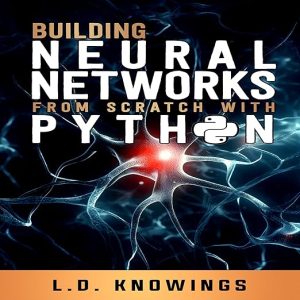
Code does not survive a speaker, and that one fact governs everything about this particular purchase. Building Neural Networks from Scratch with Python is a book about writing Python, sold as an audiobook, which places its most valuable possible content in precisely the form spoken delivery cannot carry. The recording runs three hours and fifty minutes with Bryan Hughey listed as the narrator, and it carries a 3.7 average across twenty-two ratings. The written reviews explain that number with unusual precision, and the explanation turns out to be only partly about the format. The rest is a mismatch between what the copy promises and what several readers report actually receiving.
Two Readers, One Identical Diagnosis About Code
The pitch is aggressive and aimed squarely at newcomers. The description promises you will become a debugging master, demystify layers and gradients, handle underfitting and overfitting, grasp the fundamentals of how neural networks work, and do all of it without drowning in complex math equations, accessible whether you are a Python professional or a total beginner. It signs off with a blunt instruction pointed straight at the checkout button. That register tells you something before you press play: this is self-published instructional product built for a marketplace listing, and the copywriting is doing rather more work than the table of contents.
Two of the reviewers converge on a single complaint, and for the stated audience it is fatal. T. Smythe, at five stars, calls it a "Good educational read" and attaches the one caveat that matters: "Only suggest more actual examples of code." LUIS G. RODRIGUEZ-RULLAN, at three stars, arrives at the same conclusion from the opposite direction, finding it "More theoretical than practical" and "hoping to see more code." Two readers, opposite grades, identical diagnosis. A book named for building networks from scratch is being told, by people who liked it and people who did not, that it shows too little of the thing it is named after.
Hughey Reads What a Speaker Cannot Deliver
Which brings the format question into sharp focus. Hughey is reading material whose most valuable content, were it present in quantity, would be code listings, and a code listing cannot be delivered through a speaker. Nobody absorbs indentation, bracket nesting or variable naming by ear. A supplementary PDF ships with this title, and here it is not a bonus at all but the working half of what you are buying. Anything you intend to type has to come from there. What narration can carry is the conceptual layer: what a gradient is doing, why a network overfits, what backpropagation accomplishes in plain language.
That conceptual layer has a genuine audience, and it deserves defending. Plenty of people need to understand what a neural network is without any intention of building one: managers approving budgets, analysts reading model documentation, journalists covering the field, students orienting themselves before a formal course. For them the shortage of code is not a defect at all, and three hours and fifty minutes is a reasonable investment in a working mental model. The trouble is that this is not the audience the description addresses, and the gap between the marketing and the delivered product accounts for most of the frustration in the pool. I would rather assess the book that exists than the one the copy describes, and the book that exists is a competent short primer.
Alan Says This Is Not for Beginners
The one-star notice is worth reading in full before buying, with one qualification attached. Lance Hemphill, an experienced programmer coming to neural networks for the first time, calls the book "a waste of paper" and describes the failure precisely: "the kind of book that has a lot of words but basically says nothing", material that could "be summed up in a single website", a habit of explaining something in a sentence and then padding it out with "a paragraph of pointless filler." The qualification is that the same notice admits to reading only the first twenty pages, a real limit on the verdict that should be weighed alongside it.
Alan, at two stars, contradicts the description head-on. The copy welcomes total beginners; Alan writes that "If you are just starting out with networks this is not the book for you", suggesting it suits someone already a year or two into designing and building. That is a direct conflict between what the listing promises and what a reader reports, and it may be the most useful single fact for a prospective buyer. Notice too how much of this pool is assessing paper rather than audio. One five-star notice consists entirely of the observation that "Printing quality and book quality seems good", a verdict about a physical object.
A Narrow Band of Listeners In Between
This suits the conceptual listener sketched above, and at this length and price it suits them adequately. If you want to follow a conversation about machine learning without embarrassment, if you need to know why practitioners keep saying gradients and overfitting, if you are deciding whether to commit to a proper course, then just under four hours of plain-language orientation has obvious value. Approach it as an introduction to vocabulary and intuition rather than as a build guide, and the 3.7 stops reading as a warning about quality and starts reading as a category error committed by the marketing.
Anyone intending to write actual code should look elsewhere, or at minimum treat the PDF as the purchase and the narration as a companion to it. Two independent reviewers wanted more code and a third found the material too steep for a standing start, which is an awkward combination to reconcile: too thin for the experienced, too demanding for the raw novice. What remains is a narrow band of listeners in between, curious and semi-technical, comfortable with the idea of programming without needing to leave the session able to implement anything.
Weigh the score carefully rather than dismissing the book on it. Twenty-two ratings is a thin base, and the written notices skew toward people who bought a printed copy expecting a programming manual, which is not the purchase you would be making. Judge the recording on what it can plausibly deliver through a speaker, which is understanding rather than capability, and set the promotional copy aside entirely. On that basis it is a modest, serviceable orientation. On any other basis the disappointed reviewers are right. My own test for a title like this is simple: a month later, can you follow the argument when it comes up in a room? By that measure it does its job.
In Brief
- Narrator: Bryan Hughey reads a book whose single most useful element would be code you can see, which no speaker can supply, leaving the bundled PDF to do the practical work.
- Subjects: Neural network fundamentals, gradients and layers, overfitting, beginner machine learning
- Tone: Plain, brisk, oversold
- Bottom line: A serviceable conceptual orientation badly mismatched to its own marketing, and no substitute for a book you can type from.
Common Questions
Can I actually learn to program neural networks from this audiobook?
Not from the narration alone. Code cannot be transmitted usefully by ear, and two separate reviewers report the book is light on examples even on the page. The accompanying PDF is where anything typeable lives, so treat the recording as conceptual groundwork rather than as a tutorial you follow along with.
How much does the accompanying PDF matter for this title?
More than for almost any other kind of book. For a programming text the diagrams, listings and notation are the substance rather than an extra, so the PDF effectively becomes the working half of the purchase. Anyone planning to buy should confirm they can access and read it comfortably first.
Who is this audiobook genuinely suitable for, given the beginner claims?
Curious semi-technical listeners after vocabulary and intuition rather than implementation skill. Managers signing off on machine learning budgets, analysts reading model documentation and writers covering the field all fit comfortably. One reviewer flatly rejects the beginner pitch, suggesting the material lands better for people with a couple of years of practice behind them.