- What it covers: AI-assisted development for non-programmers, prompt-driven workflow, app store submission, mobile game monetization.
- Feel: Fast, promotional and deliberately beginner-facing.
- Our call: A useful hundred-minute map of the pipeline, not a course, and dated by design.
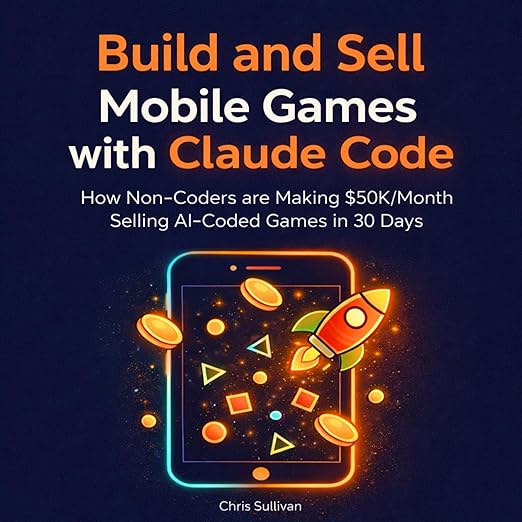
Claude Code appears in the title of this audiobook, which tells you the shelf life of the advice inside before you press play. Chris Sullivan has written a one-hour-and-forty-three-minute guide to building and monetizing mobile games with an AI coding assistant, published by BGB Learn in March 2026, and the ambition on the contents list is considerable: prompt templates, a full concept-to-store workflow, 2D game construction without programming knowledge, debugging strategies, graphics and sound polish, submission to both major app stores, and multiple revenue models. That is nine subjects in one hundred and three minutes.
Eleven Minutes per Topic Is the Honest Measure
Do the division and you get about eleven minutes per topic, which is the honest measure of what this book can be. Store submission alone is a process with dozens of decision points, review requirements and account setup steps, and monetization splits into advertising, in-app purchase and pricing strategy before you have touched implementation. None of those gets a chapter here in any meaningful sense. What they get is an orientation.
Taken as an orientation, the scope is defensible. Somebody who has never shipped anything usually stalls because the shape of the process is unknown, not because any individual step is hard, and a hundred minutes that maps the whole route from idea to listed product has real value for exactly that person. The failure mode is a buyer who reads the contents list as a curriculum and expects to be building at the end of it.
Its own headline claim sets up the tension neatly. Sullivan promises games built, tested and monetized in under sixty minutes, which means the audiobook explaining the workflow runs longer than the workflow it describes. Either the sixty-minute figure applies to a very small game, or the hundred minutes contains a lot of framing. Both are probably true, and a buyer should read that number as a demonstration of speed rather than a schedule.
Framing the Assistant as a Coding Mentor
Whatever the marketing does to it, the premise is not silly. AI-assisted development genuinely has moved the barrier for simple 2D mobile games, and the specific bottleneck it removes is the one that stops most non-programmers, which is writing syntactically correct code from a blank file. A guide organized around describing what you want and iterating on what comes back is describing how the work now actually happens for a large number of people.
Framing the assistant as a coding mentor rather than a code generator is the most useful idea on the list. The distinction matters in practice: a beginner who asks for a finished game gets something unmaintainable, while a beginner who asks why a piece of code does what it does builds capacity along the way. A hundred minutes is enough time to install that habit even if it is nowhere near enough to teach the underlying skills.
Audience targeting is honest too. Aspiring indie developers, side hustlers and people looking at mobile games as an income stream are named directly, and the copy does not pretend the reader is going to compete with a studio. Expectations set at the level of small, shippable, monetized 2D games are the expectations this runtime can support, and the description mostly keeps to them.
Version Drift Outdates Store Submission Steps
Prompt templates do not survive the format. They are the first item on the contents list and the thing a buyer is really paying for, and a prompt template is a block of text you copy, not a paragraph you memorize while driving. The record mentions no companion document, worksheet or download alongside the recording, so anyone who wants those templates will be transcribing them by ear or pausing to type. Check for supplementary material before you buy, because the listing does not promise any.
Version drift is the second problem, and the title advertises it. Tooling named in a book about AI-assisted development changes on a scale of months, and store submission requirements change on a similar clock. A guide published in March 2026 describing specific interface steps will be partly wrong by the time most buyers reach it. The conceptual material about iterating with an assistant ages far better than any of the click paths.
Disclosure takes the place of the usual credit here. The narrator field reads as a voice replica of Jon Mills rather than a recorded human performance. Publishers are not always this transparent about synthetic narration, and putting it in the credit line is the right call. It does mean a buyer who chooses audiobooks partly for the reading should sample first, since what the record is offering is a generated voice rather than a session in a booth. This title also arrived in March 2026 with the score and the counter both left blank, so nothing on the page reflects anyone's experience of it.
Specifics Stay Perishable While Concepts Hold Up
Buy it if you have never shipped an app, want the whole pipeline described end to end in a single sitting, and intend to treat it as a map rather than a manual. It suits a commute before a weekend project, or a listener deciding whether the idea of building a small game is worth pursuing at all. At a hundred minutes the cost of finding out is low, which is the strongest thing this format has going for it.
Existing coders should pass, since the beginner framing will hold them up and the assistant workflow will already be familiar. Anyone needing the prompt templates in a form they can paste should wait for a written edition. Durable reference material is not on offer either, because a title that names a specific tool in its own headline is telling you how long it expects to be current. Treat the concepts as the purchase and the specifics as perishable.
Before You Listen
Can a complete beginner really build a game from this?
Build something small, possibly. Ship something polished, not from these hundred minutes alone. The runtime allows about eleven minutes per listed topic, which orients you to the process without walking you through any single stage. Expect to leave knowing what the route looks like and needing other material to walk it.
Do the prompt templates come in a usable form?
Nothing in the listing indicates a companion file, worksheet or download. Templates are the first item on the contents list and the most valuable thing here, and delivering them purely by voice means transcribing or pausing to type. Anyone buying primarily for the templates should confirm supplementary material exists first.
How quickly will the audiobook go out of date?
The tool-specific parts, quickly. A guide that names its assistant in the title is tied to that assistant's current behavior, and app store submission requirements shift on their own schedule. The reasoning about iterating with an AI mentor rather than requesting finished code will outlast the click paths considerably.
Who reads the audiobook?
The credit line describes a voice replica of Jon Mills rather than a recorded performance, so the reading is generated rather than performed. That disclosure sits openly in the narrator field, which is more transparency than many synthetic productions offer. Listeners who choose audio partly for the reading should audition a sample.