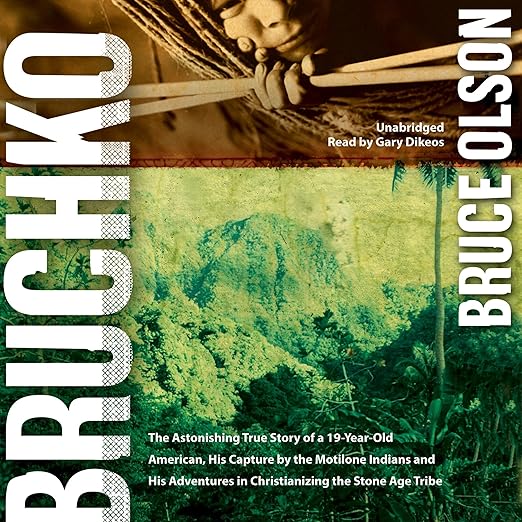
Bruce Olson was nineteen when he left home for the jungles of South America, and Bruchko spends its seven hours making sure you understand just how unprepared for that he actually was. This audiobook tells a missionary memoir that has apparently sold more than 300,000 copies in print, the kind of number that usually means a story has outgrown its original audience, crossing over into something people hand to each other regardless of their own faith background. Going in on the synopsis alone, I expected a fairly straightforward conversion narrative. What I got was stranger, and considerably more violent, than that.
What the Synopsis Undersells Is the Language Work
The setup reads almost like fiction: a teenage boy, alone, deciding to evangelize a tribe the synopsis calls 'murderous' in the South American jungle, and somehow surviving capture, disease, and years of isolation to become genuinely embedded in Motilone life. Olson's own telling covers his adoption into the tribe, his role brokering peace between the Motilone and Colombian authorities, and eventually a nine-month kidnapping by communist guerrillas that reads as the darkest stretch of the book by a wide margin. One five-star response sums up the throughline efficiently, titled around the phrase 'Go Ye': this is a story of how 'God worked through a 19 year old boy to bring Jesus Christ to a savage tribe of Indians.' That framing is dated in its language even where the underlying account holds up, and it's worth knowing going in that this is very much a product of its era's missionary vocabulary, not a contemporary anthropological account.
What the synopsis undersells is how much of this book is really about translation, in the fullest sense. The synopsis notes Olson helped develop the Motilone language into something with a written form, which becomes part of how he eventually earns the tribe's lasting trust rather than just their tolerance. That thread runs under the more dramatic captivity narrative and gives the memoir a throughline beyond pure survival story. The column of five written responses skews heavily positive beyond the two already mentioned here too: one reader calls it a book loaned out so many times it never came back, another simply logs it as 'Excellent' after multiple readings, and a third frames it as 'a powerful story and testimony' rather than a piece of entertainment. Amazon's rating for this one sits at 4.2 across eighteen votes, an open enough spread that I won't try to reverse-engineer a distribution from it, but the visible responses line up with that number more than they contradict it.
A Missionary Who Became an Informal Diplomat
Real, hard-won expertise is the pull here. By the time this memoir catches up to the present, the synopsis notes he'd won the friendship of four Colombian presidents and made appearances before the United Nations, entirely on the strength of relationships built inside a community most outsiders never got close to. That's an unusual arc for a missionary memoir, which more often ends at the point of successful conversion rather than decades later, with the subject functioning as an informal diplomat between a small Indigenous nation and a national government. Bruchko doesn't linger only on the triumphant parts either; Olson is candid, at least in what's visible here, about the trial and error that nearly got him killed more than once before any of that later credibility existed.
Readers who've worked through missionary-adjacent memoirs before and found most of them either too hagiographic or too dry will notice this one leans toward the messier, more specific version of events, which is probably why it has stayed in print and in audio for as long as it has. It reads as testimony more than theology, more concerned with what actually happened in a specific jungle in a specific decade than with drawing tidy universal lessons from it. Blackstone Audio's production runs a lean seven hours and seven minutes, tight enough that there's little padding between the capture, the years of slow trust-building, and the later kidnapping ordeal.
Dikeos Is Called Robotic by One Listener
The one piece of direct narration feedback in the visible review column is worth repeating clearly before you spend a credit: a listener who otherwise called this 'a fantastic memoir and a missions classic' rated the audio edition one star specifically because the reading struck them as processed, describing it as 'robotic' and 'heavily auto-tuned' to the point that they couldn't finish listening. No other review on the page corroborates or contradicts that impression, which makes it a single, isolated data point rather than a confirmed pattern, but it's specific enough that I don't think it should be waved away either.
Gary Dikeos is the only reader credited for the full seven hours, so there's no alternating voice to offer relief if that particular vocal quality bothers you. My honest advice: sample a few minutes before buying if audio processing artifacts are something you notice and dislike. For everyone else, the four remaining written responses describe an engaging, sometimes difficult listen with no complaints about the reading itself, which suggests the issue may not be universal across every listener's setup or ear.
A Language Built From Nothing, and a Kidnapping
Skip this one if you need airtight consistency in the narration before committing a credit, or if you're looking for a critical, contemporary anthropological lens on missionary work in Indigenous communities; Olson's own framing is unambiguously that of a believer telling his own story, not an outside analyst weighing colonial history.
Pick it up if you want a genuinely strange, specific true story: capture, disease, a language built from nothing, a kidnapping, and decades of relationship-building that eventually reached the level of national politics. The underlying material is rare enough that I'd still point curious listeners toward it. Readers who return to it, and several here describe doing exactly that, tend to mention the friendship and translation work as much as the more dramatic captivity chapters, which says something about where the book's real weight sits once the initial shock wears off.
A Few Questions About Bruchko
Is the Bruchko audiobook narration difficult to listen to, as one review suggests?
One reviewer rated it one star specifically over audio quality, describing the reading as robotic and heavily processed. No other visible review raises the same complaint, so it may not affect every listener equally, but it's worth sampling a clip first if that kind of processed sound bothers you.
How long is the Bruchko audiobook and who publishes it?
It runs seven hours and seven minutes, produced by Blackstone Audio and released in September 2013 alongside the print edition. Gary Dikeos narrates the full memoir solo, with no secondary reader credited for any portion of the recording, across the book's shifts between jungle survival and later diplomacy.