Before You Press Play
- Narrator: Fred Sanders reads a first-person memoir, so the voice across six hours and thirty-four minutes is not the fighter's own.
- Subjects: Brazilian Jiu-Jitsu and the Gracie dynasty, an undefeated career, breathing as philosophy.
- Tone: Calm and instructive, even when the stories turn violent.
- Bottom line: A short, warm martial-arts memoir let down by a listing that cannot keep its own names straight.
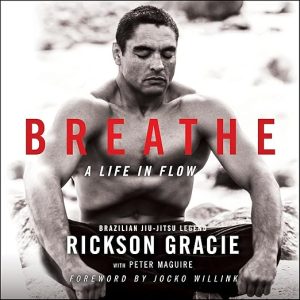
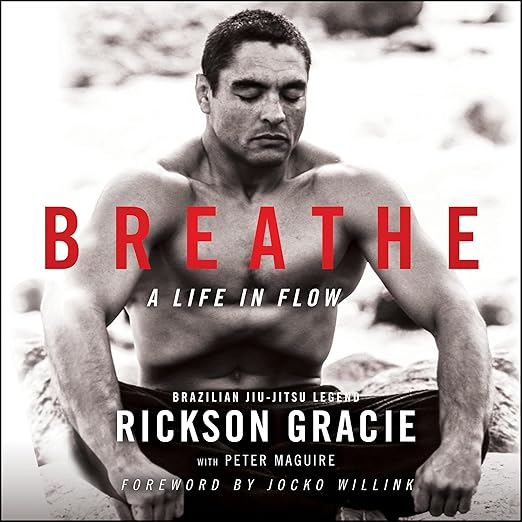
A memoir written in the first person, and two responses here call it an autobiography outright, arrives in someone else's voice. Rickson Gracie carries the byline, and the audiobook credits Fred Sanders with the reading: six hours and thirty-four minutes of a fighter's life in a hired reader's delivery. That is the one hard fact this listing offers about the recording, and it deserves a moment, because a memoir read by its subject and a memoir read by a professional are different objects. The column underneath is no help. It talks about paper, about pictures, and about a name that is not the one on the cover.
The One Thing No Response Addresses Is the Reading
Rickson Gracie's material is extraordinary on any reading. The description tracks an undefeated run from the late 1970s to a final fight in the Tokyo Dome in 2000, hundreds of victories in the street, on the mat, at the beach and in the ring, and puts him in a pantheon it fills out with Bruce Lee, Chuck Norris and Jackie Chan. Around that sits the family: the founding of Brazilian Jiu-Jitsu, the Vale Tudo fights the Gracies had a monopoly on, and the line the description draws from those to the Ultimate Fighting Championship. The pantheon sentence is the description's own, and it tells you the register the book is pitched at: legend rather than sports reporting.
Fred Sanders has six hours and thirty-four minutes to move all of it. That is a short runtime for a book carrying a personal record and a family dynasty at once, and the responses suggest the solution is philosophy rather than fight-by-fight reconstruction. One calls the result simple and candid. Another describes personal anecdotes braided with lessons on resilience, mindfulness and the importance of breathing, which is where the title comes from and where most of the praise lands.
What no response addresses is the reading, and here the gap costs something. A fighter's memoir is one of the few kinds of book where the subject's own delivery is part of the product, and this recording does not use it. Whether Sanders finds the register the reviewers hear on the page, nobody writing on this listing will tell you.
Four Years of Reviews, Warmth Barely Dips
Six hours and thirty-four minutes is a single-weekend listen, and the shape of the book suits that. The responses describe short movements rather than long technical passages: growing up among several generations of world-renowned fighters, learning to assert himself on the streets of Rio, fame and honor in Japan, and the heartbreaking tragedy the description mentions without naming. Material that moves in chapters this size carries well in the ear, and the philosophical passages in particular are easier to absorb spoken than skimmed.
The response column has a long tail, which is worth noting for a title of this kind. The dates run from November 2021, three months after the August release, through to October 2025, and the warmth barely dips across those four years. Athlete books tied to one fight or one season rarely hold up that way. This one is still being picked up by people who train, years after it appeared.
Pictures Do Not Travel Through Audio
Two of the responses hand you the register directly. One did judo and some grappling in early years, stayed a fan the whole time, and calls the result a candid bio of the best fighter and jiu-jitsu master of all time. Another arrived as a new student of the sport, wanted to know the roots of the thing, and found the writing vivid enough to see the moments while reading. Between them they describe a book that works for the committed and for the curious, which is not always true of athlete memoirs.
One line in the description notes a supplemental enhancement PDF accompanying the audiobook, and a response quietly confirms why that file matters: it praises the pictures. The file is described as a supplemental enhancement, which is the usual formula for photographs, charts and anything else the ear cannot carry. Pictures do not travel through audio. Open the PDF at the start rather than discovering it afterwards, because a memoir spanning several generations of one family is precisely the sort of book where faces help.
Two Responses Name a Different Gracie
Two responses name a different Gracie. One states that Royce does an incredible job telling his story and weaving in life lessons that jiu-jitsu taught him; another opens on the story of Hickson and the Gracies, and goes on warmly for a paragraph. The byline reads Rickson Gracie. I am not going to arbitrate which name each writer meant or how the slip happened, but if you are trying to work out from the column whose book this is, the column will not settle it.
Count the write-ups, then look at the counter above them. The tally of votes stops at four while five signed responses sit underneath, and one of those five carries four stars against a badge reading 4.8. The number cannot be reconstructed from what the page shows, so read it as a rough temperature rather than a measurement, and give more weight to the five texts than to the figure above them.
The filing spreads this across biographies and memoirs, health and wellness, and sports and outdoors, under one tag that says only Sports. All three are defensible and none is quite right. The wellness placement is presumably the breathing of the title, which the responses treat as the spine of a philosophy rather than as instruction, and nothing on this page promises a method you can practice from.
The Mismatch to Watch For Is the Voice
Anyone who trains, or used to, will recognize the terms of the thing immediately, and the two responses that mention their own mat time are the warmest in the column. The other obvious audience is the fight-history listener: the description's claim that without this family the sport of mixed martial arts and the whole UFC empire would not exist is the argument the book is making, not a piece of jacket decoration. Come for that argument and the six and a half hours will feel short. Listeners after the mechanics of specific bouts are the worse fit, since the description promises hundreds of victories and names almost none of them.
Voice, rather than content, is the mismatch to watch for here. If you have heard Gracie speak and came looking for exactly that, the credit will disappoint you before the first chapter ends. Listeners who want Rickson Gracie's own delivery in their ears should know before they buy that the reading here is credited to Fred Sanders.