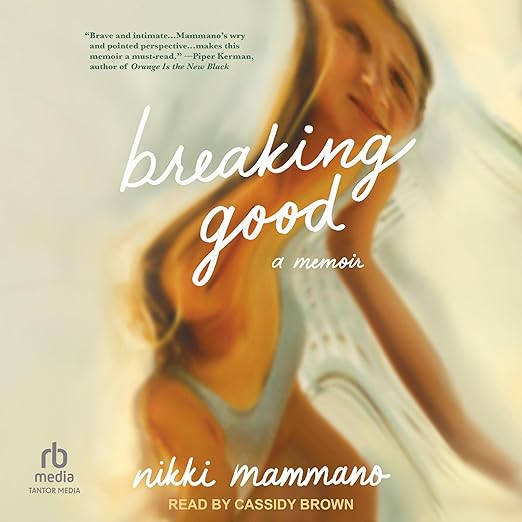
The it girl of the Waikiki drug scene is how the publisher describes Nikki Mammano at the height of it, and that phrase does a great deal of work: this is a memoir about being extremely good at something ruinous. The audiobook runs eleven and a half hours, and the reckoning takes up most of them.
The Listing Drops the Word 'Memoir' Entirely
A drug habit Nikki Mammano believed she had already kicked ends a short stint at the University of Hawaii. She starts moving her own stash to cover the bills, and before long she is an up-and-coming player in the Waikiki drug trade, the new it girl who can always get you whatever keeps the party going. Then the party winds down. Colleagues threaten her life, law enforcement threatens her freedom, and the trauma that set the whole thing in motion catches up with her.
The book has a subtitle and this listing lost it. Breaking Good: A Memoir is how one entry writes the title, and A Memoir is exactly the half the title field drops. That matters more than it looks. Breaking Good by itself reads like a self-help brand or a novel, while the shelf it actually belongs on, the first-person addiction narrative, stays invisible from the page. Anyone searching for memoirs of recovery will not turn this up under a name that never says memoir.
The geography does structural work. New Jersey suburbs at one end, Hawaii's tropical shores at the other, and back again: a story that travels far enough to feel like escape before returning to the place the trouble began. The copy calls the whole arc an odyssey and, unusually for that word, earns it, because the return matters far more than the distance covered.
Brown's Distance Serves a Story About Shame
Emotional weather is what one entry lists, and it does the job better than any blurb: laughing, crying and raging with frustration, sometimes within the same stretch, while rooting for the author the entire way through. The same response names the real arc, which runs from demons battled in early childhood through adulthood rather than starting at the drugs. Addiction memoirs that open on the addiction have skipped the part that explains everything. This one refuses to.
Darkly funny is the register the copy promises, and it is the hardest one to hold in this genre. A frank, insightful and darkly funny look at addiction, at the trauma at its core and at the long road to healing asks a great deal of eleven and a half hours. The reason it can work is that humor is how a lot of people who have lived this actually talk about it. Solemnity is the default setting in recovery writing, and solemnity flattens everything it touches.
Cassidy Brown reads it, and that fact deserves more prominence than the page gives it. This is a first-person memoir performed by somebody other than the person it happened to, which is a real artistic decision rather than an oversight: a performer can shape a scene the writer might hurry past, and a little distance sometimes serves a story about shame better than closeness does. It also means the voice in your ears never lived any of it. Sample before deciding which of those you would rather have.
The Word Narrating Here Refers to the Writing
A single word in the column is going to mislead somebody. One entry praises the courageous author for narrating her story in such an intimate and interesting way that the reader stays captivated from page one, and page one settles the meaning: narrating there refers to the writing, not to reading anything aloud. The recording credit belongs to Cassidy Brown. Anybody scanning that column for proof of a self-narrated memoir will find a sentence that looks like precisely that and means something else.
Then the dates, which explain the shape of everything else on this page. Every grade you can read was filed before the recording came out, the earliest of them more than two months ahead. A whole column arriving ahead of publication almost always indicates advance copies: readers handed the manuscript early, posting when the printed edition lands. Nothing dishonest in the practice, and it is how a great many books collect their first grades. It does mean the enthusiasm gathered here belongs to the writing, and that the recording turns up on a page it had no hand in earning.
A practical note before you buy. The subject is abuse, addiction and a criminal underworld, described by the publisher as unflinchingly raw, and the listing carries no advisory of any kind. The column is at least honest about the weight of it: one entry calls the book poignant, sad, funny, hopeful and above all deadly honest, and credits the author with pulling a hopeful ending out of a heartbreaking story. Deadly honest is the phrase to hold on to. Anyone with their own history in this territory should treat the sample as a test rather than as a preview.
A Road Rather Than a Destination
Readers who want a recovery memoir with the mechanics left in should start here. One response describes what the book does for people who have lived something similar: it puts words to unspoken feelings and experiences many find hard to express, and that reader did not expect to learn or to grow from somebody else's story and did anyway. Anyone working in treatment, anyone with an addict in the family, and anyone who likes memoirs unsentimental will get what they came for.
Hold off if you want the sociology. This is one life told from the inside rather than an account of how a drug economy functions, and the criminal material serves the personal story rather than the other way round. Hold off too if you need the healing to arrive early, because the copy is explicit that the consequences come first and that the road afterward is long and winding. Readers who want a memoir to finish on tidy resolution should note that redemption here is described as a road rather than as a destination.
Before You Listen
How long is the Breaking Good audiobook, and who released it?
Eleven hours and thirty minutes exactly, published by Tantor Media with a release date of March 31, 2026. That is a standard length for a single-life memoir, and it moves, since the story covers a dropped-out student, a drug operation, a collapse and a recovery without lingering too long in any one of them.
Is the Breaking Good audiobook suitable for somebody in early recovery?
Handle it with care. The subject is active addiction described in detail, and the copy promises an unflinchingly raw account before it promises any healing. Working in its favor are the humor and an ending the copy frames as healing and redemption. Anyone in a fragile stretch should listen with support nearby rather than alone late at night.
What shelves does the listing use?
Two of them: biography and memoir, plus health and wellness, with a tag for women. Filing it in both places is accurate and comparatively rare. Most addiction memoirs land in one category or the other, and putting this in both signals a book treating recovery as a health subject as much as a life story.