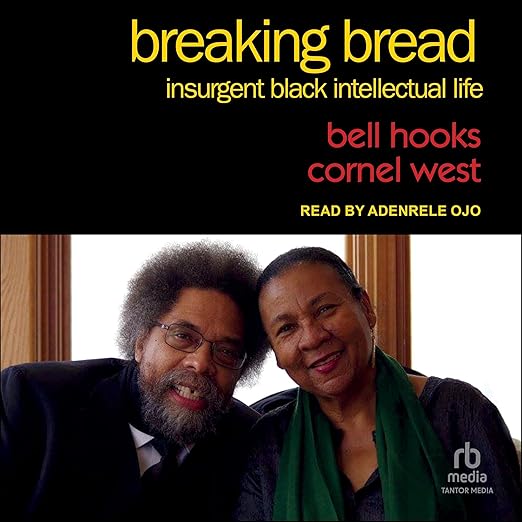
Can a book of recorded conversations between two intellectuals carry the same force as a carefully constructed argument? Breaking Bread, the dialogue between bell hooks and Cornel West, answers that question definitively, and this audiobook narrated by Adenrele Ojo makes the answer vivid in ways that the page alone cannot entirely capture. The cadences of intellectual conversation, the interruptions, the moments of playful disagreement, and the passages of genuine revelation all take on additional dimension when voiced with Ojo's attentiveness to the rhythms of Black intellectual exchange.
One of the Greatest Intellectual Exchange Series
The original conversations between hooks and West were recorded in a specific moment of Black American intellectual life, and what makes this book remarkable is how fully that moment remains alive across decades. The subjects they cover, community, capitalism, racism, politics, popular culture, and the particular pressures of Black intellectual life within and outside the academy, have not receded in relevance. If anything, the questions they raise have become more pressing in the intervening years, which is part of what makes the 25th anniversary edition, with the 2016 conversation 'In Solidarity' from the bell hooks Institute, such a valuable addition to the original text.
The book does not resolve its subjects so much as illuminate them from multiple angles simultaneously. Hooks and West do not agree on everything, and the moments of friction are some of the most valuable in the collection. Peter Mayo described the exchange as 'one of the greatest intellectual exchange series of any kind,' and that is not hyperbole. The combination of personal warmth between the two thinkers and genuine intellectual disagreement creates a model of how public intellectual conversation can actually function when it is working at its best.
Kalynda C. Smith's review named something specific and important: this book 'provides somewhat of a blueprint' for how to make a difference both personally and for others. That pragmatic dimension, the sense that intellectual conversation is inseparable from ethical action, runs through every conversation and gives the book a weight that purely theoretical work sometimes lacks. Hooks and West are not content to analyze from a distance; they are building toward something.
Ojo Voices a Tradition Built for Sharing
Adenrele Ojo's narration approaches the material with appropriate gravity and genuine attentiveness to its rhythms. For a book that is explicitly about the tradition of sharing, of passing something from one person to another across a table or a room, the audio format is arguably more faithful to the original context than silent reading. You hear the conversations as they were meant to be heard: as exchanges between people who know each other well and care deeply about what they are saying.
The 25th anniversary additions, including the 2016 conversation, are particularly important in audio form because they document a specific moment in time in which hooks and West revisit their earlier positions. Hearing these conversations in sequence creates a kind of intellectual portrait that is harder to appreciate when read. The contrast between the perspectives of the earlier and later conversations is meaningful and adds genuine historical dimension to the listening experience.
For listeners engaged with African American Studies, critical theory, or the history of contemporary Black intellectual life, this audiobook is genuinely important listening. It documents two of the most significant thinkers in that tradition in unguarded conversation, and Ojo handles the responsibility of representing that conversation with the care the material demands.
Assuming Grounding in Critical Theory and Theology
Listeners approaching this book for the first time without familiarity with hooks's or West's earlier work may find some of the references and conceptual vocabulary requiring additional context. The conversations assume some shared intellectual grounding, particularly around concepts from critical theory, Black liberation theology, and progressive political philosophy. This is not a book that explains itself exhaustively, which is both a feature and a limitation depending on where you are coming in from.
The conversational format also means that certain arguments are developed in the abbreviated way that dialogue necessarily requires. Readers who want a fully elaborated systematic argument rather than a series of incisive, open-ended exchanges should pair this with hooks's or West's individual books, where their arguments receive fuller development and more sustained attention than any single conversation can provide.
The 'In Solidarity' conversation added to this edition shows some shift in emphasis and framing that listeners should be aware of. The intellectual context of 2016 is different from the early 1990s, and the later conversation reflects that shift, which is part of what makes it valuable but also means the two sections feel somewhat different in register and in the questions they prioritize.
The 25th Anniversary Edition Is the Definitive One
This audiobook is valuable for anyone engaged with African American intellectual life, critical theory, or the question of how public intellectuals should function in relation to both the academy and broader communities. Students and teachers in African American Studies, sociology, cultural studies, and political philosophy will find it essential listening rather than optional enrichment.
It is also meaningful for readers who are encountering hooks's or West's work for the first time and want to understand how they think rather than just what they have argued. The conversational format reveals intellectual personality in ways that formal writing often obscures. Listeners who appreciate intellectuals speaking across their differences with warmth and substance will find this one of the more nourishing audiobooks in its category, and the 25th anniversary edition makes it the definitive version of the text.
- Narrator: Adenrele Ojo handles the rhythms of intellectual exchange with real attentiveness, honoring the conversational texture that gives this book its particular energy.
- Subjects: Black intellectual life inside and outside the academy, the tension between theory and practice, revolutionary struggle as ongoing daily work, the ethics of community.
- Tone: Rigorous and warm, with the particular quality of conversations between people who genuinely like each other and genuinely disagree about important things.
- Bottom line: An important audiobook that documents two major intellectual figures in conversation, with a 25th anniversary edition that adds valuable historical perspective.
Do I need prior knowledge of bell hooks or Cornel West to get value from this audiobook?
Some familiarity helps but is not strictly required. The conversations are substantive enough to be valuable on their own terms, though listeners new to both thinkers may want to supplement with some background reading.
What does the audiobook format add to this book specifically?
The conversational format was originally meant to be heard, not read, and Adenrele Ojo's narration respects that. Hearing the exchanges in sequence creates a sense of intellectual rhythm and relationship that silent reading partially obscures.
Is this audiobook primarily academic, or is it accessible to general readers?
It sits between those categories. The conversations are intellectually substantive and reference specific concepts from critical theory and Black liberation thought, but the format is accessible enough that engaged general readers will follow it without an academic background.