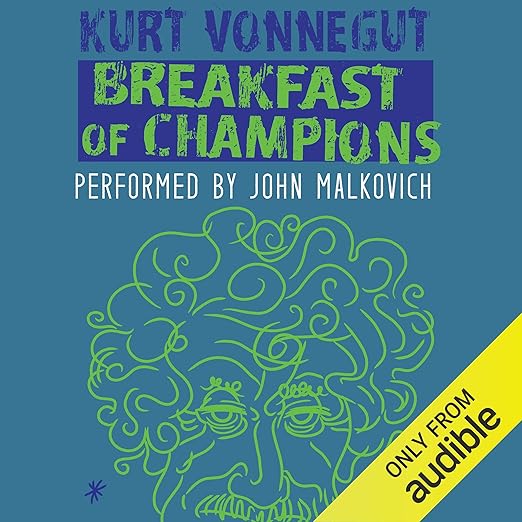
Breakfast of Champions arrived in 1973 at a specific American cultural moment: Nixon, Watergate, and the late unraveling of the Vietnam intervention. Kurt Vonnegut had already secured his literary reputation with Slaughterhouse-Five, and his publisher, his critics, and his readers all expected something comparably achieved. What they got was something deliberately more chaotic, more self-referential, more willing to fall apart in your hands. The audiobook, narrated by John Malkovich, was an Audie Award finalist for Best Male Narrator in 2016, and that recognition is entirely earned. Malkovich does not read Vonnegut so much as inhabit the novel's particular tone of barely contained desperation.
The novel centers on two characters: Kilgore Trout, an itinerant science fiction writer modeled deliberately on Theodore Sturgeon, a debt Vonnegut acknowledged in multiple interviews, and Dwayne Hoover, a Midwestern car dealer of the specifically boosterish, confused variety that Vonnegut kept returning to throughout his career. Their intersection is the excuse for everything else, and 'everything else' includes Vonnegut inserting himself into the narrative, drawing crude illustrations in the printed text, and essentially dismantling the conventions of realistic fiction in real time. The novel is not interested in your comfort, and it announces that fact early and without apology.
First, the Big Picture
Reviewer Mary Cross, returning to this audiobook after a first reading close to its 1973 publication, found the second encounter worth it for how clearly she could now hear 'his almost despair about war and life in general.' That quality, despair articulated through manic comedy, is what Vonnegut was doing across his entire career, but here it is most legible because the formal scaffolding that conceals the despair in more conventional novels is mostly removed. The novel's structure, or apparent lack of it, is the message. America in 1973 was fragmenting ideologically, and Vonnegut wanted his form to reflect that fragmentation faithfully.
Reviewer David Durtschi noted that Vonnegut himself graded this novel a C on his own grading scale, which tells you something about the self-awareness operating here. But Durtschi also enjoyed it 'from page one,' specifically for its sarcasm and structural strangeness. Reviewer alasmind, who first encountered the novel in their twenties and returned to it in their thirties, found that 'every moment in this book either makes you laugh or breaks your heart.' That is the Vonnegut promise, and even in his most chaotic work, he keeps it with surprising consistency across a novel that looks like it has given up on consistency entirely.
Why Breakfast of Champions Works as an Audiobook
The audiobook format suits this novel more than you might expect, partly because Malkovich's voice provides a kind of continuity that the novel's fractured written form does not. On the page, Vonnegut's intrusions into the narrative, his authorial asides, his sudden shifts in perspective, can feel like deliberate provocation. Heard through Malkovich's narration, they settle into something almost musical. The repetitions Vonnegut employs throughout, certain phrases and observations returned to again and again, become rhythmic rather than tedious when spoken aloud. The 6 hours and 27 minutes feel earned rather than indulgent.
Malkovich was cast because his voice carries a native quality of ironic remove that other narrators would have to perform. When Vonnegut writes about American dysfunction with the tone of someone who cannot decide whether to laugh or weep, Malkovich does not have to work for that register. He arrives there naturally. That alignment between narrator and text is relatively rare, and it elevates this audiobook above what a more conventional, earnest reading would have produced.
A Few Reservations
This is genuinely Vonnegut's most difficult novel for general readers. The plot, such as it is, is not the point. The accumulation of American absurdity is the point, and the accumulation method is associative and circular rather than linear. Listeners who need forward momentum and clear narrative payoff will struggle with the middle section in particular. The novel does not resolve in ways that feel satisfying by conventional standards, and that non-resolution is deliberate.
The crude illustrations that appear throughout the original printed text are absent in the audio format. For some readers, those drawings are central to the novel's meaning, another instance of Vonnegut refusing to be a merely literary writer, and their absence in the audiobook is a genuine loss. Listeners who feel this strongly should read the book alongside or instead of the audio version. Malkovich's performance is extraordinary enough that many find the trade-off worthwhile regardless, but it is worth knowing about before you choose.
Who Should Pick Up Breakfast of Champions
This audiobook rewards readers already familiar with Vonnegut who want to hear one of his most challenging works given its best possible narration. It also suits listeners with a genuine tolerance for formally experimental fiction and an interest in American political satire that has not aged particularly optimistically. Those new to Vonnegut should start with Slaughterhouse-Five or Cat's Cradle before arriving here; the chaotic form of this novel makes more sense as a deliberate departure once you know the territory it is departing from. John Malkovich fans who have not encountered this audiobook should seek it out for the performance alone, even if Vonnegut's particular mode of controlled disintegration is not usually their preference. The Audie nomination speaks to an industry recognition that the match of narrator and material here is genuinely unusual, and it holds up fully on sustained listening. Listening to Malkovich's voice settle Vonnegut's chaos into something coherent is, in itself, a kind of critical act.
Questions Listeners Ask
How does John Malkovich's narration handle Vonnegut's authorial intrusions and self-referential passages in the audiobook?
Malkovich handles them naturally, which is his main achievement in this performance. His voice carries an ironic distance that does not require him to signal when the narrative is becoming self-aware. The intrusions and repetitions that Vonnegut employs actually gain coherence through continuous narration rather than losing it.
Is this audiobook appropriate for someone who enjoys American political satire but has limited patience for formally experimental fiction?
With caveats. The political satire is sharp and sustained, but it is delivered through a form that resists linear reading. Listeners who want the Watergate-era critique without the structural strangeness may find the middle section frustrating. The novel rewards patience rather than plot-following instincts.