The Short Version
- Narrator: David McCullough narrates his own essays with the same unhurried, resonant delivery familiar from his documentary work, adding genuine intimacy a hired narrator couldn't replicate.
- Subjects: Overlooked historical figures, intellectual curiosity, quiet persistence
- Tone: Reflective, measured, appreciative
- Bottom line: A rewarding, episodic collection best suited to existing McCullough fans rather than newcomers looking for one sweeping narrative.
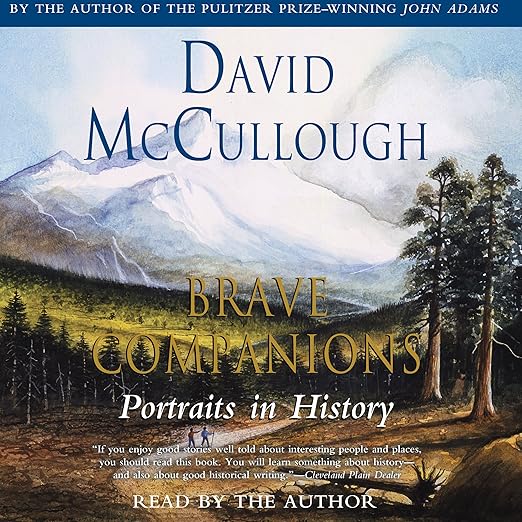
Brave Companions rewards patience more than momentum, and that's worth knowing before you press play on David McCullough's own narration of his own essay collection. This isn't a single sweeping narrative like Truman or John Adams; it's nine profiles of people McCullough considered unfairly overlooked, Alexander von Humboldt, Harriet Beecher Stowe, Frederic Remington, Louis Agassiz, the Lindberghs and their fellow long-distance aviators, Harry Caudill, and photographer David Plowden, each treated as a self-contained portrait rather than a chapter in one continuous story. McCullough's own voice narrates this audiobook, the same measured, resonant delivery familiar to anyone who's heard him narrate Ken Burns' documentary work, and hearing him read his own prose adds a layer of intimacy a hired narrator simply couldn't replicate for this particular author.
The Harry Caudill Essay That Could Fill a Book
Reviewer Sam Toole, a longtime fan of McCullough's bigger, better-known books, was pleasantly surprised by this shorter essay format and noted its connection to the same artful tradition as 1776 and Mornings on Horseback. That surprise seems common; Jim A. admitted going in skeptical, having already read five other McCullough titles, and wondering why a collection about relatively obscure figures like Humboldt and Agassiz deserved his time. Both reviewers came around, and listening to McCullough's own narration, I understand why. He treats each subject with the same seriousness he'd bring to a president, which turns out to be the entire point: these are people history nearly forgot, and McCullough's narration argues, quietly but insistently, that it shouldn't have.
The essay format means each profile has its own shape and rhythm rather than following a single narrative arc across eleven hours, and McCullough's pacing adjusts accordingly, more contemplative for Agassiz's Harvard career, more propulsive for the Lindberghs' aviation exploits and their contemporaries Antoine de Saint-Exupery and Beryl Markham. Reviewer Larry Fishman called this a total joy for history buffs and highlighted how each chapter focuses on a person or subject whose impact is little known, sometimes little appreciated, and occasionally both. That description matches my own experience: the Harry Caudill essay on Appalachia's coal economy in particular felt like it could carry an entire separate book, compressed here into something tighter and more urgent.
The Same Voice From The Civil War Documentary
The case for audio here rests almost entirely on McCullough narrating his own work, and it's a strong case. His prose has always had an oratorical quality, sentences built with a speaker's rhythm rather than a purely literary one, and hearing him deliver those sentences himself closes the gap between the writing and its intended cadence. This is the same voice millions of listeners already know from The Civil War documentary, applied here to his own essays rather than someone else's script, which changes the relationship between narrator and material in a way worth experiencing directly rather than through a substitute narrator, however skilled that alternative might otherwise be for comparable nonfiction.
Because this collects nine separate profiles rather than one throughline, it's also genuinely well suited to episodic listening. You can start and stop between essays without losing narrative momentum the way you might pausing mid-chapter in a conventional biography, which makes this a good choice for commute-length listening sessions or for anyone easing into McCullough's catalog before committing to something as long as Truman. Jim A.'s initial skepticism about the book's more obscure subjects is worth taking seriously as a real first reaction, but it's also worth noting how consistently that skepticism resolved into appreciation once the actual essays got underway.
Competence and Quiet Conviction Over Fame Itself
This is a shorter, lighter commitment than McCullough's major biographies, and listeners expecting another sweeping single narrative like 1776 or John Adams should recalibrate expectations accordingly. The genre tagging here is a little unusual too; alongside biography, this gets filed under adventure and exploration, which fits the Humboldt and Lindbergh material well but undersells how much of the book is really about intellectual and cultural history rather than physical adventure. Agassiz's Harvard career and Harriet Beecher Stowe's literary and political impact are as central here as any expedition narrative, so don't go in expecting wall-to-wall derring-do.
McCullough narrating his own material at an advanced stage of his career means the delivery is unhurried, sometimes deliberately so, and listeners who prefer a brisker narrative pace might find certain essays slower than expected. That deliberateness is, for most listeners based on the available reviews, a feature rather than a flaw, since it matches the reflective, appreciative tone of essays meant to rescue overlooked figures from obscurity rather than race through their accomplishments. If you've found McCullough's pacing in other audiobooks too measured for your taste, this collection won't change that; if his voice is part of why you love his books, this delivers more of exactly that.
It's also worth noting how well this collection functions as an introduction to McCullough's broader interests, since the through-line connecting all nine subjects, people who accomplished something remarkable without seeking the spotlight for it, reappears across his other work in different forms. Listeners who go on to his full-length biographies afterward will likely recognize this same instinct: an attraction to competence and quiet conviction over fame itself. That makes Brave Companions a genuinely useful entry point, not just a lesser addition to his catalog, for anyone deciding where to start with McCullough.
Trusting McCullough's Judgment About Who Deserves Attention
This suits existing McCullough readers curious about a shorter, essay-format entry into his catalog, and anyone specifically drawn to lesser-known historical figures whose stories don't usually get feature-length biographical treatment. If hearing McCullough narrate his own prose is part of the appeal for you, and for many longtime listeners it clearly is, this delivers that experience across a more manageable eleven hours than his longest works.
Skip it if you're new to McCullough and want the full sweep of a single subject first; Truman or John Adams would serve that purpose better. This collection rewards listeners who already trust McCullough's judgment about who deserves attention, since several of these figures, however historically significant, aren't household names. For that audience, though, this is a genuinely rewarding, unhurried tour through nine lives McCullough clearly believed deserved rescuing from the margins of American memory.