
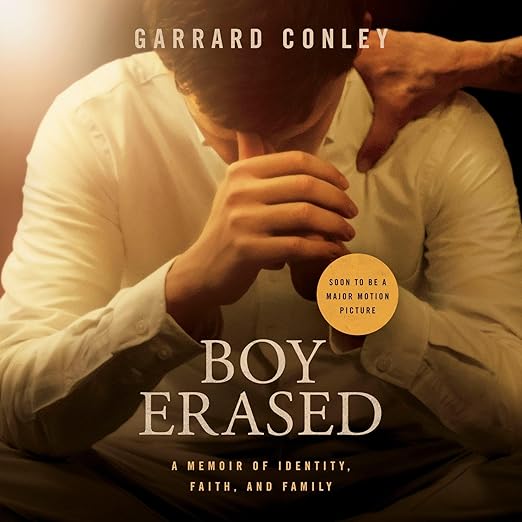
I listened to Boy Erased over two evenings in winter, and I did not feel ready by the end of the first. Garrard Conley's memoir is not a book that releases you easily. It is structured nonlinearly, moving between Conley's time inside the Love in Action program and his earlier life in small town Arkansas as the son of a Baptist pastor, and that structure mirrors the way trauma actually lives in the mind - returning, interrupting, refusing clean chronology.
The audiobook was published by Penguin Audio in 2016, narrated by Michael Crouch, and runs just over eight hours. By 2018 it was a major film with Nicole Kidman, Russell Crowe, and Lucas Hedges. But the book came first, and it deserves to be understood as a literary object in its own right rather than source material for Hollywood.
Where This One Lands
Conley is a more self-conscious stylist than many memoirists who take on difficult subject matter, and that literary attention is both the book's greatest strength and, for some readers, an occasional source of friction. He is interested in how memory works, in the construction of a self under observation, in the grammar of religious certainty. One reviewer called him a fantastic writer who does a wonderful job of setting scenes - and that is accurate. The prose is dense with the specific textures of evangelical Southern life: the feel of Bible paper, the particular acoustics of a church gymnasium, the language of spiritual warfare applied to a nineteen-year-old's sexuality.
Why Boy Erased Works as an Audiobook
Michael Crouch's narration earns the material. He reads in a voice that is controlled without being cold, and that restraint is exactly right for Conley's prose, which is itself controlled without being emotionally distant. The memoir's nonlinear structure is easier to follow in audio than you might expect, partly because Conley's writing is so specific that each scene anchors itself clearly in time and place. The Love in Action sequences - the group sessions, the paperwork of confession, the hierarchies of the supposedly healed - are rendered with a specificity that makes them documentary in quality.
What Gives Us Pause
One reviewer offered what I think is an honest and fair counterpoint: they had read dozens of survivor memoirs including accounts by Holocaust survivors and kidnapping victims, and found Boy Erased the least optimistic. That observation is worth sitting with. Conley does not organize the narrative around a triumphant recovery arc. The emotional resolution is real but earned slowly and without fanfare, and some listeners may find the relentless interiority frustrating if they are hoping for the memoir to arrive somewhere brighter. This is not a complaint about the book's quality - it is a description of its character.
Who Should Pick Up Boy Erased
Readers interested in LGBTQ+ memoir, the psychology of religious conversion therapy, or the specific collision between evangelical faith and sexual identity will find this essential. Conley's literary background gives the book a craft that distinguishes it from straightforward testimony. Those who want an uplifting coming-out narrative will find the tone too austere. And anyone tempted to read or listen to this without having encountered the original book should know: the film is a different emotional argument entirely. This audiobook deserves attention as a literary achievement independent of its cultural moment - Conley is a writer of real distinction, and the memoir's refusal to resolve cleanly is itself a form of honesty that most books about trauma cannot sustain. This audiobook deserves attention as a literary achievement independent of its cultural moment - Conley is a writer of real distinction, and the memoir's refusal to resolve cleanly is itself a form of honesty that most books about trauma cannot sustain. Readers who have found the subject of conversion therapy through news reporting or documentary film will find the memoir a more nuanced and interior account than either of those formats can provide.







