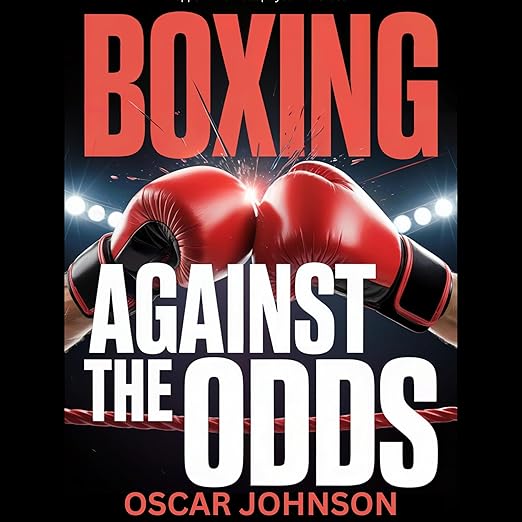
Ricky Hatton versus Manny Pacquiao. Buster Douglas over Tyson. Oliver McCall dropping Lennox Lewis. I put on this audiobook during a long afternoon of household chores, and somewhere between vacuuming and folding laundry, I forgot what I was doing entirely and just stood in the kitchen listening. Oscar Johnson's Boxing: Against the Odds is a collection of the sport's most seismic upset moments, and the audiobook version narrated by Derrick Magolski moves through decades of drama with a pace that mirrors the sport itself: long stretches of setup, then sudden, breathtaking impact.
For anyone who grew up watching boxing with a parent or grandparent who insisted it was the purest sport, this title hits that same nerve. It is not a clinical analytics text. Johnson writes with the explicit aim of making you feel the canvas, hear the roar, and believe for a moment that the underdog might actually do it, even when you already know the outcome. The audiobook format suits this intention better than the print edition might, because Magolski's delivery understands timing in a way that a page cannot.
Contagious When Magolski Reads Aloud
Johnson structures the book chronologically, moving decade by decade from the early legends through what he calls the Age of Disruption in the 2020s. This framework gives readers a satisfying sense of progression, and it works well as an audiobook because each chapter functions almost like a self-contained short documentary. You can dip in and out between chores or commutes without losing the thread, or you can listen straight through and experience the cumulative effect of watching boxing's hierarchy get dismantled again and again across the decades.
The writing leans toward the visceral. Johnson describes swollen eyes, corner shouts, and the specific silence that falls over an arena when the impossible starts to happen. One reviewer noted feeling the tension and doubt as each fight was described. That observation holds up. Magolski does not over-emote, which is the right call here; the material is emotional enough on its own and a narrator who pushed harder would tip into parody. His voice has the slight gravel that suits a boxing book without veering into cliche sports-announcing territory.
Where the book genuinely earns attention is in its bonus rounds section, which covers fights that didn't quite reach mainstream consciousness but had the same heartbeat-stopping quality as the headliners. These lesser-known matchups are where Johnson's enthusiasm is most evident. He clearly loves the sport beyond its marquee events, and that affection becomes contagious when Magolski reads it aloud.
Reads Like a Fighter Working a Jab
The audiobook format gives this material something the print edition cannot replicate easily: rhythm. Boxing is a sport of rhythms, of feints and counterpunches and the long wait between moments of chaos. Magolski reads the build-up sections with a kind of patient confidence that mirrors a fighter working a jab, and then shifts into something slightly faster and tighter when the pivotal moment arrives. It is a subtle effect, but it works.
The historical scope also distinguishes this title from narrower boxing books. Johnson covers the 1980s, 1990s, and 2000s with roughly equal attention before arriving at more recent decades, and for listeners whose boxing knowledge skews toward one era, the chapters covering unfamiliar territory function as a genuine discovery rather than a refresher. A listener who grew up watching the 1990s heavyweights might be surprised by how much drama the 2010s produced, and vice versa.
Reviewer Eugene Jr. described it as the book that reminded him why he fell in love with boxing in the first place, and that captures the emotional register Johnson aims for. This is not a book that will satisfy statisticians or technical analysts, but it was never meant to. Its goal is to revive the wonder of moments when the expected script tears apart, and within that specific aim it is largely successful.
Synthesis and Narrative Energy Over New Research
The book does have limitations worth noting. One reviewer flagged that the underlying idea is not new; upset collections exist across several sports, and boxing has particularly well-traveled territory in this genre. If you have already read extensive accounts of Douglas-Tyson or Ruiz-Joshua, some ground here will feel familiar. Johnson does not offer revisionist history or new archival research; his value is synthesis and narrative energy rather than revelation.
There is also a runtime consideration. At five hours and twelve minutes, this audiobook sits comfortably in the range that works well for a long weekend listen or a series of commutes, but it will not feel encyclopedic to a true boxing historian. The selection of fights reflects Johnson's own perspective on what constitutes the most significant upsets, and a reasonable listener might find themselves wondering why one fight made the cut while another did not. The title promises definitive coverage that the format's length cannot entirely support, and listeners going in with that expectation should adjust.
The facts and trivia sections embedded throughout are a useful addition. They answer the how and why questions that arise naturally when you are hearing about a fight without being able to pause and look things up, which is the audiobook listener's common frustration with sports nonfiction. Johnson anticipated this, and the contextual information is woven in without breaking narrative momentum.
Storytelling About Drama for Casual Fans
Casual boxing fans who want to revisit the sport's most dramatic moments will find this a rewarding listen. It also works well for listeners who are curious about boxing but don't know where to start; the decade-by-decade structure provides scaffolding without being condescending about assumed knowledge. Longtime fans who have read extensively in the genre may find less to surprise them, though the bonus rounds chapters offer some compensation. This audiobook is not aimed at coaches, trainers, or anyone seeking tactical analysis; it is storytelling about competitive drama, and on those terms it delivers.
- Narrator: Derrick Magolski narrates with controlled timing, letting the material's inherent drama carry without overselling it. Solid casting for a sport where rhythm matters.
- Subjects: Underdog victory, competitive drama across boxing history, the gap between expectation and outcome
- Tone: Energetic and nostalgic, like watching old fight tape with someone who loves every frame
- Bottom line: A crowd-pleasing collection of boxing's most startling upsets, strongest for casual fans revisiting favorite moments and weakest for readers who want deep new analysis.
Does the audiobook cover international boxing or primarily American fighters?
Johnson covers both American and international figures across the decades. The scope includes notable upsets from the UK, Mexico, and the Philippines, though some chapters naturally cluster around American venues given the sport's commercial center of gravity.
How does Derrick Magolski handle the pacing of the audiobook narration?
Magolski is a solid match for the material. His delivery is even and controlled during buildup sections and tightens perceptibly during pivotal moments. He avoids over-dramatization, which keeps the emotional impact of the source material intact rather than competing with it.
Does the audiobook include fights from the 2020s?
Yes. Johnson includes a section on what he calls the Age of Disruption, covering significant upsets from the 2020s. This contemporary coverage is one of the distinguishing features compared to older boxing upset retrospectives, which naturally could not include recent events.