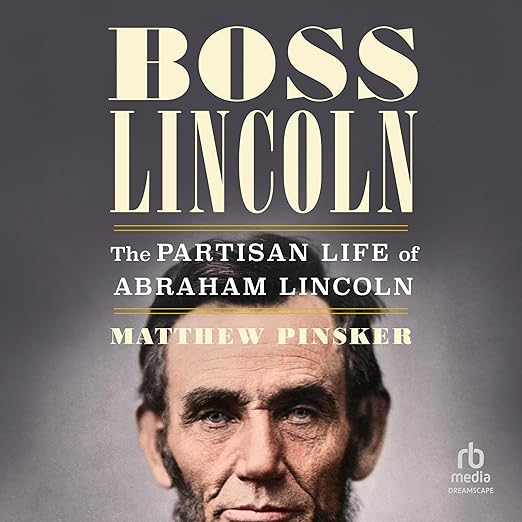
Everyone knows Lincoln the eloquent statesman, but Boss Lincoln, Matthew Pinsker's biography audiobook, argues the man was just as much a working party operator, someone schooled as a Whig in the rough-and-tumble of 1830s Illinois electioneering before he ever reached the presidency. Drawing extensively on Lincoln's private correspondence, Pinsker builds a portrait of decades of coalition-building that set the political foundation for emancipation and Union victory, moving from Illinois machine politics through the birth of the Republican party and into the Civil War presidency itself. Dreamscape Media put this out in February 2026 with Peter Lerman narrating across seventeen hours and fifty-nine minutes; a 4.8 average currently rests on just 9 ratings, only one of which comes with any written explanation.
Part III Is Where It's At, Says One Reviewer
That single review comes from Nicholas Quintero, a self-described history teacher using the audiobook for a graduate program essay specifically about the balance of power between Congress and the president, and the framing is unusually specific and credentialed for a general-audience review. Quintero states plainly that the early sections weren't especially interesting, skipping them to focus instead on material closer to the presidency itself, which tells listeners something real about how the book is structured even from just one data point: apparently distinct enough in its sections that a listener can meaningfully skip ahead without losing the thread.
Quintero's review title says it directly: "Part III is where it's at." That's a strong, specific endorsement of one particular section over the rest of a nearly eighteen-hour book, and it's worth taking seriously precisely because it comes from someone using the material for academic purposes rather than casual listening. Whether Part III covers the presidency and Civil War leadership specifically, where Pinsker's thesis about party-politics mastery would presumably pay off most directly, is a reasonable guess based on Quintero's stated academic focus, though the review doesn't spell out exactly what Part III contains.
Pinsker's stated method, building the biography by drawing "extensively on Lincoln's private correspondence," is worth taking seriously as a structural choice, not just a research footnote. Letters written in the moment carry a different kind of evidence than speeches crafted for public consumption, closer to how a politician actually thought and maneuvered rather than how he wanted to be remembered, and a biography built primarily on that kind of material promises a more procedural, less mythologized Lincoln than the standard version most listeners already carry around.
Moving Beyond the Marble Icon of Lincoln
Pinsker's core argument, that Lincoln's presidential effectiveness grew directly out of decades of unglamorous party politics rather than pure moral clarity or rhetorical gift alone, is a genuinely different angle than the standard Lincoln-as-eloquent-martyr narrative most listeners already know. The synopsis promises to move "beyond the marble icon" using Lincoln's actual private correspondence as evidence, which suggests a biography built on primary-source discipline rather than received mythology, a meaningful distinction for anyone who has already read the more familiar version of this story elsewhere.
Quintero's academic use case is itself a kind of endorsement: a history teacher citing Boss Lincoln in graduate coursework focused on legislative-executive power dynamics suggests the book holds up to scholarly scrutiny, not just popular biography standards. For listeners specifically interested in how party machinery and coalition-building actually functioned in the Civil War era, rather than just Lincoln's personal biography in isolation, that academic credibility is a meaningful signal.
Illinois in the 1830s, where the synopsis says Lincoln first got schooled as a Whig in electioneering, is a less familiar chapter of his story than the Civil War presidency that dominates most popular accounts, and Boss Lincoln treating that early apprenticeship as foundational rather than a footnote is itself an argument about how political skill actually gets built over decades rather than arriving fully formed. Listeners curious about the mechanics of nineteenth-century American party politics generally, not just this one figure, get real material to work with here.
Lerman's Narration Still Awaits a Broader Verdict
Only one written review currently sits visible against a rating count of nine, a real gap between the number of people who rated this book and the number who explained their reasoning, which means the 4.8 average is mostly untested by public reasoning beyond Quintero's single, specific, academically-framed response. Listeners hoping for a broader consensus on tone, pacing, or Lerman's narration specifically won't find much to draw on yet beyond this one detailed account.
Quintero's own listening approach, skipping the early Illinois sections to focus on presidency-era material, raises a real question for anyone planning to listen straight through: does Boss Lincoln's early material on 1830s electioneering reward patience, or does it genuinely drag compared to the Civil War-era chapters? Nearly eighteen hours is a serious commitment either way, and one reviewer's choice to selectively skip ahead suggests the book's pacing may not be uniformly gripping across its full length.
A Narrower Angle Than Cradle-to-Grave Biography
How party politics functioned as a professional discipline in the nineteenth century, not just Lincoln's personal moral journey, is what this book is actually selling, and Civil War history enthusiasts and students of American political machinery are positioned to get the most out of it. Quintero's graduate-level use case suggests the material rewards close, purposeful listening rather than passive background consumption.
Pinsker isn't really writing a traditional cradle-to-grave Lincoln biography focused on personal life and rhetorical legacy, so listeners expecting that broader treatment might find the party-politics angle narrower than they came in wanting. Anyone without patience for eighteen hours of dense political history, especially the early Illinois sections one reviewer skipped entirely, should consider whether this specific angle on Lincoln justifies that length for their own listening goals.
Key Details
- Narrator: Peter Lerman is the sole voice across nearly eighteen hours of dense political history; Quintero's single review, detailed enough to name a favorite section by number, never once mentions how the reading itself comes across.
- Subjects: Lincoln as party operator, decades of coalition-building behind the presidency, primary-source correspondence over received mythology
- Tone: Dense, scholarly, quietly revisionist
- Bottom line: Boss Lincoln earns real credibility from a single, specific academic endorsement, though nearly eighteen hours on party mechanics demands patience the one visible reviewer admits skipping in the early chapters.
Before You Listen
Does the Boss Lincoln audiobook cover Lincoln's entire life, or focus on a specific period?
It spans from his 1830s Illinois political apprenticeship through his Civil War presidency, but the one visible review recommends focusing on the presidency-era material specifically, suggesting the early sections may interest general listeners less than dedicated Civil War history readers.
Is the Boss Lincoln audiobook better suited to casual listening or academic research?
The available evidence leans academic: the only written review comes from a history teacher using it for graduate coursework on congressional and presidential power. That doesn't rule out casual listening, but it suggests the material rewards close attention over passive background listening.
How reliable is the 4.8 rating on the Boss Lincoln audiobook given how few reviews are visible?
Worth treating cautiously. Nine total ratings produced only one written review, so the average reflects very little public reasoning, and listeners currently cannot see whether other raters actually agreed with the one detailed, academically-framed review that happens to be visible.
Can listeners skip ahead in the Boss Lincoln audiobook without losing the thread?
Possibly. The one visible reviewer skipped the early Illinois sections entirely to focus on presidency-era chapters and still found the book worthwhile for that purpose, suggesting Boss Lincoln's sections stand distinctly enough that selective listening doesn't necessarily break the overall argument.