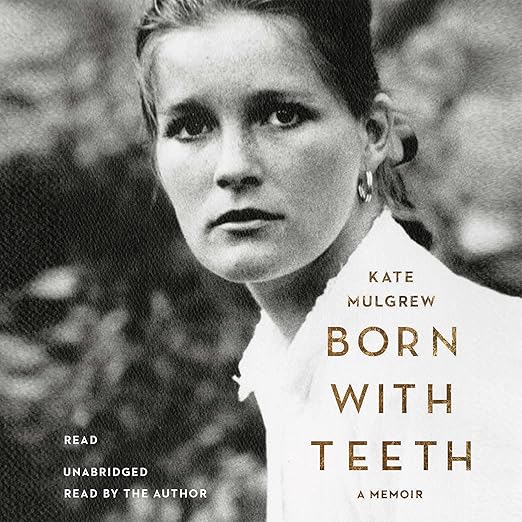
Use it, Stella Adler told her, and that instruction organizes the whole book. Whatever disappointment, pain, or anger life throws in your path, channel it into the work. Kate Mulgrew was eighteen, newly arrived in New York from a small Midwestern town, and the description singles that lesson out as the one that defined her as an actress. What makes this audiobook worth its own paragraph is that she applies the lesson to the memoir as well: she reads all ten hours and forty minutes herself, so the pain inside the book and the voice describing it belong to one person, working from a single instruction. No small distinction, that, in a book whose subject is performance.
A Closer Look at Born with Teeth
Mulgrew's material is unusually hard and she does not soften it. At twenty-two, with a career beginning to move, she became pregnant, gave birth to a daughter, and, having already signed the adoption papers, was allowed only a fleeting glimpse of the child. Two decades passed before she faced it. That thread runs underneath everything else, the love affairs, the life-saving friendships, the bone-crunching work, and R PRIUS names it outright: a daughter she reluctantly gave away. L Kathleen Runkle calls the result the most interesting autobiography read to date and praises her striking honesty. Both responses are pointing at the same quality, a refusal to arrange the story so that it flatters the person telling it. Rare in an actor's memoir, and it is the quality every warm response here keeps circling.
Stella Adler's lesson is also the book's largest liability, and one reader says so. Lynda's four stars arrive attached to a real complaint: jumping, vagueness, pretentious writing, overall inconsistency. The specific charge is sharper than those adjectives. Lynda argues that Mulgrew's love of dramatic flair is intentionally misleading, then starts to unpack an example involving how the book presents her father. Whether that counts as a flaw or a technique depends entirely on what you want from a memoir. An actress trained to use her own life as raw material may well shape it the way she shapes a role, and this is the only response on the page that notices the possibility.
What Makes Born with Teeth Worth Hearing
Lynda's objection deserves to be pushed further than Lynda pushes it, because it changes what the recording is. If the writing performs, then hearing the performer deliver it stops being a bonus and becomes the correct format. Five people wrote responses here. Two praise the prose as prose: an exquisite writer, incredibly well written, a book that flows like a poem. Nobody mentions what it sounds like. For a memoir read aloud by a professional actress whose whole subject is turning private feeling into public work, that gap is the oddest feature of the whole page, and it leaves the single most distinctive feature of the product undescribed.
The badge above these responses reads 4.4 while the grades beneath it run five, four, five, five, five. Whatever that decimal measures, the column is warmer than it is. More useful than the number is the shape of the enthusiasm. Chris D, writing in 2026, says the book takes you away and supplies many nostalgic moments, recommending it to anyone with Irish in them at all. R PRIUS, writing back in 2015, describes an Irish Catholic kid from Iowa who wanted to be an actress, landed in NYC, and became a soap icon in extremely short order. More than a decade apart, both readers respond to the same thing: a life that moved fast and a narrator who enjoys the telling.
Things to Know Before Starting Born with Teeth
Adoption is the load-bearing subject and prospective listeners should know how much of it the book contains. The description is explicit: papers signed in advance, a fleeting glimpse, and two decades before she could face the past and step into what the copy calls the most challenging role of her life. Nothing in the responses suggests it is handled sentimentally, and one describes the book as candid and direct, holding nothing back. If that material sits close to your own life, ten hours read aloud by the person it happened to is a different proposition from turning the pages yourself at whatever speed you like. Delivery of this kind does not permit skimming, and that is worth planning around.
Voyager and Orange Is The New Black are why most buyers arrive, and the book is not primarily about either. Steve Blanchard makes the point exactly, insisting she amounts to far more than Captain Janeway, then reaching for a Star Trek comparison in the very next breath. R PRIUS treats the Red role as a lens on the person rather than a subject in itself. The description positions both parts as the entry point and then announces that the memorable character on offer is the author herself. Anyone hoping for a set-by-set account of either show will find those years present but not central, and the memoir's center of gravity sits well before them. The show years are context for the person rather than the point of the book.
Who Kate Mulgrew Is Writing For
Memoir readers who want a performer's life told without decorum are the primary audience, and this column backs that up. The word reached for most often is honesty: striking honesty, candid and direct, nothing held back. The second audience is anyone drawn to the Irish-American material, which two readers name specifically, one recommending it to anyone with Irish in them at all and one sketching an Irish Catholic upbringing in the Midwest. The third is anyone curious about what an actress sounds like reading her own sentences instead of someone else's, which is the particular pleasure this format exists to deliver.
Fans expecting a warm celebrity memoir should adjust. The adoption, the mother whose own ambitions vanished under the endless arrival of new babies, the love affairs and the bone-crunching work the description promises, all of it is here and none of it is softened. Anyone who wants a tidy narrative should read Lynda's four-star response first, because that reader found the storytelling deliberately slippery and said so at length. Anyone after dates, credits and a career chronology should look elsewhere, since this is a book about what a life cost rather than what it produced. Her own voice is the reason to take the recording: the lesson she was handed at eighteen was to use everything, and reading the result aloud is the last step in doing exactly that.
Do the reviews say anything about Kate Mulgrew's performance in this audiobook?
Not one of them does. Five people wrote, and while two praise the prose and several praise the actress, none mentions hearing the book read aloud. For a memoir performed by the woman who lived it, that leaves the most distinctive feature of the recording completely undocumented. You will have to judge the delivery yourself.
How much of Born with Teeth covers Star Trek and Orange Is The New Black?
Less than a fan might expect. Both parts appear, and Captain Janeway and Red are named in the copy, but the pitch is that the most memorable role Mulgrew ever played was herself. One reviewer insists she amounts to far more than the Janeway credit. The book's weight sits in the years before either show existed.
Is the adoption story handled gently in this audiobook?
No. The description states that the papers were signed in advance and only a fleeting glimpse of the child was permitted, with two decades passing before she faced the past. A reviewer describes the whole book as candid and direct, holding nothing back. Ten hours in Mulgrew's own reading does not allow skimming.