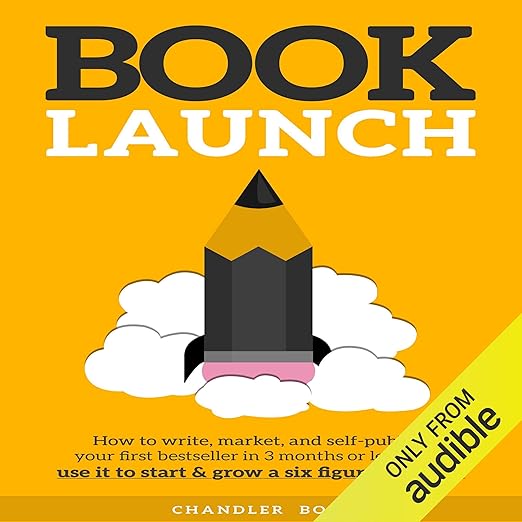
Book Launch enters its subject from a specific angle: Chandler Bolt is not teaching you how to write a good book. He is teaching you how to launch one. The distinction matters more than it might initially seem, because the landscape of self-publishing rewards those who understand the mechanics of launch visibility as much as, or in some cases more than, those who simply write well. Bolt's audiobook, running just under three and a half hours, is a concentrated download of the process he used to build his own self-publishing track record across multiple bestselling titles in the personal development and productivity space.
Al Kessel narrates with the brisk, conversational energy that suits a guide designed to be actionable rather than contemplative. Bolt writes in the first person and in the imperative mode, directing the listener through steps rather than arguing for positions, and Kessel reads it with the appropriate forward momentum. The audiobook is not a passive listening experience. It is built to be used, and the narration reflects that orientation from the first chapter.
The framework Bolt builds across the audiobook has a clear architecture. Before you can launch a book, you need to write one quickly enough to maintain momentum and not burn out in the process. He addresses the writing phase first, with advice on manuscript structure, daily output targets, and the common traps that stall first-time authors before they reach a finished draft. This section is necessarily brief because getting words on the page is not Bolt's primary subject. But the acknowledgment that a book must exist before it can be launched is useful framing, and his advice on beating the blank-page paralysis is practical rather than motivational in the generic sense.
The launch mechanics that occupy the audiobook's center are where Bolt has the most authority and delivers the most value. He covers the logic of building pre-launch anticipation through an advance reader network, how to approach category selection on self-publishing platforms to maximize bestseller list eligibility, the mechanics of a coordinated release that concentrates sales velocity in a narrow window, and how to leverage initial ranking visibility to sustain discovery after the launch window closes. For first-time authors who have never thought through these mechanics, the audiobook provides a genuine orientation that would otherwise require months of trial and error to assemble independently.
Authorship as Credential, Delivered in Under Four Hours
Reviewers confirm that the audiobook delivers what it promises. One describes using it as research preparation for writing their first book on the subject of inspiration to action, finding it the fastest way to grasp the launch landscape before investing significant time in manuscript work. Another notes that the audiobook covers considerably more than its page count or runtime might suggest, reaching into business building, passive income construction, and authority positioning alongside the core launch mechanics. The compression of a lot of practical information into under four hours is one of the audiobook's clearest practical virtues.
Bolt makes the argument, supported by the examples he draws on from Tony Robbins, Tim Ferriss, Dave Ramsey, and Oprah among others, that authorship functions as a credential in the modern attention economy. A published book confers authority in a way that other forms of content production do not, because the book format still carries connotations of sustained expertise that blog posts and social content do not reliably produce. That framing gives the audiobook a broader relevance than a pure how-to guide, positioning the launch process within a larger strategy of platform and brand building for coaches, consultants, and entrepreneurs who want to establish recognized expertise in their field.
The audiobook's brevity is both a feature and a constraint. At under three and a half hours, it communicates the essential framework without expanding into the additional case studies or chapter-length treatments that longer business books sometimes require. For listeners who want a fast, comprehensive map of the self-publishing launch process, the compact format serves them well. For listeners who want deep implementation detail on every step, the audiobook is a foundation for further research rather than a complete instruction set in itself.
Platforms Change Faster Than Any Book Can
Self-publishing platforms and their algorithms evolve faster than any book about them. Some of the specific platform mechanics Bolt describes, particularly those related to bestseller list ranking and category selection, have evolved since the book's publication. The underlying logic of launch concentration, advance reader coordination, and category positioning remains sound, but listeners should verify current platform policies and algorithm behavior before applying any specific tactic that depends on features as they existed at the time of writing. The framework is durable even where specific tactics require updating.
The audiobook also comes from an explicitly self-promotional framework. Bolt refers to his own books and his own track record throughout, and the guide has the character of a well-developed system for doing what he himself has done. For listeners whose book is significantly different from Bolt's nonfiction, personal development, and productivity titles, the template requires meaningful adaptation rather than direct application. Fiction writers in particular will find much of the category and positioning advice needs translation before it fits their situation.
The section on passive income and business building from a book, while interesting, is covered briefly. Listeners whose primary goal is building a consulting practice, speaking career, or coaching business around a book will want additional resources that go deeper into the post-launch business development phases that Bolt addresses only in broad strokes within this audiobook's runtime.
First-Time Nonfiction Authors Are the Target
This audiobook is best suited to first-time authors in the nonfiction, personal development, business, or self-help space who want a fast, practical overview of the self-publishing launch process before they invest more time in specialized platform guides or longer books on the subject. It is also relevant for entrepreneurs, coaches, and consultants who are considering authorship as a strategy for credibility building and who need a concise argument for why the investment is worth making. Fiction writers, academic authors, and those pursuing traditional publishing paths will find the framework less directly applicable to their specific situations. Listeners who have already self-published one or more books and are looking for advanced launch strategy will find Bolt's foundational material familiar territory, and would benefit more from more specialized resources.
Questions Listeners Ask
Is this audiobook focused on self-publishing specifically or does it cover traditional publishing as well?
The audiobook focuses specifically on self-publishing and the mechanics of a coordinated launch on platforms like Kindle. Traditional publishing is not the subject, and listeners pursuing that path will find the specific launch tactics less applicable to their situation.
Is the platform-specific advice in this audiobook still current?
Self-publishing platforms and their algorithms evolve frequently. The underlying strategic framework of launch concentration and advance reader coordination remains sound, but listeners should verify that specific platform features, category structures, and ranking mechanics Bolt describes reflect current conditions before applying them directly.
Does the audiobook address how to use a book to build a business or speaking career beyond the launch itself?
It touches on the post-launch business building potential of authorship, including passive income and authority positioning, but covers these areas in broad strokes rather than deep implementation detail. Listeners who want a thorough guide to the business-building phase will need to supplement this audiobook with additional resources.
At just under three and a half hours, does this audiobook cover the launch process with enough depth to be genuinely useful?
Reviewers consistently say yes. The compact runtime is matched by a dense concentration of practical mechanics around manuscript completion, pre-launch audience building, release day coordination, and category optimization. The framework is complete even if individual sections are not exhaustive.